Securing Plaid Webhooks: Best Practices for Financial Data Syncing and Data Sovereignty
Securing Plaid Webhooks: Best Practices for Financial Data Syncing and Data Sovereignty In modern financial technology, real-time data sync is no longer optional — it's a core...
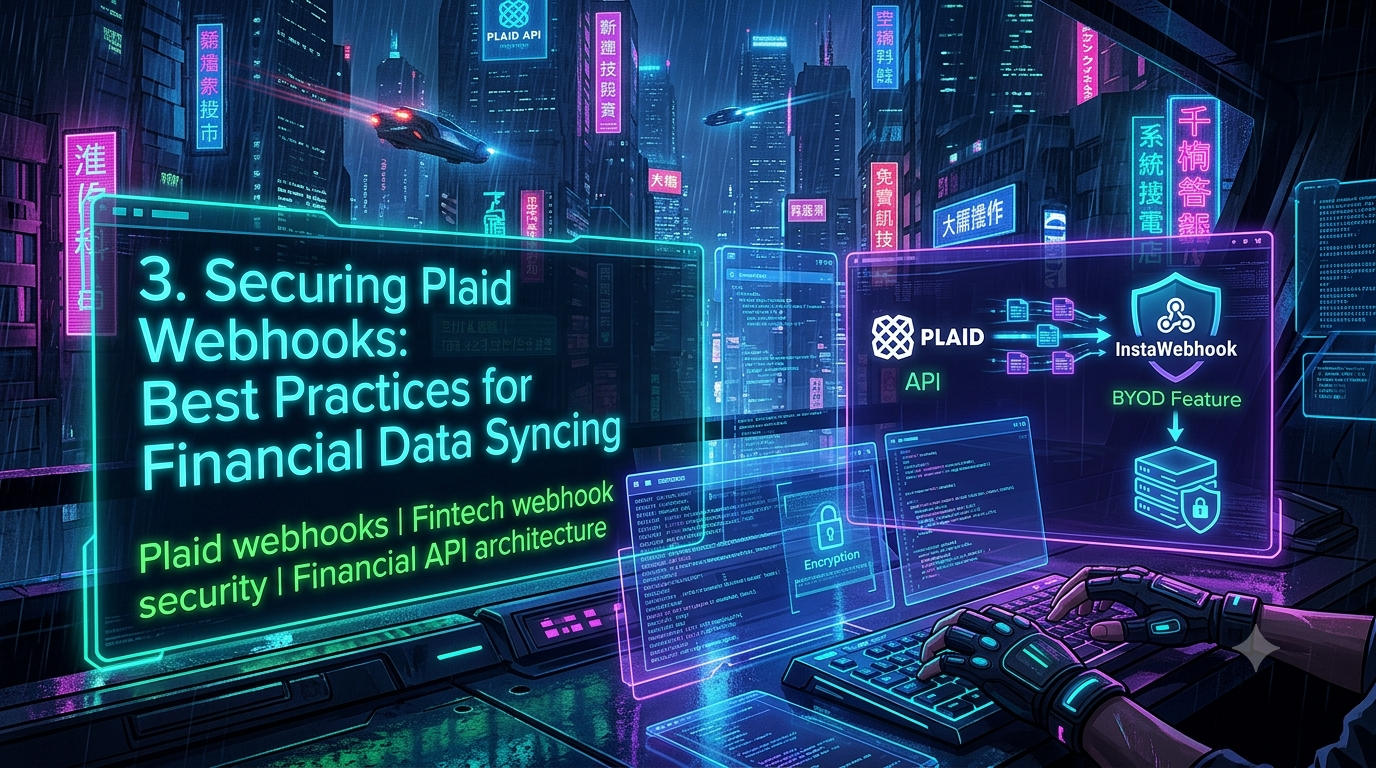
Securing Plaid Webhooks: Best Practices for Financial Data Syncing and Data Sovereignty
In modern financial technology, real-time data sync is no longer optional — it's a core expectation. Whether you're building an automated wealth management app, an instant lending platform, or an account-to-account (A2A) payment system, your application relies heavily on event-driven financial API architecture.
Plaid is the industry standard for linking user bank accounts, pulling transactions, and executing balance checks. But relying on Plaid webhooks means opening a public HTTP endpoint to receive server-to-server notifications. Because these webhooks signal updates to sensitive financial states — newly cleared transactions, revoked Item access, account balance changes — an unverified or poorly architected webhook receiver exposes your system to real risks: spoofed events, replay attacks, duplicate transaction processing, and compliance gaps.
This guide walks through building a production-grade, audit-ready Plaid webhook pipeline: cryptographic signature verification, asynchronous and idempotent event processing, and how to think about data sovereignty when a third-party gateway sits in front of your webhook receiver. Every technical claim about Plaid's behavior below is checked against Plaid's current API documentation as of July 2026, with sources linked at the end.
Table of Contents
- Understanding Plaid Webhooks & Common Architecture Pitfalls
- Cryptographic Signature Verification (JWT & JWK)
- Designing an Async, Idempotent Event Receiver
- Data Sovereignty: Keeping Payloads Inside Your Own Infrastructure
- FinTech Security Hardening Checklist
- Conclusion
1. Understanding Plaid Webhooks & Common Architecture Pitfalls
Webhooks Are Signals, Not Data Payloads
A common misconception among developers new to fintech webhook security is treating the webhook payload as the complete dataset. When Plaid fires a TRANSACTIONS webhook with the code SYNC_UPDATES_AVAILABLE, it does not contain the actual bank transactions. It sends a light event payload with meta-information:
{
  "webhook_type": "TRANSACTIONS",
  "webhook_code": "SYNC_UPDATES_AVAILABLE",
  "item_id": "kB3V54R679i63z87210x99231",
  "initial_update_complete": true,
  "historical_update_complete": false,
  "environment": "production"
}
The webhook is an action signal telling your system: "Data has changed for item_id. Call /transactions/sync using your stored cursor to fetch what changed." One detail worth calling out because it trips up a lot of integrations: the SYNC_UPDATES_AVAILABLE webhook will not fire for an Item unless /transactions/sync has already been called at least once for that Item. So your onboarding flow needs to make an initial /transactions/sync call right after exchanging the public_token — before you can rely on the webhook to tell you anything changed.
The Top Failure Modes in FinTech Webhook Pipelines
Synchronous execution and timeout cascades. If there is a non-200 response or no response within 10 seconds from your webhook endpoint, Plaid will keep attempting delivery for up to 24 hours, with each retry delayed four times longer than the previous one, starting at 30 seconds. If your handler calls Plaid's REST API, parses transactions, and writes to your database synchronously inside the HTTP request, you will eventually time out under load, triggering this retry storm and duplicate job processing. Plaid does build in a circuit breaker of sorts: it stops retrying if your endpoint has rejected more than 90% of webhooks over the trailing 24 hours — which protects Plaid's infrastructure, but by that point you've likely already lost events.
Skipping cryptographic signature verification. Webhook endpoints are public URLs. Attackers can scan for them and fire dummy POST requests. Notably, Plaid itself treats verification as optional at the transport level — Plaid documentation describes webhook verification as something you "can optionally" do, which means the responsibility for rejecting spoofed requests sits entirely with you.
Payload storage and compliance exposure (SOC 2, GDPR, PCI-DSS). To debug delivery issues, teams often log raw payloads or route them through third-party webhook proxy SaaS tools. If those providers persist sensitive payload bodies on multi-tenant servers, you risk expanding your compliance boundary in ways that are hard to unwind later.
2. Cryptographic Signature Verification (JWT & JWK)
Plaid signs outgoing webhook requests using Elliptic Curve Digital Signatures — a JSON Web Token (JWT) is included in the Plaid-Verification header so you can verify the authenticity of any incoming webhook, using the ES256 algorithm over the P-256 curve.
The Verification Sequence
1. Extract 'Plaid-Verification' HTTP header (unverified JWT)
                    |
                    v
2. Decode JWT header -> extract Key ID ('kid') & confirm 'alg' == "ES256"
                    |
                    v
3. Fetch/cache public key from POST /webhook_verification_key/get
                    |
                    v
4. Validate JWT signature & confirm 'iat' is < 5 minutes old
                    |
                    v
5. SHA-256 the raw request body & constant-time compare against the JWT claim
Walking through it: decode the JWT header without validating the signature yet, confirm the alg field is ES256, and extract the kid value — this identifies which public key was used to sign the request. Use the /webhook_verification_key/get endpoint with that kid to retrieve the JSON Web Key (JWK), then verify the JWT signature against it. If the signature doesn't check out, reject the webhook outright.
Two details worth flagging because they're easy to get wrong and Plaid's docs are explicit about them:
- Clock skew tolerance is 5 minutes. Use the
iatfield to verify the webhook is not more than 5 minutes old as protection against replay attacks. Don't hand-roll a looser threshold "to be safe" — it just widens your replay window. - Whitespace matters for the body hash. This one is subtle: the
request_body_sha256claim is sensitive to whitespace in the webhook body and assumes a tab-spacing of 2 — if you re-serialize or store the body with 4-space indentation before hashing, the hash comparison will fail even though nothing malicious happened. Hash the raw, untouched request body bytes, before any JSON parsing or re-formatting touches them.
Production TypeScript Implementation
import crypto from 'crypto';
import * as jose from 'jose';
import axios from 'axios';

// In-memory cache for Plaid JWKs (Key ID -> JWK). In production, back this
// with Redis or similar so a cold start doesn't hammer /webhook_verification_key/get.
const keyCache = new Map<string, jose.KeyLike>();

interface PlaidJwtPayload extends jose.JWTPayload {
  request_body_sha256: string;
}

/**
 * Verifies an incoming Plaid webhook request signature.
 *
 * @param plaidVerificationHeader The 'Plaid-Verification' HTTP header value
 * @param rawBodyBuffer           The RAW, untouched Buffer of the incoming request body
 * @param plaidClientId           Plaid API Client ID
 * @param plaidSecret             Plaid API Secret
 * @param plaidEnv                'sandbox' | 'production'
 */
export async function verifyPlaidWebhook(
  plaidVerificationHeader: string,
  rawBodyBuffer: Buffer,
  plaidClientId: string,
  plaidSecret: string,
  plaidEnv: 'sandbox' | 'production' = 'production'
): Promise<boolean> {
  try {
    if (!plaidVerificationHeader) return false;

    // Steps 1 & 2: decode the JWT header without verifying yet, to get 'kid'
    const decodedHeader = jose.decodeProtectedHeader(plaidVerificationHeader);

    if (decodedHeader.alg !== 'ES256' || !decodedHeader.kid) {
      console.error('Unexpected JWT algorithm or missing kid');
      return false;
    }

    const kid = decodedHeader.kid;

    // Step 3: fetch (or reuse cached) public key
    let publicKey = keyCache.get(kid);

    if (!publicKey) {
      const baseUrl = `https://${plaidEnv}.plaid.com`;
      const response = await axios.post(`${baseUrl}/webhook_verification_key/get`, {
        client_id: plaidClientId,
        secret: plaidSecret,
        key_id: kid,
      });

      publicKey = await jose.importJWK(response.data.key, 'ES256');
      keyCache.set(kid, publicKey);
    }

    // Step 4: verify signature and reject tokens older than 5 minutes
    const { payload } = await jose.jwtVerify(plaidVerificationHeader, publicKey, {
      maxTokenAge: '5m',
    });

    const jwtPayload = payload as PlaidJwtPayload;

    // Step 5: hash the RAW body and compare in constant time
    const computedHash = crypto.createHash('sha256').update(rawBodyBuffer).digest('hex');
    const hashA = Buffer.from(computedHash, 'utf8');
    const hashB = Buffer.from(jwtPayload.request_body_sha256, 'utf8');

    if (hashA.length !== hashB.length) return false;
    return crypto.timingSafeEqual(hashA, hashB);
  } catch (error) {
    console.error('Plaid webhook signature verification failed:', error);
    return false;
  }
}
A framework note: whatever body-parsing middleware you use (Express body-parser, Next.js API routes, etc.) needs to expose the unparsed request body to this function. If your framework re-serializes JSON before your handler sees it, the hash comparison above will silently fail for legitimate webhooks — this is one of the most commonly reported issues in Plaid's SDK repos.
3. Designing an Async, Idempotent Event Receiver
Once verification is in place, the receiver needs to handle volume, network retries, and out-of-order delivery. Plaid's own guidance is direct on this point: keep your receiver as simple as possible — ideally one whose only job is to write the webhook into a queue or reliable storage — because a slow receiver risks missing the 10-second window, and unpredictable webhook arrival rates can otherwise overwhelm downstream services.
The "Fast Ack, Async Process" Pattern
- Verify the signature using
verifyPlaidWebhook(). - Insert the event into an internal Event Inbox table.
- Enqueue a background job (BullMQ, SQS, Celery, etc.).
- Respond
200 OK— well under the 10-second budget.
Plaid  --POST-->  Webhook Receiver --verify--> Event Inbox (DB insert)
  ^                                                    |
  |                                                    v
  +------------- 200 OK (<1s) --------------- Push job to Background Queue
                                                        |
                                                        v
                                              Worker calls /transactions/sync
The Event Inbox Table
CREATE TABLE webhook_event_inbox (
    id UUID PRIMARY KEY DEFAULT gen_random_uuid(),
    provider VARCHAR(32) NOT NULL DEFAULT 'plaid',
    item_id VARCHAR(128) NOT NULL,
    webhook_type VARCHAR(64) NOT NULL,
    webhook_code VARCHAR(64) NOT NULL,
    idempotency_key VARCHAR(256) NOT NULL UNIQUE,
    raw_payload JSONB NOT NULL,
    status VARCHAR(32) NOT NULL DEFAULT 'pending', -- pending | processing | completed | failed
    retry_count INT NOT NULL DEFAULT 0,
    error_message TEXT,
    received_at TIMESTAMPTZ NOT NULL DEFAULT NOW(),
    processed_at TIMESTAMPTZ
);

CREATE INDEX idx_inbox_pending ON webhook_event_inbox(status, received_at) WHERE status = 'pending';
Enforcing Idempotency
Plaid may resend webhooks due to network retries or its own backoff behavior. Plaid explicitly instructs applications to design for duplicate and out-of-order webhooks and to ensure idempotency on the actions taken when a webhook is received, without relying on delivery order to drive application state. Generate an idempotency_key from the payload (e.g., a hash of item_id + webhook_type + webhook_code + received timestamp bucket). On insert, a unique-constraint violation means "duplicate — log it, return 200 OK, skip re-enqueuing."
Cursor Mechanics and Pagination Safety
When your worker picks up a SYNC_UPDATES_AVAILABLE job, it calls /transactions/sync with the item_id's stored cursor. A couple of behaviors are worth building into your worker explicitly, since they're easy to miss in a first pass:
- If
has_morecomes backtrue, you must keep paging using the returnednext_cursoruntilhas_moreisfalse— don't persist a partial cursor mid-page. - If a paginated call to
/transactions/syncfails withTRANSACTIONS_SYNC_MUTATION_DURING_PAGINATION, restart the entire pagination loop from the cursor you had at the start of that page sequence — retrying only the single failed request is not sufficient, because a mutation mid-page can leave the cursor sequence inconsistent. - Store
next_cursortransactionally with the data you write from that page, so a crash between "fetched page" and "saved cursor" doesn't cause you to either skip or reprocess a page on restart.
4. Data Sovereignty: Keeping Payloads Inside Your Own Infrastructure
Signature verification and queuing solve the code-level problem. Scaling this across distributed environments raises an infrastructure question: where does the webhook payload body actually live once it's ingested?
The SaaS Webhook Proxy Trade-off
Many teams put a managed webhook gateway in front of their receiver for retry handling, delivery observability, and uptime — instead of running that infrastructure themselves. The trade-off is that standard multi-tenant webhook SaaS platforms typically persist payload bodies on their own managed database clusters, which raises real questions for regulated fintech data:
- PII and compliance scope. Financial payloads carry account metadata and other identifiers. Persisting that on a third party's shared servers pulls that vendor into your SOC 2 and data-processing-agreement scope, even if only transiently.
- Data residency. GDPR and various U.S. state privacy laws expect sensitive financial records to stay within defined geographic or network boundaries.
- The "thin payload" workaround has real costs. Some teams strip the payload at the edge to avoid third-party storage, turning the webhook into an even thinner signal. That just forces an extra API round-trip and adds latency and failure surface, since you still need to go fetch the real data.
A Bring-Your-Own-Database (BYOD) Pattern
One way to resolve this is a zero-persistence gateway: a routing/compute layer that performs cryptographic verification and retry management at the edge but never writes the raw payload to its own storage. Instead, it writes directly into a database instance that you own and operate — inside your own VPC or cloud project.
                [ Gateway: Zero-Persistence Compute Layer ]
                       (verification & routing only)
                                    |
                                    v
                +---------------------------------------------+
                |             Your Private Cloud (VPC)          |
                |                                                |
                |   Your Database (Postgres / DynamoDB)          |
                |   - Raw webhook payloads persisted HERE ONLY   |
                |   - Least-privilege, INSERT-only role          |
                |                       |                         |
                |                       v internal network         |
                |   Your internal app / background workers        |
                +---------------------------------------------+
A quick note on terminology: the original brief for this article referenced a specific vendor product ("InstaWebhook") offering this pattern under a "Bring Your Own Database" name. I wasn't able to independently verify that product as a currently operating, publicly documented service through search — so rather than assert vendor-specific claims I can't confirm, this section describes the underlying architecture pattern on its own merits. If you're evaluating a specific vendor for this, ask them directly (and check their SOC 2 report and DPA) whether payload bodies ever touch their own persistent storage, even transiently in logs or dead-letter queues — "zero-persistence" claims are worth verifying, not taking at face value.
A Least-Privilege Database Role for BYOD Ingestion
Whichever gateway you use, the database credential it holds should be able to write new rows and nothing else:
-- 1. Isolated schema for webhook ingestion
CREATE SCHEMA webhook_sovereignty;

-- 2. Target table
CREATE TABLE webhook_sovereignty.plaid_payloads (
    payload_id UUID PRIMARY KEY DEFAULT gen_random_uuid(),
    item_id VARCHAR(128) NOT NULL,
    webhook_type VARCHAR(64) NOT NULL,
    webhook_code VARCHAR(64) NOT NULL,
    encrypted_body JSONB NOT NULL,
    received_at TIMESTAMPTZ NOT NULL DEFAULT NOW()
);

-- 3. Restricted role for the gateway's write credential
CREATE ROLE byod_writer WITH LOGIN PASSWORD 'use_a_strong_vault_generated_password';

-- 4. Schema usage
GRANT USAGE ON SCHEMA webhook_sovereignty TO byod_writer;

-- 5. INSERT only -- explicitly no SELECT, UPDATE, or DELETE
GRANT INSERT ON TABLE webhook_sovereignty.plaid_payloads TO byod_writer;

-- Result: even if the gateway's credential is compromised, an attacker
-- cannot read existing financial records back out of your database.
| Security dimension | Typical multi-tenant SaaS proxy | BYOD-style pattern |
|---|---|---|
| Payload storage | Vendor's multi-tenant DB | Your own VPC/database |
| Compliance scope | Vendor SOC 2 review + DPA needed | Payload never leaves your boundary |
| Encryption | Managed by vendor's keys | Managed by your own KMS |
| Read access | Vendor staff could plausibly access logs | Write-only role — no vendor read path |
5. FinTech Security Hardening Checklist
1. Enforce modern TLS. Plaid's API is served over HTTPS with TLS 1.2; HTTP and TLS versions other than 1.2 are not supported on Plaid's side, and Plaid recommends clients use an up-to-date root certificate bundle as the sole verification path, and specifically advises against certificate pinning. For your own receiver endpoint, Plaid requires that any HTTPS webhook URL present a valid SSL certificate — treat TLS 1.2 as your floor and support 1.3 on your edge where your stack allows it, but don't implement pinning against Plaid's certs.
2. Use IP allowlisting as defense-in-depth only, not your primary control. Plaid currently sends webhook POST requests from a documented set of IP addresses (52.21.26.131, 52.21.47.157, 52.41.247.19, 52.88.82.239), but explicitly notes that these addresses are subject to change. Don't hard-block on a stale list — if you allowlist at your WAF, monitor Plaid's docs for changes and fail open to signature verification rather than silently dropping legitimate traffic.
3. Mask sensitive fields in logs. Never print raw webhook bodies or access tokens to stdout/stderr. Configure log-scrubbing filters (Datadog, CloudWatch, Loki) to redact access_token, account_id, and similar fields.
4. Implement dead-letter queues and alerting. If a worker exhausts retries — say, from a transient DB outage or a Plaid API error — move the event to a DLQ rather than dropping it, and alert when verification failure rates spike, queue lag grows, or an Item enters an error state requiring re-authentication via Plaid Link's update mode.
5. Build a reconciliation fallback. Plaid warns that if either your system or Plaid experiences downtime longer than the 24-hour retry window, webhooks will be lost — and notes that all data present in webhooks is also available through Plaid's other APIs. Don't treat webhooks as your only source of truth; add periodic polling or reconciliation for Items that haven't reported activity in an unexpected window.
6. Conclusion
Building a secure, highly available Plaid webhook pipeline means moving past a basic HTTP receiver script. In financial engineering, reliability and security are two sides of the same coin:
- Verify every request. Treat every unverified POST as untrusted, validating JWT signatures against Plaid's JWK verification keys — and remember that verification is opt-in on Plaid's side, so it has to be mandatory on yours.
- Decouple ingestion from processing. Use an Event Inbox table and async worker queues to acknowledge within Plaid's 10-second window and avoid retry storms.
- Treat payload storage as a deliberate architectural decision, not a side effect of whichever proxy tool was fastest to wire up — whether that means running your own receiver or choosing a gateway that writes directly into infrastructure you control.