Redis Streams vs. AWS SQS vs. RabbitMQ: Choosing a Webhook Ingestion Buffer
Redis Streams vs. AWS SQS vs. RabbitMQ: Choosing a Webhook Ingestion Buffer In modern cloud architectures, incoming webhooks represent an uncontrollable influx of external data.
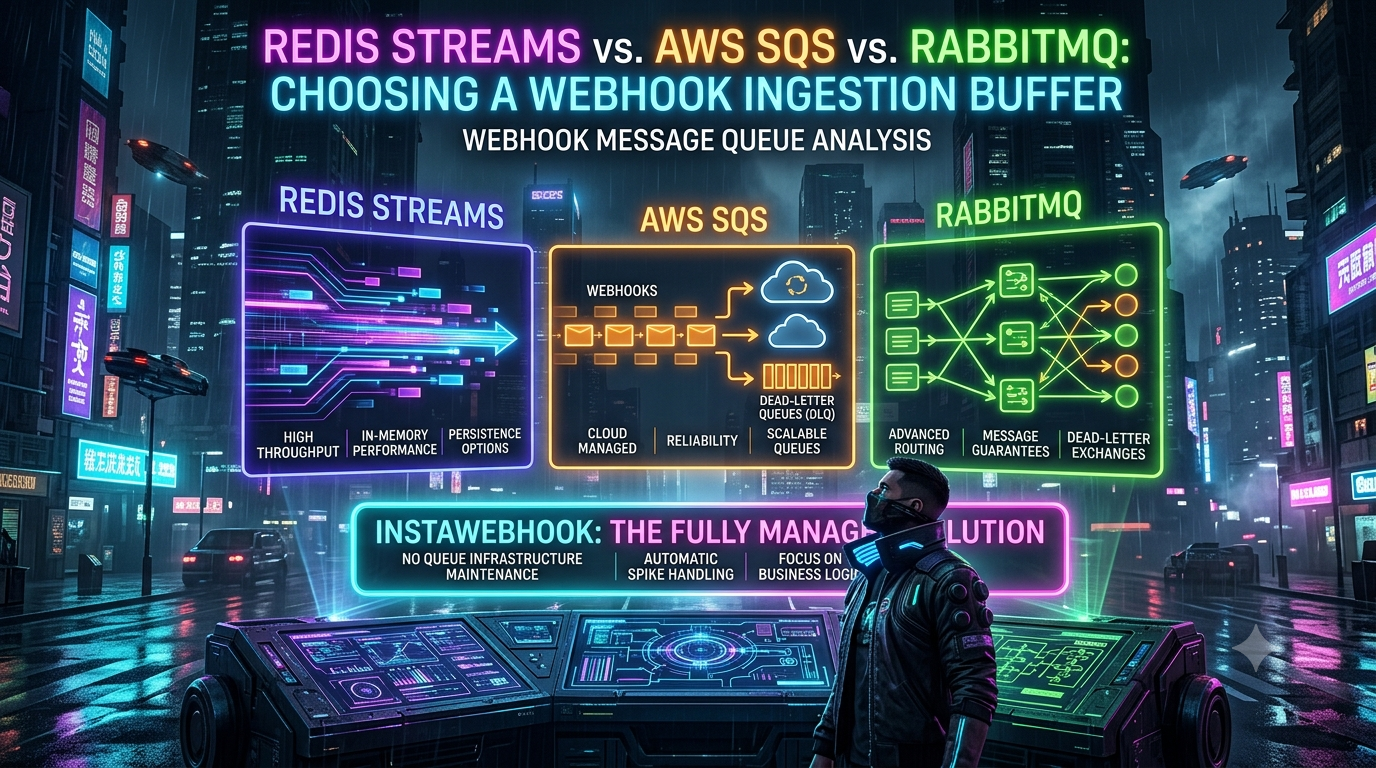
Redis Streams vs. AWS SQS vs. RabbitMQ: Choosing a Webhook Ingestion Buffer
In modern cloud architectures, incoming webhooks represent an uncontrollable influx of external data. Whether you're processing payment notifications from Stripe, e-commerce orders from Shopify, or event streams from GitHub, webhook senders operate on their own timelines. During sudden traffic spikes — a flash sale, a viral post, a batch job on the sender's side — your endpoint can be hit with hundreds or thousands of concurrent HTTP POST requests with no warning.
If your backend tries to synchronously run business logic, write to a database, and call external APIs on every incoming webhook, a few things go wrong at once:
- Timeouts. Most webhook providers expect a fast
200 OK, often within a few seconds. Slow processing causes timeouts. - Retry storms. When a provider times out, it retries — often with the same event — compounding the spike.
- Dropped data. Unhandled concurrency spikes exhaust database connections and memory, and payloads get lost.
The standard fix is an ingestion buffer: something that accepts the raw webhook, immediately acknowledges the request with a 200/202, stores the payload durably, and lets background workers process events at a rate your downstream systems can actually handle.
+------------------+         +--------------------------+         +--------------------+         +-------------------+
| Third-Party API  | ------> |  Webhook Ingestion Buffer | ------> | Background Worker  | ------> | Primary Database  |
| (Stripe/Shopify) |  POST   | (Redis / SQS / RabbitMQ) |  Pull   |  (Rate-Controlled) |  Write  |  (Postgres/Mongo) |
+------------------+         +--------------------------+         +--------------------+         +-------------------+
                                (Instantly returns 200 OK)
Three technologies dominate this decision: Redis Streams, AWS SQS, and RabbitMQ. Below is a deep-dive comparison of how each works, what's changed recently, and how to pick between them.
1. Architectural Deep Dives
Redis Streams: The In-Memory Speed Demon
Redis Streams, introduced in Redis 5.0, is an append-only log data structure that turns Redis into a lightweight messaging engine alongside its usual key-value duties.
How it works for webhooks
Your API server issues an XADD to append the raw payload to a stream. Workers join a Consumer Group and pull batches with XREADGROUP. Once a worker finishes processing, it calls XACK to acknowledge the message.
# Appending an incoming webhook to a Redis Stream
XADD webhooks:stripe * event_type "charge.succeeded" payload "{\"id\":\"ch_123\", ...}"
Key technical characteristics
- Very low latency. Because Redis operates in RAM, ingestion and reads are typically sub-millisecond. Single-node throughput is commonly cited in the tens of thousands to 100k+ operations per second, but this varies a lot with payload size, persistence settings, and hardware — treat any specific number as a starting point for your own benchmark, not a guarantee.
- Consumer groups. Multiple workers can split load while Redis tracks which worker has claimed which unacknowledged message.
- Memory-bound. Unconsumed data lives in RAM, so you need to actively cap growth with
XADD ... MAXLEN ~ <n>or run periodic trimming, or you risk out-of-memory failures. - Persistence trade-offs. Redis relies on RDB snapshots and an AOF (append-only file). With
appendfsync everysec(the common setting), a hard crash can lose up to roughly one second of recent writes. Stricterfsync=alwaysavoids this at a latency cost.
The Redis licensing story you should know about
This part of the decision changed materially in the last two years and most older comparisons don't mention it:
- Through Redis 7.2, Redis was BSD-licensed, permissive open source.
- March 2024: Redis Inc. switched new releases to a dual SSPL/RSAL license — no longer OSI-approved open source. Within days, the Linux Foundation and a group of cloud vendors (AWS, Google Cloud, Oracle, Ericsson, Snap, and others) announced Valkey, a BSD-licensed fork of Redis 7.2.4.
- May 2025: Redis Inc. reversed course. Redis 8.0 shipped back under the OSI-approved AGPLv3 license, with Redis creator Salvatore "antirez" Sanfilippo back at the company.
Practically, this means: Redis Streams' commands and semantics (XADD, XREADGROUP, XACK, XPENDING, XCLAIM) are also implemented in Valkey, and AWS now offers both ElastiCache for Valkey and MemoryDB for Valkey alongside its Redis OSS-compatible offerings. If you're choosing "Redis Streams" as a category today, you're really choosing between Redis (AGPLv3, Redis Inc.-controlled) and Valkey (BSD, community/vendor-governed) as the underlying engine — the streams functionality itself is essentially the same either way.
2. AWS SQS: The Serverless Cloud Workhorse
Amazon Simple Queue Service (SQS) is a fully managed queuing service. For webhook ingestion, it's typically paired with API Gateway or an Application Load Balancer so incoming HTTP POSTs land directly in a queue without a permanent web server in the hot path.
How it works for webhooks
SQS offers two queue types:
- Standard queues — near-unlimited throughput, at-least-once delivery, best-effort ordering.
- FIFO queues — strict ordering and exactly-once processing per
MessageGroupId, with throughput limits (see below).
When a worker calls ReceiveMessage, the message enters a visibility timeout window. If the worker crashes or doesn't delete the message before the timeout expires, the message becomes visible again for another worker to pick up.
+---------------+     HTTP POST     +-----------------+     Enqueue     +-----------------+
| Webhook Sender | ----------------> | AWS API Gateway | -------------> |  Amazon SQS     |
+---------------+                   +-----------------+                 +-----------------+
                                                                                 |
                                                                           Poll  | (Visibility Timeout)
                                                                                 v
                                                                        +-----------------+
                                                                        | AWS Lambda / ECS |
                                                                        +-----------------+
Key technical characteristics (current, as of 2026)
- Zero infrastructure ops. No servers to provision or patch. SQS scales automatically.
- Message size: 1 MiB, not 256 KB. This is the biggest thing older comparisons get wrong: AWS raised the maximum SQS payload from 256 KiB to 1 MiB in August 2025, across standard and FIFO queues, in all commercial regions. For anything larger, you still need the SQS Extended Client Library, which offloads the payload to S3 and passes a reference through the queue.
- FIFO throughput is regional and tiered. Standard (non-high-throughput) FIFO is limited to 300 transactions per second (TPS) per API action, or 3,000 messages/sec with batching. High-throughput mode raises this considerably, but the ceiling depends on region — as of the current published quotas, US East (N. Virginia), US West (Oregon), and Europe (Ireland) support up to 70,000 TPS per API action (700,000 msgs/sec batched); other regions range from about 4,500 TPS down to a 2,400 TPS default elsewhere. Always check AWS's current quota table for your region before designing around a number.
- In-flight message limit. SQS raised the FIFO in-flight message cap from 20,000 to 120,000 in November 2024, which matters if your webhook backlog processing was previously bottlenecked on that ceiling.
- Built-in dead-letter queues. A
maxReceiveCountredrive policy moves a message to a linked DLQ after N failed processing attempts — no custom code required. - Cost model. You pay per request (in increments of, effectively, per-million API calls), which is cost-effective at low-to-moderate volume; continuous aggressive polling adds up, so long polling is worth using deliberately.
3. RabbitMQ: The Flexible AMQP Routing Engine
RabbitMQ is an open-source message broker built primarily on AMQP 0-9-1, with AMQP 1.0, MQTT, and STOMP also supported. It's strongest where incoming webhooks need to be dynamically routed to different backend services based on headers or topics.
How it works for webhooks
Producers publish to exchanges, not directly to queues. An exchange uses routing keys and bindings to deliver each message to one or more bound queues.
                                    +-------------------+     Routing Key     +----------------------+
                                    | Direct / Topic    | ------------------> | Billing Queue        |
+----------------+     Publish      | Exchange          |                     +----------------------+
| Webhook Server | ----------------> |                   |                     +----------------------+
+----------------+                  |                   | ------------------> | Analytics Queue      |
                                    +-------------------+                     +----------------------+
For durability, modern RabbitMQ deployments use quorum queues — a replicated, Raft-based queue type — rather than the deprecated mirrored classic queues.
Key technical characteristics (RabbitMQ 4.x, current line as of 2026)
- Rich routing. Route
stripe.charge.succeededto a billing queue andstripe.customer.createdto a CRM queue using topic exchanges, without application-level filtering. - Quorum queues by default for durability. They replicate via Raft and confirm a write only after a majority of nodes persist it. As of RabbitMQ 4.0, classic queue mirroring was removed entirely — classic queues are now single-replica only, and quorum queues (or streams) are the supported path for replicated, durable data.
- Dead Letter Exchanges (DLX). Native and flexible. Quorum queues also ship with a default redelivery limit of 20 (configurable via a policy), after which a message is dead-lettered automatically — this replaced the older manual TTL/
requeue=falsepattern as the default behavior. - A second replicated option: Streams. Separately from quorum queues, RabbitMQ has a Streams queue type (its own log-based structure with a dedicated binary protocol, distinct from Kafka-style "streaming platforms" but conceptually similar to Redis Streams). Streams are heavily disk-I/O bound and benefit a lot from SSD/NVMe storage, but offer strong throughput for append-only, replay-capable workloads and support non-destructive, repeatable consumption.
- Khepri replaces Mnesia. RabbitMQ 4.0 made Khepri (a Raft-based metadata store) the fully supported default, and by 4.3 it's the only supported metadata store — Mnesia was removed. Operationally this means a cluster now needs a majority of nodes online at all times for the metadata layer, the same requirement quorum queues and streams already had.
- AMQP 1.0 is now core. As of 4.0, AMQP 1.0 is a built-in protocol (not a plugin) with more than double the peak throughput of the 3.13.x implementation on some workloads.
- Message size. Configurable via
max_message_size. The default changed from 128 MiB (RabbitMQ ≤3.13) to 16 MiB as of RabbitMQ 4.0+ — you can raise it, but very large messages hurt broker performance regardless of the ceiling. - Operational overhead. Running a highly available cluster means managing Erlang upgrades, network partitions, disk-alarm thresholds, and (until recently) two possible metadata stores — now consolidated to one.
Technical Comparison Matrix
| Feature / Criteria | Redis Streams (Redis or Valkey) | AWS SQS | RabbitMQ (Quorum Queues / Streams) |
|---|---|---|---|
| Primary paradigm | In-memory append-only log | Fully managed serverless queue | Replicated AMQP broker (+ separate log-based Streams type) |
| Ingestion throughput | High, single-node (workload-dependent; benchmark before relying on a number) | Standard: near-unlimited. FIFO: 300–70,000 TPS per action depending on region and mode | High; exact ceiling depends on message size, disk speed, and cluster config |
| Ingestion latency | Sub-millisecond typical | Tens of milliseconds (HTTP-based API) | Low single-digit milliseconds typical |
| Persistence guarantee | In-memory first; optional AOF/RDB async disk sync | Multi-AZ durable by default | Raft-based write-ahead log (quorum queues); disk-log (streams) |
| Dead-letter handling | Manual — via XPENDING/XCLAIM and your own logic | Built-in — maxReceiveCount + native DLQ redrive | Built-in — native DLX; quorum queues default to a 20-attempt redelivery limit |
| Message ordering | Strict per-stream | Best-effort (standard) / strict per MessageGroupId (FIFO) | Strict FIFO per queue |
| Routing flexibility | Basic (stream key naming) | Basic (1 queue = 1 target; SNS fan-out needed for more) | Advanced (direct, fanout, topic, headers exchanges) |
| Max payload size | Bounded by available RAM — keep payloads small | 1 MiB (raised from 256 KiB in August 2025); larger via S3-backed Extended Client | Configurable; default 16 MiB as of RabbitMQ 4.0 (was 128 MiB) |
| Operational complexity | Medium (self-managed) to low (managed Redis/Valkey) | Zero (fully managed) | High (Erlang runtime, Raft-based cluster state, Khepri) |
| Licensing | Redis: AGPLv3 (as of Redis 8.0, May 2025). Valkey: BSD (Linux Foundation) | Proprietary AWS service | Mozilla Public License 2.0 |
Head-to-Head Evaluation for Webhook Workloads
1. Throughput and latency during sudden spikes
When a payment provider fires tens of thousands of webhooks in a short window, your buffer has to absorb them without dropping connections.
- Redis Streams wins on raw speed — in-RAM writes mean your edge layer can return
200 OKin low single-digit milliseconds. - SQS Standard wins on elasticity — no pre-provisioning, and it absorbs spikes automatically, at the cost of tens of milliseconds of per-call network latency versus Redis.
- RabbitMQ performs well under load, but if backlogs grow into the millions of unconsumed messages, memory pressure can trigger RabbitMQ's high-watermark alarms, which deliberately block publishers to protect the node.
2. Persistence and data-loss protection
Webhooks often carry financial or state-changing events — losing one can mean a missed sale or an inconsistent record.
- SQS offers the strongest out-of-the-box durability: messages are stored across multiple Availability Zones before the write is acknowledged.
- RabbitMQ quorum queues confirm a write only once a majority of Raft cluster members have persisted it.
- Redis Streams is in-memory first. Even with AOF enabled at
everysec, a hard crash can lose up to about a second of recent writes. Synchronous replication or a more conservativefsyncpolicy narrows this gap at a throughput cost.
3. Poison-payload and dead-letter handling
A "poison" webhook is one that reliably crashes your worker on every attempt.
- SQS handles this cleanly: set
maxReceiveCount, and after that many failed attempts SQS moves the message to a linked DLQ and can trigger a CloudWatch alarm, with a console UI for inspecting and redriving. - RabbitMQ dead-letters via DLX, and quorum queues now default to a 20-attempt redelivery limit before that happens automatically — no custom TTL logic required.
- Redis Streams still has no built-in DLQ. You need to poll
XPENDINGfor messages that have been claimed but not acknowledged for too long, track delivery attempts yourself, and move stuck entries to a separate stream withXCLAIM.
4. Operational complexity and maintenance
- SQS requires close to zero infrastructure maintenance.
- Redis Streams / Valkey needs memory monitoring, eviction/trim policy, and replication management to avoid out-of-memory crashes.
- RabbitMQ is the heaviest to run yourself: Erlang upgrades, network-partition handling, disk-alarm monitoring, and — as of 4.x — a single Khepri-based metadata store that requires a quorum of nodes to be online.
Decision Framework
Choose Redis Streams (or Valkey Streams) if:
- You already run Redis or Valkey and want the lowest possible ingestion latency without adding new infrastructure.
- Your webhook volume is high but transient, and you have processes in place to trim streams and monitor memory.
- You're comfortable writing your own dead-letter and retry logic around
XPENDING/XCLAIM. - You've made a deliberate choice on licensing — Redis (AGPLv3) vs. Valkey (BSD) — rather than assuming "Redis" still means what it did before 2024.
Choose AWS SQS if:
- You're already on AWS and want a serverless, pay-per-use model with no cluster to manage.
- You want native dead-letter queues and don't want to build that logic yourself.
- Your payloads fit in 1 MiB (true for the vast majority of webhook providers) and tens-of-milliseconds latency is acceptable.
- You need FIFO guarantees at meaningful scale — just check your region's current high-throughput quota rather than assuming the older 3,000 msg/sec figure still applies everywhere.
Choose RabbitMQ if:
- You need complex, multi-tenant routing — e.g., dynamically routing webhooks to many internal queues by header or tenant ID.
- You're on multi-cloud or on-prem infrastructure where AWS SQS isn't an option.
- You have the operational capacity to run an Erlang-based, Raft-backed cluster (Khepri, quorum queues) and keep it patched.
The Hidden Engineering Tax of Building Your Own Webhook Queue
Comparing these three engines highlights something worth stating plainly: a message queue is only one piece of a complete webhook processing pipeline. Around whichever engine you pick, you still need to build and maintain:
+-----------------------------------------------------------------------------------+
|                        Your Custom Webhook Infrastructure                        |
|                                                                                   |
|  +--------------------+   +-----------------------+   +------------------------+  |
|  | Webhook Receiver   |   | Ingestion Buffer      |   | Processing & Security  |  |
|  | (API Endpoints)    |   | (Redis/SQS/RabbitMQ)  |   | (Signature Validation) |  |
|  +--------------------+   +-----------------------+   +------------------------+  |
|                                                                                   |
|  +--------------------+   +-----------------------+   +------------------------+  |
|  | Retry & Backoff    |   | Poison Message / DLQ  |   | Debugging UI & Logs    |  |
|  | Engines            |   | Management            |   | & Observability        |  |
|  +--------------------+   +-----------------------+   +------------------------+  |
+-----------------------------------------------------------------------------------+
- Signature verification. You need middleware to check cryptographic signatures (Stripe's
Stripe-Signature, Shopify'sX-Shopify-Hmac-SHA256, and so on) before trusting a payload. - Idempotency and deduplication. Providers routinely deliver duplicate events. You need a dedup layer — a lock key in Redis, a unique constraint in your database — to keep processing idempotent.
- Backoff and jitter. When a downstream write fails (a lock, a third-party outage), your consumer pipeline needs exponential backoff with jitter so it doesn't hammer your own systems.
- Visibility and replay. When a critical webhook fails, someone needs to inspect the raw payload, see the error trace, and re-drive it. None of the three engines above gives you a webhook-specific inspection UI out of the box — SQS's DLQ console comes closest, but it's generic to SQS, not webhook-aware.
If that surrounding tooling is more work than your team wants to own, that's the actual trade-off to weigh against build-vs-buy for a dedicated webhook ingestion/delivery platform — evaluate any such vendor on the same criteria above (throughput, durability, DLQ handling, and what it actually costs at your volume) rather than on marketing copy.
Conclusion
The choice comes down to your priorities:
- Redis Streams (on Redis or Valkey) for the lowest latency, if you're equipped to handle memory management and build your own DLQ logic — and you've made a conscious call on which license/engine you're running.
- AWS SQS for a serverless, low-maintenance queue with native dead-lettering, now with a much less restrictive 1 MiB message size than it had before August 2025.
- RabbitMQ for advanced routing topologies and multi-cloud or on-prem independence, on a now-simplified (Khepri-only) operational model as of 4.x.
Whichever you pick, budget for the signature verification, deduplication, retry, and observability layer around it — that's usually the larger and more error-prone part of the build, not the queue itself.
Sources
- AWS SQS message quotas — official docs
- AWS: SQS increases maximum message payload size to 1 MiB (Aug 2025)
- AWS: SQS increases FIFO in-flight limit from 20K to 120K (Nov 2024)
- AWS: SQS FIFO high-throughput quota increases, 2022–2023 whats-new posts
- RabbitMQ 4.0 release notes
- RabbitMQ persistence configuration guide
- CloudAMQP: RabbitMQ message size limits by version
- InfoQ: Redis returns to open source under AGPL (May 2025)
- Valkey GLIDE client — engine version support
This is a sensitive-to-change area — throughput quotas, licenses, and version defaults shift over time. Treat the specific numbers above as accurate at time of writing and re-check the linked official docs before making an architecture decision.