Preventing SSRF Attacks When Consuming Third-Party Webhooks: A Developer's Security Deep Dive
Preventing SSRF Attacks When Consuming Third-Party Webhooks: A Developer's Security Deep Dive In modern cloud architectures, webhooks are the connective tissue of asynchronous...
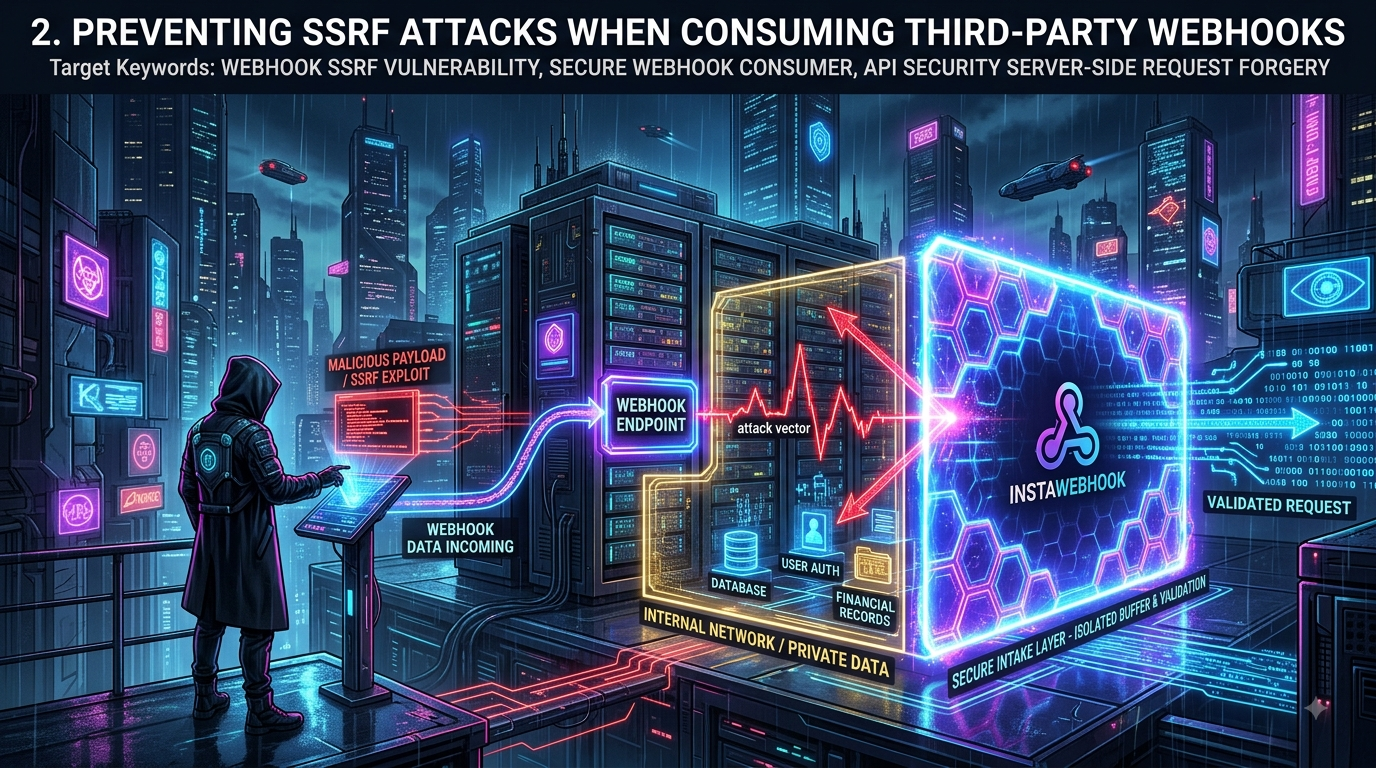
Preventing SSRF Attacks When Consuming Third-Party Webhooks: A Developer's Security Deep Dive
In modern cloud architectures, webhooks are the connective tissue of asynchronous, event-driven applications. Whether you're listening for payment confirmations from Stripe, repository updates from GitHub, or CRM triggers from Salesforce, consuming third-party webhooks is now a standard requirement for production software.
But accepting incoming webhook events — and fetching remote resources referenced inside those payloads — introduces a subtle, high-severity vulnerability class: Server-Side Request Forgery (SSRF). When your application ingests a webhook payload and then fetches something it points to (an avatar URL, an invoice PDF, a media attachment, a callback link), it hands whoever controls that payload the ability to make your own server issue arbitrary outbound HTTP requests. Those requests can probe your internal network, bypass perimeter firewalls, steal cloud credentials from instance metadata services, or reach internal microservices that were never meant to be internet-facing.
This is not a theoretical risk. SSRF is formally recognized in the OWASP API Security Top 10 (API7:2023) and in the OWASP Top 10 for web applications (A10:2021), and it was the root cause of one of the largest financial-sector data breaches on record. We'll walk through the mechanics, real attack vectors, a real breach, and the exact architectural patterns needed to build a genuinely secure webhook consumer.
What Is a Webhook SSRF Vulnerability?
SSRF occurs when a server-side application makes an HTTP request to a destination controlled — directly or indirectly — by an attacker, without adequate validation. While SSRF is often discussed in the context of "import from URL" or image-preview features, webhook consumers are uniquely exposed for two reasons:
- Implicit trust in background workers. Webhook processing usually runs in background job queues (Celery, Sidekiq, BullMQ, SQS consumers). These workers frequently have broad network access inside a VPC — to databases, object storage, and internal RPC endpoints — because nobody thought of them as internet-facing attack surface.
- Payload-driven outbound requests. Many webhook payloads legitimately contain URLs the receiving application is expected to fetch — an image, a file, a "learn more" link.
Anatomy of an Attack
Consider a typical webhook payload:
{
  "event": "user.profile_updated",
  "user_id": "usr_998234",
  "avatar_url": "http://169.254.169.254/latest/meta-data/iam/security-credentials/admin-role"
}
A naive handler fetches whatever URL it's given:
// Vulnerable webhook handler
app.post('/webhooks/user-update', async (req, res) => {
  const { avatar_url, user_id } = req.body;

  // VULNERABILITY: fetching an attacker-controlled URL from inside your infrastructure
  const imageResponse = await fetch(avatar_url);
  const buffer = await imageResponse.buffer();

  await storeAvatar(user_id, buffer);
  res.status(200).send('Processed');
});
Because the request originates from inside your infrastructure, it bypasses perimeter firewalls entirely. 169.254.169.254 is the link-local address used by AWS, GCP, and OpenStack for their Instance Metadata Service (IMDS); Azure uses 168.63.129.16 for its equivalent host metadata endpoint. If the instance's metadata service is reachable and not properly hardened, an attacker who can make your server issue that request can retrieve temporary IAM credentials — effectively borrowing your cloud identity.
This Already Happened: The Capital One Breach
This isn't a hypothetical. In March 2019, an attacker exploited an SSRF vulnerability in a misconfigured ModSecurity web application firewall running on a Capital One EC2 instance. The SSRF let her reach the instance's metadata service and retrieve temporary credentials for an over-privileged IAM role. Those credentials were then used to list and download data from S3 buckets, exposing roughly 106 million customer records — names, dates of birth, Social Security numbers, and bank account numbers among them. Capital One ultimately paid an $80 million penalty to the Office of the Comptroller of the Currency, on top of a separate class-action settlement.
Two things made the SSRF catastrophic rather than merely embarrassing: the metadata service was running the original, token-less version (IMDSv1), and the IAM role attached to the WAF had far more S3 access than it needed. Neither the WAF vulnerability nor the IAM over-permissioning was novel — the combination is what turned a single application bug into one of the largest breaches in financial services history, and it's why AWS treats IMDS hardening and SSRF prevention as inseparable topics to this day.
Common Webhook SSRF Attack Vectors
Attackers use several techniques to defeat naive string-based filtering.
1. Cloud Metadata Exfiltration (IMDS)
As above — 169.254.169.254 (AWS/GCP) or 168.63.129.16 (Azure) can expose instance identity documents, service account tokens, and IAM role credentials if reachable and unauthenticated.
2. Internal Network Reconnaissance and Port Scanning
Attackers submit URLs targeting RFC 1918 private ranges (10.0.0.0/8, 172.16.0.0/12, 192.168.0.0/16) or loopback (127.0.0.1). By observing response codes, timing, and error messages, they can fingerprint open ports, unauthenticated Redis or Elasticsearch instances, and internal admin panels.
3. DNS Rebinding (Time-of-Check to Time-of-Use)
A common but broken mitigation is resolving a hostname once to check it's "safe," then making the request separately. In a DNS rebinding attack, the attacker's DNS server sets a TTL of 0 on a domain like evil.example:
- Time-of-check: your validator resolves
evil.example→ a public IP. It passes. - Time-of-use: the HTTP client re-resolves the same hostname a moment later. The attacker's DNS server now answers with
127.0.0.1or169.254.169.254. Your client connects to an internal target.
The fix is to resolve once and pin the connection to that specific IP, never re-resolving between validation and connection.
4. HTTP Redirect Exploitation
Even if the initial URL resolves to a safe public IP, the destination server can respond with a 301/302 redirect to http://169.254.169.254/... or http://localhost:6379. If your HTTP client follows redirects automatically, validation on the original URL is meaningless. This exact technique — bypassing SSRF filters via a cross-protocol redirect — was the basis for CVE-2023-28155 in the popular (now deprecated) request npm package, which is part of why most SSRF-prevention libraries now insist you validate the agent on every redirect hop, not just the original URL.
5. Alternative IP Representations
Blocklists that string-match "127.0.0.1" or "169.254.169.254" miss equivalent representations:
- Octal:
0177.0.0.1 - Hexadecimal:
0x7f000001 - Decimal/dword:
2130706433 - IPv4-mapped IPv6:
::ffff:127.0.0.1 - Shortened forms:
http://127.1/,http://0/
Any real defense has to normalize and parse the address, not pattern-match the string.
Architectural Pillars of a Secure Webhook Consumer
| Defense Layer | Objective | Implementation |
|---|---|---|
| Ingress authentication | Verify payload sender identity | HMAC-SHA256 signature + timestamp validation |
| Input parsing | Normalize and sanitize URLs | Canonical URL parsing, enforce https:// |
| Network IP resolution | Block private/reserved ranges | Resolve DNS, check every returned IP against a CIDR blocklist |
| Connection pinning | Prevent DNS rebinding | Connect directly to the validated IP, keep TLS SNI intact |
| Redirect handling | Prevent bypass via 3xx | Disable auto-redirects, or re-validate on every hop |
| Egress isolation | Prevent lateral network access | Route outbound fetches through an isolated egress proxy |
Step 1: Verify the Webhook Signature Before Touching the Payload
Before your code does anything with a webhook body, confirm it actually came from the expected sender. Nearly every major provider signs its payloads with HMAC-SHA256, though the header name and exact string that gets signed differ by provider: Stripe uses Stripe-Signature (format t=<timestamp>,v1=<hex>), GitHub uses X-Hub-Signature-256, Shopify uses X-Shopify-Hmac-Sha256, Slack signs v0:timestamp:body, and Svix, OpenAI, and a growing number of providers follow the open Standard Webhooks specification, which defines a webhook-signature header and a 300-second timestamp tolerance by default — the same 5-minute window Stripe's own libraries use.
import crypto from 'node:crypto';

export function verifyWebhookSignature({ rawBody, signatureHeader, secret, toleranceInSeconds = 300 }) {
  if (!signatureHeader) {
    throw new Error('Missing signature header');
  }

  const parts = signatureHeader.split(',');
  const timestampPart = parts.find(p => p.startsWith('t='));
  const signaturePart = parts.find(p => p.startsWith('v1='));

  if (!timestampPart || !signaturePart) {
    throw new Error('Invalid signature header format');
  }

  const timestamp = parseInt(timestampPart.split('=')[1], 10);
  const signature = signaturePart.split('=')[1];

  // Prevent replay attacks: reject stale timestamps
  const currentTime = Math.floor(Date.now() / 1000);
  if (Math.abs(currentTime - timestamp) > toleranceInSeconds) {
    throw new Error('Webhook timestamp outside acceptable tolerance');
  }

  const payloadToSign = `${timestamp}.${rawBody}`;
  const expectedSignature = crypto
    .createHmac('sha256', secret)
    .update(payloadToSign, 'utf8')
    .digest('hex');

  // Constant-time comparison prevents timing attacks
  const isMatch = crypto.timingSafeEqual(
    Buffer.from(signature, 'hex'),
    Buffer.from(expectedSignature, 'hex')
  );

  if (!isMatch) {
    throw new Error('Signature verification failed');
  }

  return true;
}
One practical trap worth calling out: signature verification has to run against the exact raw bytes the sender signed. Most web frameworks parse JSON before your handler ever sees it, and re-serializing a parsed object rarely reproduces the original bytes (key order, whitespace, and Unicode normalization can all differ). In Express, capture the raw body explicitly before any JSON-parsing middleware runs:
app.post(
  '/webhooks/provider',
  express.raw({ type: 'application/json' }),
  (req, res) => {
    // req.body is a Buffer of the exact bytes the sender signed
  }
);
Step 2: Don't Hand-Roll IP Validation — But Understand What It Has to Do
If your application must fetch a URL that arrived inside a webhook payload, you need to resolve the hostname, check every returned IP against a reserved-range blocklist, and pin the connection to the validated IP so a second DNS lookup can't rebind it. The reserved ranges you need to block include:
0.0.0.0/8— current network10.0.0.0/8,172.16.0.0/12,192.168.0.0/16— private networks (RFC 1918)100.64.0.0/10— carrier-grade NAT127.0.0.0/8— loopback169.254.0.0/16— link-local, including cloud metadata endpoints::1/128— IPv6 loopbackfc00::/7— IPv6 unique localfe80::/10— IPv6 link-local
Here's an illustrative implementation showing the mechanics — resolve first, validate every address, pin the socket, and refuse redirects:
import dns from 'node:dns/promises';
import net from 'node:net';
import https from 'node:https';
import { URL } from 'node:url';

function isRestrictedIP(ip) {
  const normalizedIP = ip.replace(/^::ffff:/i, '');

  if (net.isIPv4(normalizedIP)) {
    const parts = normalizedIP.split('.').map(Number);
    if (parts[0] === 127) return true;        // loopback
    if (parts[0] === 10) return true;          // private
    if (parts[0] === 172 && parts[1] >= 16 && parts[1] <= 31) return true; // private
    if (parts[0] === 192 && parts[1] === 168) return true; // private
    if (parts[0] === 169 && parts[1] === 254) return true; // link-local / metadata
    if (parts[0] === 100 && parts[1] >= 64 && parts[1] <= 127) return true; // CGNAT
    if (parts[0] === 0) return true;
  } else if (net.isIPv6(ip)) {
    if (ip === '::1' || ip.startsWith('fe80:') || ip.startsWith('fc00:')) return true;
  }

  return false;
}

export async function safeFetchWebhookAsset(targetUrlStr) {
  const parsedUrl = new URL(targetUrlStr);

  if (parsedUrl.protocol !== 'https:') {
    throw new Error('Only HTTPS is allowed for webhook-referenced assets');
  }

  const addresses = await dns.resolve4(parsedUrl.hostname);
  if (!addresses || addresses.length === 0) {
    throw new Error('Could not resolve hostname');
  }

  for (const ip of addresses) {
    if (isRestrictedIP(ip)) {
      throw new Error(`Security violation: hostname resolved to restricted IP [${ip}]`);
    }
  }

  const targetIP = addresses[0];

  // Pin the socket to the validated IP to defeat DNS rebinding
  const agent = new https.Agent({
    lookup: (hostname, options, callback) => callback(null, targetIP, 4),
  });

  return new Promise((resolve, reject) => {
    const req = https.get(parsedUrl.href, {
      agent,
      timeout: 5000,
      headers: { 'User-Agent': 'SecureWebhookConsumer/1.0' },
    }, (res) => {
      if (res.statusCode >= 300 && res.statusCode < 400) {
        reject(new Error(`Redirects forbidden. Server returned HTTP ${res.statusCode}`));
        return;
      }
      const data = [];
      res.on('data', chunk => data.push(chunk));
      res.on('end', () => resolve(Buffer.concat(data)));
    });

    req.on('error', reject);
    req.on('timeout', () => { req.destroy(); reject(new Error('Request timed out')); });
  });
}
A more important, and more current, recommendation: don't actually ship this hand-rolled version to production. IP-blocklisting code is a well-documented source of its own vulnerabilities. As recently as 2025, the widely used private-ip npm package had an advisory filed against it because its regex-based range checks failed to catch multicast and other reserved addresses, letting SSRF payloads slip through validation that looked correct. That's exactly the class of subtle bug a full CIDR-aware library is built to avoid. For Node.js specifically, prefer a maintained agent-based library that plugs directly into http/https/axios/got, such as request-filtering-agent or ssrf-req-filter — and apply the agent to both httpAgent and httpsAgent, since cross-protocol redirects are exactly how the request package's SSRF filter was bypassed in CVE-2023-28155.
Step 3: Harden Instance Metadata Access at the Infrastructure Level
Application-layer validation is defense-in-depth, not a substitute for hardening the cloud layer underneath it. AWS's IMDSv2 requires a session token obtained via a PUT request before any metadata GET will succeed — since most SSRF bugs can only coerce a GET and can't set arbitrary custom headers, this single change blocks the exact technique used against Capital One. AWS made IMDSv2 the default for the AWS Console's Quick Start launch path in November 2023, added an API to enforce IMDSv2-only by default for all new instances in a region in March 2024, and moved newly released EC2 instance types to IMDSv2-only starting mid-2024. If you're running EC2, GCE, or Azure workloads, confirm this is enforced account- or organization-wide rather than instance-by-instance — existing instances aren't retroactively changed.
Step 4: Isolate Egress at the Network Level
Relying purely on application code to catch every outbound fetch is fragile — a new microservice or a forgotten code path can reintroduce the exact bug you already fixed elsewhere. The more durable pattern is a centralized egress proxy.
Stripe open-sourced Smokescreen for exactly this purpose: it's an HTTP CONNECT proxy that all outbound traffic from internal services — including webhook delivery — is routed through. Smokescreen resolves the destination hostname, checks the resolved IP against role-based ACLs and a deny-list of internal/reserved ranges, and only then establishes the connection, refusing anything that resolves to Stripe's own internal network. Centralizing egress this way has a second benefit: your outbound traffic now comes from a small, stable set of proxy IPs, which makes it easier for downstream partners to allowlist you and easier for your own team to log and monitor everything leaving the network. The pattern is general enough to apply whether or not you use Smokescreen specifically — Envoy egress listeners and cloud-native NAT/firewall egress rules accomplish the same goal.
Where Managed Webhook Infrastructure Fits — and Doesn't
A number of companies — Svix, Hookdeck, and Convoy among them — sell webhook infrastructure that handles delivery retries, exponential backoff, dead-lettering, and signature generation/verification, and several of them are contributors to or adopters of the Standard Webhooks spec. That's genuinely useful: it removes a lot of error-prone plumbing (retry scheduling, endpoint health tracking, secret rotation) from your own codebase.
Worth being precise about, though: those platforms primarily solve reliable delivery and authenticity of inbound webhook data, not SSRF risk from fetches your own application code later makes based on that data. If your handler still takes a URL out of a verified, authenticated payload and fetches it directly, that fetch is exactly as exposed to SSRF as it was before — the payload being authentic doesn't make an embedded URL safe. The metadata-fetch and IP-validation steps above are still your responsibility regardless of which webhook delivery platform sits in front of your endpoint.
Security Checklist
Before shipping webhook-consuming code to production:
- Signature verification — every inbound webhook is checked with HMAC-SHA256 (or the provider's documented scheme) using a constant-time comparison.
- Replay protection — timestamps are checked against a short tolerance window (5 minutes is a reasonable default).
- No raw outbound fetches — application code never calls
fetch()/axios()directly on a URL taken from an unvalidated payload field. - HTTPS enforced — outbound asset fetches require
https://. - DNS rebinding protection — resolve once, validate every returned IP, pin the socket to that IP.
- Redirects disabled or re-validated — automatic 3xx following is off, or every hop is re-validated against the same blocklist.
- A maintained library, not hand-rolled regex — for Node.js, an agent-based SSRF filter (
request-filtering-agent,ssrf-req-filter) applied to both HTTP and HTTPS agents. - IMDSv2 enforced — confirmed account- or org-wide, not left as an instance-level default.
- Egress isolation — webhook workers route outbound traffic through a proxy (Smokescreen or equivalent) with an internal-range deny-list, and direct outbound access is blocked at the network layer.
Conclusion
Webhooks are essential to modern integrations, but consuming unverified payloads — and blindly fetching whatever URLs they contain — is a direct path to SSRF. The Capital One breach shows what that path leads to when it's combined with an over-privileged cloud identity. HMAC signature verification stops forged payloads; strict, library-backed IP validation with connection pinning stops DNS rebinding and redirect bypasses; IMDSv2 limits the blast radius even if a bug slips through; and a centralized egress proxy catches what any single code path might miss. None of these is optional on its own — they're layers, and webhook consumers need all of them.