Webhooks vs. WebSockets vs. SSE: Choosing the Right Real-Time API Architecture
Webhooks vs. WebSockets vs. SSE: Choosing the Right Real-Time API Architecture Building real-time applications — interactive dashboards, collaborative whiteboards, live financial...
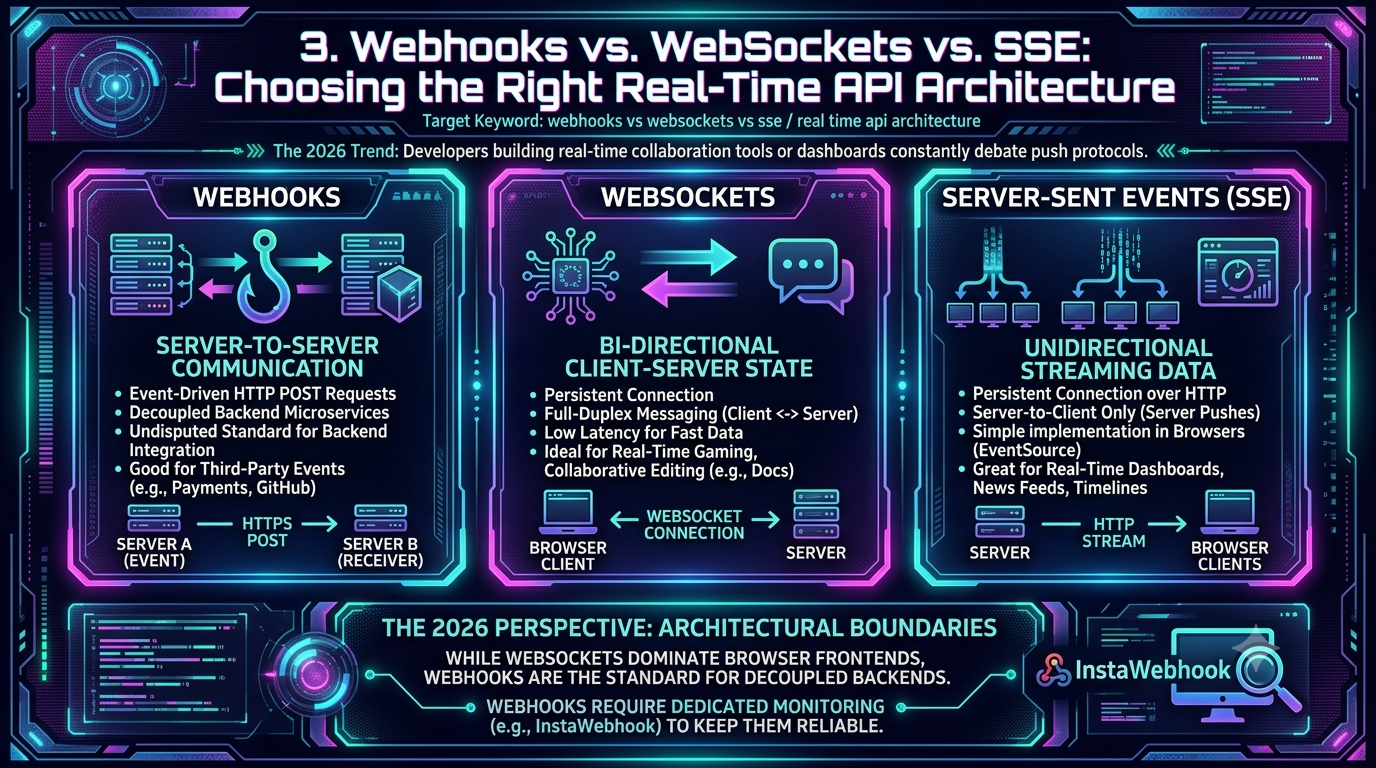
Webhooks vs. WebSockets vs. SSE: Choosing the Right Real-Time API Architecture
Building real-time applications — interactive dashboards, collaborative whiteboards, live financial tickers, or AI streaming workflows — comes down to one core architectural question: how should data move across your stack when an event occurs?
Developers used to default to HTTP polling, repeatedly asking a server "anything new?" In modern systems, polling is treated as an anti-pattern: it wastes CPU cycles, adds unnecessary latency, and burns bandwidth on empty responses. Today, three patterns dominate real-time architecture:
- Webhooks — server-to-server HTTP callbacks for event-driven, decoupled systems
- WebSockets — full-duplex, bi-directional persistent connections for interactive client-server state
- Server-Sent Events (SSE) — lightweight, unidirectional streaming over standard HTTP for client updates
Picking the wrong one shows up later as production pain: socket exhaustion under load, corporate firewalls silently killing connections, ballooning infrastructure costs, or events that vanish without anyone noticing. Below is a technical breakdown of how each protocol works, where each one breaks, and — new for 2026 — where WebTransport fits as a fourth option now that it has reached baseline browser support.
Technical Comparison Matrix
| Architectural Axis | Webhooks | WebSockets (ws:// / wss://) | Server-Sent Events (SSE) |
|---|---|---|---|
| Directionality | Unidirectional (Server → Server) | Bi-directional (Client ⇄ Server) | Unidirectional (Server → Client) |
| Protocol Layer | Standard HTTP/HTTPS | TCP (initiated via HTTP Upgrade) | Standard HTTP/1.1 or HTTP/2 |
| Connection State | Stateless (short-lived HTTP POST) | Stateful (persistent TCP socket) | Stateful (persistent HTTP connection) |
| Latency Profile | Event-driven (sub-second to a few seconds) | Ultra-low (≤ 50 ms typical) | Low (≤ 100 ms typical) |
| Multiplexing / HTTP2 | Standard HTTP/2 or HTTP/3 POST | No native HTTP/2 multiplexing | Native multiplexing over HTTP/2 |
| Auto-Reconnection | N/A (handled via provider retries) | Custom client logic required | Native browser auto-reconnect |
| Scalability Bottleneck | Receiving endpoint throughput | Stateful open file descriptors | Stateful open HTTP connections |
| Primary Target | Backend microservices, third-party SaaS | Interactive browser/mobile UI | Dashboards, streaming AI tokens |
1. Webhooks: The Standard for Server-to-Server Event Ingestion
Core Mechanism
A webhook is an automated, event-driven HTTP POST sent from a producer system to a subscriber the moment an action happens, instead of forcing the consumer to keep polling a REST endpoint for status changes.
+------------------+         HTTP POST /webhook         +-------------------+
|                  | ---------------------------------> |                   |
| Producer Service |                                     | Consumer Service  |
|  (e.g., Stripe)  | <--------------------------------- | (Your Server API) |
+------------------+            200 OK                   +-------------------+
Because webhooks run over standard HTTP, they're stateless: the connection opens on an event, transmits a JSON (or occasionally XML) payload, receives a status code (200 OK or 202 Accepted), and closes.
Architectural Strengths
- Server-to-server decoupling — ideal for distributed microservices and third-party integrations (Stripe payment events, GitHub commit hooks, Twilio delivery receipts).
- Resource efficiency — zero connection overhead while idle; compute is only spent when an event actually fires.
- Horizontal scalability — stateless endpoints distribute cleanly across load balancers and autoscaling groups.
Failure Modes & Reliability Challenges
- Silent drops — consumer downtime, deploy restarts, or network blips can lose events if retry logic isn't configured on the sender side.
- Out-of-order delivery — concurrent sends or retries after a failure can arrive out of chronological order, especially across serverless instances.
- Spoofing and replay attacks — an unauthenticated public POST endpoint is inherently vulnerable unless payloads are cryptographically verified.
How Webhook Security Actually Works in Practice
The original pain point here — every provider inventing its own signature header — has been consolidating around the open Standard Webhooks specification, which a growing number of providers and libraries implement. The pattern, in short:
- The payload is signed with HMAC-SHA256, the same algorithm used by Stripe, GitHub, Shopify, Slack, and Dropbox for their own webhook signing.
- A timestamp is signed alongside the body (not just the payload alone), and receivers reject anything outside a tolerance window — 300 seconds (5 minutes) is the spec's recommended default — specifically to block replay attacks, since a valid signature can otherwise be resent indefinitely.
- Secrets are versioned (a
v1,prefix convention) so a header can carry multiple valid signatures during key rotation without downtime.
If you're building or hardening a webhook receiver in 2026, verifying (id + timestamp + raw body) against HMAC-SHA256 with a short timestamp tolerance is the baseline, not an advanced feature.
The Reliability Tooling Landscape
Because webhooks span independent, uncoordinated servers, most teams outgrow "just POST it and hope" fairly quickly. Rather than pointing to one vendor, here's how the current market actually breaks down by job-to-be-done:
- Sending webhooks to your customers: platforms like Svix focus on outbound delivery — retries with backoff, an embeddable customer-facing management portal, and compliance certifications (SOC 2, HIPAA, PCI-DSS) that matter for regulated industries.
- Receiving webhooks from many providers: tools like Hookdeck act as an inbound gateway — buffering, transformation, routing, and replay for webhooks flowing into your system.
- Self-hosted / open-source: Convoy is a source-available Go gateway you can run yourself if you need full data ownership, though it's worth noting community activity around it has slowed.
- Local development: tools like ngrok or the Hookdeck CLI tunnel a public endpoint to your laptop so you can test webhooks before deploying.
None of these are strictly required for a low-volume integration — but if webhooks drive anything customer-facing (payments, order status, notifications), unmonitored failures tend to surface as support tickets before they surface as alerts.
2. WebSockets: Stateful, Bi-Directional Real-Time Messaging
Core Mechanism
The WebSocket protocol (RFC 6455, standardized in 2011) provides a persistent, full-duplex channel over a single TCP connection.
+---------------+   HTTP GET /chat (Upgrade: websocket)    +---------------+
|               | ----------------------------------------> |               |
|               | <---------------------------------------- |               |
| Browser Client|       HTTP 101 Switching Protocols        | Web Server    |
|               | =========================================  |               |
|               | <======= Persistent Bi-Directional ======> |               |
+---------------+              Data Frames                  +---------------+
The handshake starts as a normal HTTP request carrying an Upgrade: websocket header. If the server accepts, it responds 101 Switching Protocols, and the underlying TCP connection stays open — both sides can now push binary or text frames without repeating HTTP headers on every message.
Architectural Strengths
- True full-duplex communication — both sides can send at will, with no request/response waiting.
- Ultra-low latency — skipping per-message HTTP overhead keeps latency close to raw TCP performance.
- Best fit for rich, interactive UI — the standard choice for collaborative canvas tools, multiplayer game state sync, and live multi-user chat.
Failure Modes & Scalability Bottlenecks
- Stateful scaling overhead — millions of open TCP sockets require stateful server nodes; horizontal scaling typically needs sticky sessions or a pub/sub backplane (Redis Pub/Sub, NATS) to relay messages between nodes.
- Firewall/proxy interference — some corporate networks throttle or kill long-lived non-HTTP connections that go quiet.
- Connection drop handling — mobile clients frequently drop sockets on network handoff (Wi-Fi → cellular), so production systems need heartbeat ping/pong frames and manual reconnect logic — unlike SSE, the browser won't do this for you automatically.
3. Server-Sent Events (SSE): Lightweight Unidirectional Streaming
Core Mechanism
SSE, standardized as part of HTML5, streams events from server to client over a single long-lived HTTP connection using the text/event-stream MIME type.
+---------------+       HTTP GET /stream (EventSource)        +---------------+
|               | -------------------------------------------> |               |
| Browser Client| <-------------------------------------------- | Web Server    |
|               |    200 OK (Content-Type: text/event-stream)  |               |
|               | < - - - - - - event: data: {...} - - - - - - |               |
+---------------+                                               +---------------+
The browser's native EventSource API opens the stream; the server keeps the connection alive and pushes text-formatted chunks over time.
Architectural Strengths
- Native browser handling — automatic reconnection and
Last-Event-IDoffset tracking are built intoEventSource, with no extra library needed. - HTTP/2 & HTTP/3 compatible — because SSE is just HTTP, it benefits from HTTP/2 multiplexing, letting many streams share one TCP connection instead of exhausting the browser's per-domain connection cap.
- Firewall/proxy friendly — it's ordinary traffic on ports 80/443, so it rarely gets blocked the way raw WebSocket upgrades sometimes do.
Limitations
- Strictly unidirectional — anything the client needs to send back has to go over a separate HTTP request.
- HTTP/1.1 connection limits — browsers cap concurrent connections per domain at roughly six under HTTP/1.1, which is why HTTP/2 is effectively mandatory for production SSE at scale.
- Text only — SSE natively carries UTF-8 text; binary payloads need Base64 encoding, adding overhead.
Why SSE Is the Default for AI Streaming in 2026
This is the part of the original comparison that's aged the most since generative AI went mainstream: SSE has become the de facto transport for LLM token streaming, used natively by OpenAI, Anthropic, and Google's model APIs — a client sets stream: true and receives incremental token deltas as text/event-stream chunks rather than waiting for one large JSON blob.
Two production gotchas worth knowing if you're building this yourself:
- Reverse proxy buffering — Nginx and other proxies buffer output by default for efficiency, which shows up as the stream freezing and then dumping everything at once. It needs to be explicitly disabled (e.g.,
X-Accel-Buffering: no). - Idle timeouts — load balancers and proxies often kill a connection after 30–60 seconds of silence, which is a real problem for reasoning models that pause mid-generation. The common fix is a periodic heartbeat comment sent every 15–20 seconds to keep the connection visibly alive.
4. The Fourth Option in 2026: WebTransport
For over a decade, WebSockets were the only real answer for persistent, bi-directional browser connections. That's started to change. WebTransport — a browser API built on HTTP/3 and QUIC — reached Baseline status in March 2026, meaning it now works without flags or polyfills across every major browser engine.
The core technical difference is the transport layer underneath it:
- WebSockets run over a single TCP stream, so one dropped packet blocks everything on that connection until it's retransmitted (head-of-line blocking).
- WebTransport runs over QUIC, which multiplexes independent streams — a lost packet only stalls its own stream, not the whole connection — and adds unreliable datagrams for data where the latest value matters more than guaranteed delivery (think live cursor positions or rapid telemetry, where an 800ms-old value is worthless anyway).
- QUIC's 0-RTT resumption also gives returning clients a near-instant reconnect, which plain TCP/WebSocket handshakes can't match.
Where this matters in practice: high-frequency multiplayer state, real-time 3D/telemetry, and cloud gaming are the workloads pushing hardest against WebSocket's TCP ceiling. Industry commentary from Mozilla's networking team frames WebTransport as filling gaps WebSockets were never designed for, rather than replacing them outright.
Where it doesn't (yet) replace WebSockets: server-side language support is uneven. Go has mature libraries and powers most production WebTransport deployments today; Python's ASGI ecosystem has usable support; but Node.js still has no built-in WebTransport client or server as of mid-2026. The practical recommendation from most current guidance is progressive enhancement — keep a WebSocket fallback and migrate only the specific features that benefit from unreliable datagrams or stream isolation, rather than a wholesale rewrite.
Updated Comparison: All Four Protocols
| Axis | Webhooks | WebSockets | SSE | WebTransport |
|---|---|---|---|---|
| Directionality | Server → Server | Bi-directional | Server → Client | Bi-directional |
| Transport | HTTP/HTTPS | TCP | HTTP/1.1 or HTTP/2 | QUIC (HTTP/3) |
| Head-of-line blocking | N/A | Yes (single TCP stream) | Mitigated via HTTP/2 | No (independent streams) |
| Unreliable/datagram mode | No | No | No | Yes |
| Browser support | N/A | Universal | Universal | Baseline (all major engines, since March 2026) |
| Node.js server support | N/A | Mature (ws, socket.io) | Mature (native http) | Not yet built-in |
Decision Framework
                  What is the target destination?
                                 |
         +-----------------------+-----------------------+
         |                                                |
[ Backend Server ]                                [ Client Browser/Mobile ]
         |                                                |
  Is it event-driven                              Is communication
   server-to-server?                            bi-directional or one-way?
         |                                                |
         v                                    +-----------+-----------+
    [ WEBHOOKS ]                               |                       |
                                        [ Bi-directional ]     [ Unidirectional ]
                                               |                       |
                                    Need QUIC-level perf?              v
                                       (games, telemetry)           [ SSE ]
                                          /         \
                                       yes            no
                                        |              |
                                        v              v
                              [ WEBTRANSPORT ]   [ WEBSOCKETS ]
                              (with WS fallback)
Use Webhooks when:
- Connecting independent backend systems, serverless functions, or third-party APIs (payment gateways, subscription events).
- Events fire unpredictably with idle gaps in between.
- Components need to stay decoupled and stateless.
Use WebSockets when:
- Building interactive features that genuinely need two-way communication (collaborative editors, multi-user chat, whiteboards).
- You need broad, guaranteed browser and infrastructure compatibility today.
- Sub-50ms bidirectional updates are required but you don't need QUIC-specific features.
Use SSE when:
- Streaming updates one-way to dashboards (stock tickers, sports scores, system monitors).
- Streaming AI token generation — this is now the industry-standard use case.
- You want to lean on native browser reconnection instead of writing your own.
Use WebTransport when:
- You're building latency-critical, high-frequency, or loss-tolerant use cases — multiplayer games, live cursors, telemetry — and can accept it as an enhancement layer with a WebSocket fallback rather than a sole dependency.
- Your server stack has mature QUIC/HTTP3 support (Go and Python are furthest along; Node.js is not yet there).
Conclusion
Modern real-time systems rarely lean on a single protocol. Production platforms typically combine webhooks for decoupled backend events, WebSockets for interactive browser collaboration, and SSE for one-way UI and AI-token streams — and a growing number are starting to layer WebTransport on top for the specific slice of traffic where TCP's guarantees cost more than they're worth.
The right call isn't "pick a winner" — it's matching each data flow in your system to the protocol whose failure modes you can actually live with.
Further reading
- Standard Webhooks specification — the open standard for webhook signing
- WebSocket.org protocol comparisons
- RxDB: WebSockets vs SSE vs Long-Polling vs WebRTC vs WebTransport