Webhooks and GDPR: Managing Personally Identifiable Information in Payloads
Webhooks and GDPR: Managing Personally Identifiable Information in Payloads Modern web development runs on event-driven architecture.
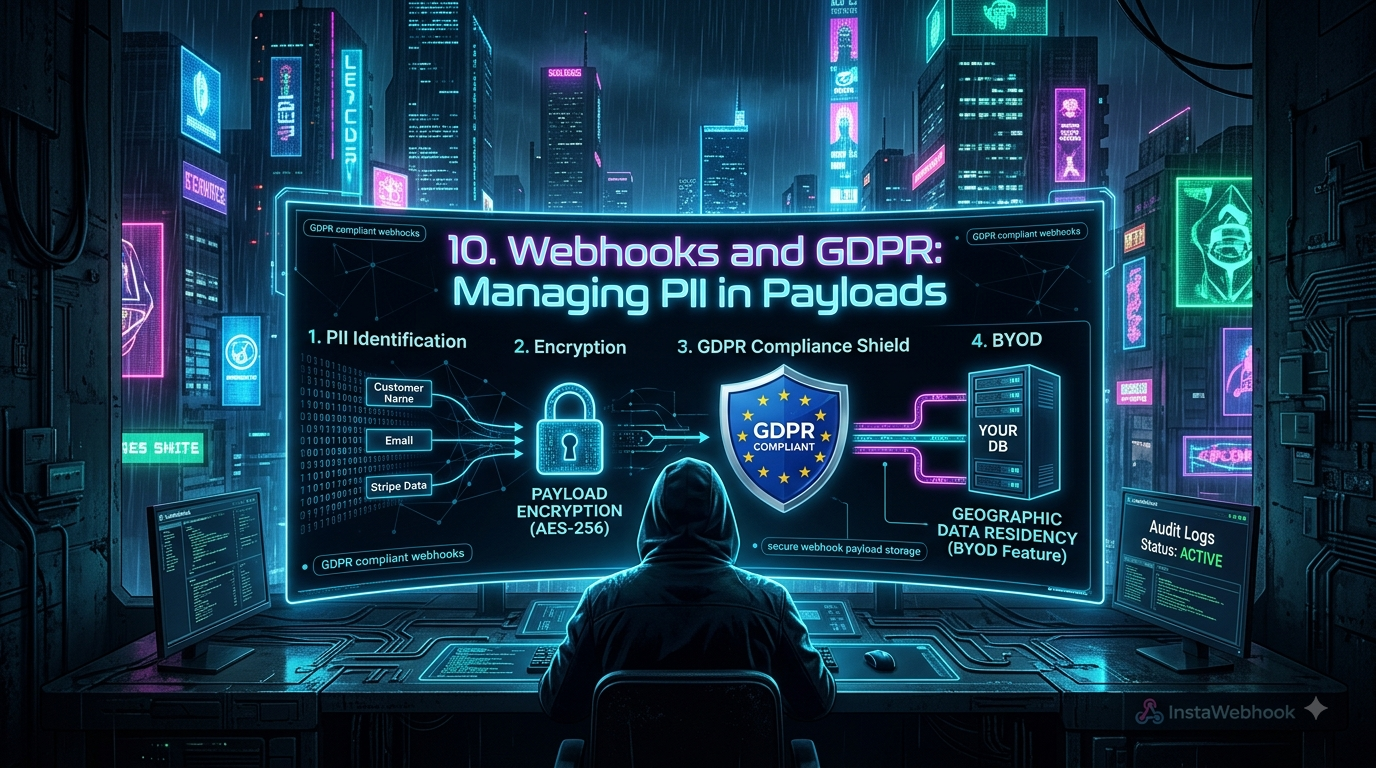
Webhooks and GDPR: Managing Personally Identifiable Information in Payloads
Modern web development runs on event-driven architecture. When a customer subscribes to a service, upgrades a plan, updates an address, or triggers an alert, microservices talk to each other through webhooks. Platforms like Stripe, Shopify, HubSpot, and Auth0 fire off huge volumes of HTTP POST callbacks every day to keep downstream systems in sync.
Behind that convenience sits a compliance problem most teams don't notice until it's expensive: webhook payloads routinely carry Personally Identifiable Information (PII) — names, email addresses, billing details, phone numbers, IP addresses, payment history. For any organization operating in the EU, or processing the data of EU residents, dumping raw webhook payloads into application logs, database tables, or third-party monitoring tools triggers real obligations under the General Data Protection Regulation (GDPR). Get it wrong and the exposure isn't hypothetical — GDPR fines have passed roughly €7 billion in cumulative penalties since the regulation took effect in 2018, and 2026 has already produced fines in the tens of millions of euros tied directly to weak logging, access controls, and breach response.
This article covers what counts as PII in a webhook payload, which GDPR articles actually create liability, the architectural tension between debuggability and compliance, concrete patterns for resolving it, and where EU data protection law is headed in the second half of 2026.
1. What Counts as PII in a Webhook Payload
Under Article 4(1) of the GDPR, personal data is any information relating to an identified or identifiable natural person — someone who can be identified, directly or indirectly, by an identifier such as a name, an ID number, location data, or an online identifier.
Webhook payloads rarely carry PII in isolation. It arrives bundled inside JSON (or XML) event objects generated by upstream providers:
{
  "id": "evt_1N0Xyz2eZvKYlo2C",
  "type": "customer.created",
  "created": 1755302400,
  "data": {
    "object": {
      "id": "cus_N3x9A01B2C",
      "email": "user.example@company.eu",
      "name": "Elena Rostova",
      "phone": "+4915123456789",
      "address": {
        "city": "Berlin",
        "country": "DE",
        "line1": "Friedrichstraße 42",
        "postal_code": "10117"
      },
      "signup_ip": "194.12.54.1"
    }
  }
}
Direct vs. indirect identifiers
| Identifier category | Webhook payload examples | GDPR risk level |
|---|---|---|
| Direct identifiers | Full name, email address, phone number, physical address, tax ID | High — identifies a living individual immediately |
| Indirect identifiers | IP address, device fingerprint, user ID, order ID, cookie ID | High — identifiable when cross-referenced with other data |
| Financial / special-category data | Billing details, partial card numbers, transaction history | Critical — subject to Article 9 (special categories) and PCI-DSS |
A common misconception among engineering teams is that storing an IP address or a bare customer_id without a name is automatically safe. It isn't. In Breyer v. Bundesrepublik Deutschland (CJEU, Case C-582/14, 2016), the Court of Justice of the EU held that a dynamic IP address is personal data for a service provider that has the legal means to combine it with other data held by a third party (like an ISP) to identify the user. The same logic extends to opaque webhook identifiers that can be joined against a customer table.
2. The Legal Exposure: Which GDPR Articles Are Actually at Stake
When your intake endpoint accepts an HTTP POST from a provider like Stripe or Shopify and writes it to disk or a database, you take on liability as a data controller (or as a processor acting for one). Storing raw, unencrypted payloads indefinitely creates exposure across several core articles.
Article 5 — principles relating to processing
- Data minimisation (5(1)(c)): personal data must be adequate, relevant, and limited to what's necessary for the purpose. Persisting a full customer object when your system only needs an
order_idand astatusfield violates this. - Storage limitation (5(1)(e)): personal data can only be kept in identifiable form for as long as necessary. Webhook debug logs sitting in Elasticsearch or S3 for months without a TTL breach this.
- Integrity and confidentiality (5(1)(f)): processing must be secured against unauthorized access, loss, or damage. Unencrypted payload storage fails this outright.
Articles 15 and 17 — data subject rights
- Right of access (Article 15): EU data subjects can request a copy of everything you hold about them. If PII is buried in unstructured JSON blobs across millions of log lines, answering a Data Subject Access Request (DSAR) becomes an expensive manual search.
- Right to erasure (Article 17): when someone asks you to delete their data, you have to remove it from every operational store, backup, and log repository — including dead-letter queues where failed webhook deliveries pile up.
Article 30 — records of processing. If webhook payloads are a meaningful part of your processing activity, they belong in your Article 30 records, along with retention periods and security measures.
Article 32 — security of processing. This is the article regulators reach for most often in breach cases. It requires "appropriate technical and organisational measures," which in practice means encryption, access control, and the ability to restore availability after an incident. A March 2026 Slovenian case is a clean illustration of what happens without it: a healthcare portal exposed patient test results — including health data — because result URLs used short, sequential, guessable numeric IDs with no other authentication. The regulator (IPRS) found a straightforward Article 32 failure. The lesson generalizes directly to webhook systems: resource IDs and reference tokens are not access controls.
Article 33 — breach notification. Controllers must notify their supervisory authority within 72 hours of becoming aware of a personal data breach likely to result in risk to individuals. If a webhook dead-letter queue full of unencrypted PII is compromised, that clock starts the moment you know about it — which is one more reason unmonitored, unencrypted payload stores are dangerous: you can't respond to a breach you don't know happened.
Articles 44–49 — international transfers. Moving personal data outside the European Economic Area requires a legal transfer mechanism. This is the area that has moved the most since this topic was last written about, and it's worth its own section.
3. International Transfers: Where the EU–US Data Privacy Framework Stands in 2026
If your webhook ingestion, logging, or monitoring stack runs on US-based infrastructure, the legal basis for that data leaving the EU is almost certainly the EU–US Data Privacy Framework (DPF), adopted by the European Commission as an adequacy decision on July 10, 2023. It replaced Privacy Shield, which the CJEU struck down in the 2020 Schrems II ruling, and Safe Harbor before that, which was invalidated in 2015.
As of August 2026, the DPF is still valid law — but it's under real pressure:
- French MEP Philippe Latombe's challenge to the DPF (Case T-553/23) was dismissed by the EU General Court on September 3, 2025. He appealed to the Court of Justice of the EU (Case C-703/25 P), and that appeal is still pending.
- On June 29, 2026, the US Supreme Court ruled 6–3 in Trump v. Slaughter that statutory limits on the President's power to remove Federal Trade Commission commissioners are unconstitutional. The FTC is one of the enforcement bodies the European Commission relied on when it found US protections "adequate."
- On July 31, 2026, the European Data Protection Board formally asked the European Commission to assess whether that ruling undermines the FTC's independence — and with it, part of the legal foundation of the DPF.
- Separately, privacy advocate Max Schrems and noyb have signaled a broader legal challenge (informally dubbed "Schrems III" in industry commentary) targeting the same weakness, alongside longstanding objections to US surveillance law (FISA Section 702) and the independence of the Data Protection Review Court.
None of this has struck the DPF down. If you're transferring webhook PII to US infrastructure today, that transfer is currently lawful under the DPF. But given that both of the DPF's predecessors were eventually invalidated by the CJEU, betting your compliance posture entirely on the DPF surviving indefinitely is a real business risk, not a hypothetical one. The safer architectural position — regardless of how the legal fight resolves — is to avoid the question where you can: keep EU customer PII inside EU infrastructure and only transfer what you actually need.
4. The Architectural Tension: Debugging vs. Compliance
Webhook infrastructure has to satisfy two goals that pull in opposite directions.
Operational needs:
- Inspecting failed deliveries and debugging 5xx errors
- Replaying events after an outage
- Idempotency tracking so retries don't double-process an event
- Audit trails for signature verification and delivery state
Compliance needs:
- No PII in plain text, ever
- No PII forwarded to centralized logging tools (Datadog, CloudWatch, Sentry, Slack alerts) by default
- Data kept inside the correct geographic region
- Strict, automated retention limits
If a team disables webhook logging entirely to satisfy compliance, they lose the ability to debug payment failures or replay lost transactions. If they log everything to a shared database in plain text, they've created exactly the kind of exposure Article 32 exists to prevent. Neither extreme works — the goal is an architecture that supports both without compromising either.
5. Four Patterns for GDPR-Compliant Webhook Handling
Pattern 1 — Data minimization via reference-only callbacks
Where the vendor supports it, request "thin" webhook payloads that carry only an event ID and a resource reference, rather than a full customer object:
{
  "id": "evt_99887766",
  "type": "customer.updated",
  "resource_id": "cus_N3x9A01B2C"
}
Your system then calls the provider's authenticated API over TLS to fetch only the fields it actually needs. This keeps PII out of intermediate queues and third-party ingestion layers entirely. Not every vendor supports this pattern — Stripe and Shopify, among others, send heavy payloads by default — so treat it as an optimization to apply where available, not a universal fix.
Pattern 2 — Envelope encryption at rest
Payload bodies should never touch disk in plain text. Use envelope encryption with a strong cipher (AES-256-GCM or ChaCha20-Poly1305):
- Data Encryption Key (DEK): encrypts the raw JSON payload before it's written to storage.
- Key Encryption Key (KEK): held in a KMS or HSM (AWS KMS, GCP KMS, HashiCorp Vault), and used only to encrypt/decrypt the DEK.
The payload exists as ciphertext at rest. It's decrypted in memory, briefly, only when an authorized engineer opens it for debugging or replay — and that access should be logged.
Pattern 3 — Log and alert redaction
Failure alerts routed to Slack or email are a common, overlooked leak point. If the alert body includes the raw payload, PII ends up sitting in chat history and email servers indefinitely.
BAD:
[Alert] Webhook delivery failed to /orders/process
Payload: {"user_email": "john.doe@example.com", "credit_card_last4": "4242"}

BETTER:
[Alert] Webhook delivery failed to /orders/process
Event ID: evt_1N0Xyz2eZvKYlo2C | Status: HTTP 503 | Retries exhausted: 5
Open in dashboard to inspect (requires decrypt permission).
Alerts should carry event IDs, timestamps, HTTP status codes, and endpoint URLs — never the payload body itself.
Pattern 4 — Strict, automated retention
Set short, enforced retention windows rather than relying on manual cleanup:
- Successful deliveries: retain encrypted payloads for roughly 7–14 days for audit purposes, then hard-delete automatically.
- Failed / dead-lettered deliveries: retain up to ~30 days to allow investigation and replay, then purge or anonymize.
Automated purging matters more than the specific window you pick — the failure mode regulators actually penalize is indefinite retention with no defined policy at all.
6. Reference Implementation
Step 1 — Verify the signature before you touch the payload
Never parse or store a webhook body before confirming it's authentic:
const crypto = require('crypto');
const express = require('express');
const app = express();

// Preserve the raw body buffer for signature validation
app.use(express.json({
  verify: (req, res, buf) => {
    req.rawBody = buf;
  }
}));

function verifyWebhookSignature(req, secret) {
  const signature = req.headers['x-webhook-signature'];
  const timestamp = req.headers['x-webhook-timestamp'];

  if (!signature || !timestamp) {
    return false;
  }

  // Reject stale payloads to mitigate replay attacks
  const currentTime = Math.floor(Date.now() / 1000);
  if (Math.abs(currentTime - parseInt(timestamp, 10)) > 300) {
    return false;
  }

  const payloadToSign = `${timestamp}.${req.rawBody.toString('utf8')}`;
  const expectedSignature = crypto
    .createHmac('sha256', secret)
    .update(payloadToSign)
    .digest('hex');

  return crypto.timingSafeEqual(
    Buffer.from(signature),
    Buffer.from(expectedSignature)
  );
}

app.post('/webhooks/intake', (req, res) => {
  const isValid = verifyWebhookSignature(req, process.env.WEBHOOK_SECRET);

  if (!isValid) {
    return res.status(401).json({ error: 'Invalid HMAC signature' });
  }

  res.status(200).json({ status: 'accepted' });
  // Hand off to an async worker for encryption + storage from here.
});
Step 2 — Separate encrypted payload bodies from queryable metadata
-- Example schema for EU-hosted webhook storage (e.g. AWS eu-central-1 / GCP europe-west3)

CREATE TABLE webhook_events (
    event_id VARCHAR(64) PRIMARY KEY,
    provider VARCHAR(32) NOT NULL,            -- e.g. 'stripe', 'shopify'
    event_type VARCHAR(64) NOT NULL,          -- e.g. 'customer.created'
    delivery_status VARCHAR(20) NOT NULL,     -- e.g. 'delivered', 'failed'
    attempt_count INT DEFAULT 0,

    -- Encrypted payload body (AES-256-GCM ciphertext)
    encrypted_payload BYTEA NOT NULL,
    encryption_iv BYTEA NOT NULL,
    kms_key_id VARCHAR(128) NOT NULL,

    created_at TIMESTAMPTZ DEFAULT CURRENT_TIMESTAMP NOT NULL,
    expires_at TIMESTAMPTZ NOT NULL           -- TTL purge target
);

-- Index non-PII metadata for operational queries
CREATE INDEX idx_webhook_status_type ON webhook_events (delivery_status, event_type);
CREATE INDEX idx_webhook_expiry ON webhook_events (expires_at);

-- Automated purge, run on a schedule (Article 5(1)(e))
CREATE OR REPLACE FUNCTION purge_expired_webhooks()
RETURNS void AS $$
BEGIN
    DELETE FROM webhook_events
    WHERE expires_at < CURRENT_TIMESTAMP;
END;
$$ LANGUAGE plpgsql;
Run SELECT purge_expired_webhooks(); on a daily cron job or scheduler, and alert if it fails to run — a broken purge job is functionally the same as having no retention policy at all.
7. GDPR Webhook Compliance Checklist
| Requirement | Common failure mode | Compliant baseline |
|---|---|---|
| Payload encryption at rest | Unencrypted JSON in app logs or a plain DB column | Envelope encryption (DEK + KMS-managed KEK) before write |
| Data residency | Payloads stored wherever the vendor's default region happens to be | Payloads stored in your chosen EU region, with a documented legal basis for any transfer |
| Log/alert leak protection | Full payloads forwarded to Slack, email, or observability tools | Alerts carry event IDs and status codes only; payload access is a separate, logged action |
| Storage limitation | Payloads retained indefinitely "just in case" | Automated TTL purge (days for success, weeks for failures) |
| DSAR / erasure readiness | Manual grep across unindexed log files | PII indexed and deletable by customer ID across all stores, including DLQs |
| Signature verification | Inconsistent or missing HMAC checks | HMAC verification with timestamp checks on every intake endpoint |
| Breach detection | No visibility into who accessed decrypted payloads | Access logging on every decryption event, feeding your Article 33 breach process |
When evaluating a webhook infrastructure vendor against this list, the questions that actually matter are: where is payload data physically stored, is it encrypted before it touches disk, can you get a hard-delete for a single customer's data without a support ticket, and does the vendor's own logging leak PII into places you don't control. A vendor that can answer all four is a materially different risk profile than one that can't — regardless of what its marketing page emphasizes.
8. What's Changing: The EU's Digital Omnibus
It's worth knowing that the ground under all of this is moving. On November 19, 2025, the European Commission published the Digital Omnibus — the most significant proposed set of amendments to the GDPR since it took effect in 2018. As of August 2026 it is still a proposal, under negotiation in the European Parliament and Council, and none of it is in force yet. But the direction is relevant to anyone building compliance-sensitive infrastructure right now:
- A proposal to narrow and clarify the definition of what counts as "personal data," which the EDPB and EDPS jointly criticized in a February 2026 opinion as going further than a technical clarification and risking a real reduction in protection.
- A single EU-wide list (replacing 27 national ones) of which processing activities require a full Data Protection Impact Assessment.
- A simplified Records of Processing Activities (Article 30) regime for organizations under 250 employees whose processing doesn't touch high-risk data categories.
- A proposed single incident-reporting portal intended to consolidate breach notifications currently split across GDPR, NIS2, and DORA.
None of this changes your obligations today. But if your webhook compliance architecture assumes today's Article 5 and Article 30 requirements will hold indefinitely, it's worth watching this process through the rest of 2026 — particularly the DPIA-trigger changes, since they'd directly affect whether a webhook intake pipeline handling special-category data needs a formal assessment at all.
9. Key Takeaways
Webhooks aren't going away, and they shouldn't become a blind spot in your data protection posture just because they move fast and sit outside your primary application. Storing raw JSON callbacks containing names, emails, addresses, and IP addresses in plain-text logs — or on infrastructure outside the EU without a solid legal basis — creates real exposure under Articles 5, 17, 32, and Chapter V of the GDPR, and 2026's enforcement numbers show regulators are acting on exactly these failure patterns.
Practical next steps:
- Audit what you already store. Search your logging and observability tools for raw payload bodies containing email, address, or IP fields.
- Encrypt payloads before they hit disk, not after — envelope encryption with a KMS-managed key is the standard pattern.
- Enforce short, automated retention windows on payload tables, and alert if the purge job stops running.
- Strip PII out of failure alerts and logs, and keep decrypted-payload access as a separate, logged action.
- Know your transfer mechanism for any PII leaving the EU, and keep an eye on the DPF's legal status through the rest of 2026 rather than assuming it's settled.