Webhook Payload Encryption at Rest: Application-Layer Cryptography for Sensitive Webhook Pipelines
Learn how to implement client-side envelope encryption, manage tenant ephemeral keys, and protect PCI, HIPAA, and PII data in webhook queues and audit logs.
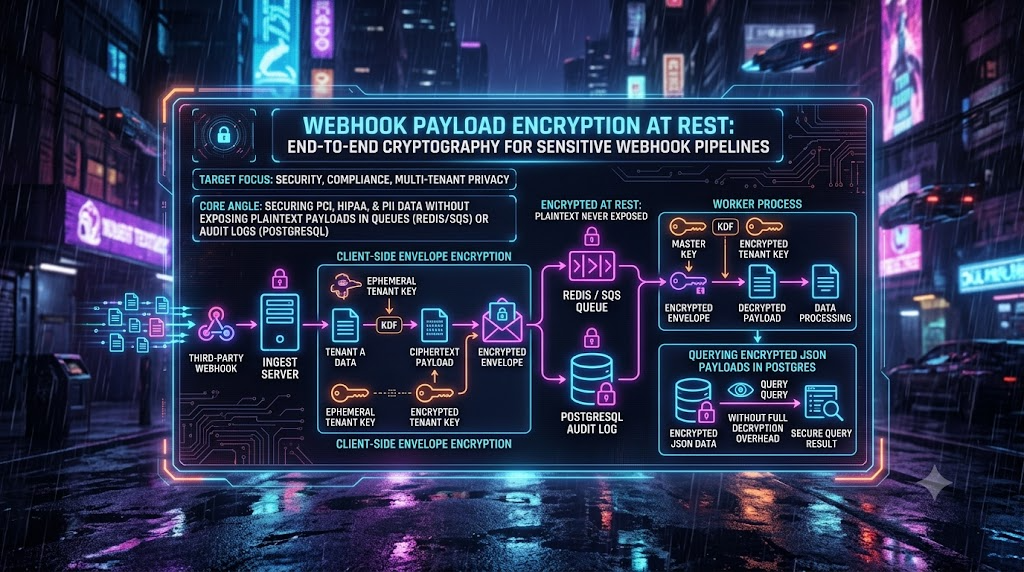
Webhook Payload Encryption at Rest: Application-Layer Cryptography for Sensitive Webhook Pipelines
Webhooks synchronize data between microservices, trigger automated workflows, and deliver events from third-party SaaS providers. More and more of them carry regulated data: payment card numbers, health records, and personal data covered by GDPR and CCPA. That makes every system a webhook touches after your ingress point part of your security perimeter.
A typical pipeline terminates HTTPS at a gateway, pushes the JSON body into a queue such as Redis or Amazon SQS, and archives it in a relational database like PostgreSQL. Every hop after TLS termination usually holds plaintext. An attacker who reads your queue, restores a database backup, or finds an unredacted log line gets the full payloads.
This guide describes a practical blueprint for application-layer (envelope) encryption of webhook payloads, so that plaintext exists only at the ingress service and at the workers that actually need it. It covers envelope encryption, a per-tenant key hierarchy, and how to keep events searchable in PostgreSQL. It also covers retries and idempotency, and what “cryptographic erasure” can and cannot promise.
A note on terminology: the sender’s TLS session ends at your edge, so this is not end-to-end encryption between you and the webhook provider. It is end-to-end inside your own infrastructure, from the ingress service to the worker that processes the event.
1. The Threat Model of Traditional Webhook Pipelines
A standard webhook carrying sensitive data goes through these stages:
- Ingress: A provider (Stripe, Salesforce, a healthcare partner) sends an HTTP POST with a JSON body to your public endpoint.
- Termination: Your load balancer or API gateway terminates TLS, and the body exists as plaintext bytes in memory. Your receiver also needs those raw bytes to verify the provider’s signature (see Section 6).
- Queueing: The receiver pushes the body to a broker (Redis Streams, RabbitMQ, SQS) for asynchronous processing. In many setups, the queue holds raw JSON.
- Worker processing: A worker consumes the message, runs business logic, and writes the event to an audit table or event store, often in a PostgreSQL
JSONBcolumn. Without payload-level encryption, those rows hold the sensitive values indefinitely, and they propagate into replicas and backups. - Logging: Debug statements and exception handlers print request bodies into Datadog, Elasticsearch, CloudWatch, or similar systems.
Platform-level encryption helps but does not close these gaps. SQS supports server-side encryption, and managed databases encrypt volumes. That protects against stolen disks and storage-layer access. It does not protect against any principal that is authorized to read the queue or query the database, such as an over-privileged service role, a compromised application credential, or a developer with production read access. Application-layer encryption narrows that exposure to principals that are also allowed to use the key.
Compliance Implications
Encryption is not the only control these frameworks require, but each one points toward protecting stored data in this way.
- PCI DSS (v4.0.1): Requirement 3.5.1 says the primary account number (PAN) must be rendered unreadable anywhere it is stored. Acceptable methods are one-way hashes, truncation, index tokens, or strong cryptography with key-management processes. The requirement’s applicability notes cover primary storage and also backups, audit logs, and exception or troubleshooting logs. In PCI DSS v3.2.1 this was Requirement 3.4. Requirement 3.5.1.2 also limits disk-level or partition-level encryption as a way to render PAN unreadable. It is acceptable only on removable media, otherwise another mechanism meeting 3.5.1 is needed. This is a strong argument for field-level or payload-level encryption of non-removable storage. Separately, Requirement 3.3.1 prohibits storing sensitive authentication data after authorization, even if encrypted. The best design is to keep PANs out of webhook payloads entirely by using tokens.
- HIPAA Security Rule: 45 CFR § 164.312(a)(2)(iv) covers encryption and decryption of ePHI. Today it is an “addressable” implementation specification: you must implement it or document an equivalent alternative. HHS published a proposed rule on January 6, 2025 that would make encryption of ePHI at rest and in transit mandatory with limited exceptions. As of mid-2026 reporting, it had not been finalized, and sources differ on when it might be, with some pointing to a 2027 target. Encryption also matters for breach response. Under HHS guidance, ePHI encrypted consistent with NIST guidance, with the keys not compromised, is generally not considered “unsecured PHI” for breach notification purposes.
- GDPR Article 32: It lists pseudonymisation and encryption of personal data as examples of appropriate technical measures, to be chosen according to risk, cost, and context. It does not mandate encryption in every case. Article 17 provides the right to erasure.
- CCPA/CPRA: California’s consumer right is a right to delete personal information, not a literal “right to be forgotten.” The statute’s breach-related private right of action (Civil Code § 1798.150) applies to nonencrypted and nonredacted personal information, which gives encryption direct legal value.
2. Core Pattern: Envelope Encryption
To protect payloads across queues, caches, and general-purpose databases, you encrypt before the data touches any of them. The standard technique for this is envelope encryption, which uses two tiers of keys:
- Data Encryption Key (DEK): A random symmetric key generated for each webhook payload. It encrypts the payload with an authenticated mode such as AES-GCM or ChaCha20-Poly1305.
- Key Encryption Key (KEK): A longer-lived key that never encrypts payloads directly. It only wraps (encrypts) DEKs. In production the root KEK lives in a KMS or HSM, such as AWS KMS, Google Cloud KMS, Azure Key Vault, or HashiCorp Vault’s transit engine.
Incoming webhook body (plaintext bytes)
        │
        ▼
[ Generate random DEK ] ──encrypts──> [ Ciphertext + nonce + auth tag ]
        │                                          │
        ▼                                          │
[ Wrap DEK with KEK ]                              │
        │                                          │
        ▼                                          ▼
   [ Wrapped DEK ]  ───────── stored together ─────────>  queue / database
Why an AEAD mode?
Use an Authenticated Encryption with Associated Data (AEAD) cipher. AES-256-GCM (specified in NIST SP 800-38D) and ChaCha20-Poly1305 (RFC 8439) provide confidentiality and integrity. If anyone modifies the ciphertext, nonce, or associated data, decryption fails with an authentication error instead of returning altered plaintext. Alert on those failures.
Two details are often missed:
- Bind context with associated data. Pass values such as the tenant ID, event ID, and envelope version as AAD. They are not encrypted but are authenticated, so an attacker cannot move a valid ciphertext into another tenant’s record or swap it between events.
- Respect nonce limits. GCM is catastrophically weak if a nonce repeats under the same key. NIST SP 800-38D requires that the probability of reusing an IV under one key stay at or below 2^-32. With random 96-bit IVs this is commonly interpreted as a cap of about 2^32 (roughly 4.3 billion) invocations per key. A fresh DEK per message makes the payload encryption safe by construction. But if you wrap every DEK under one long-lived tenant key with random nonces, you are accumulating invocations under that key. Version your keys and rotate them well before the limit, or use a KMS call for wrapping.
3. Multi-Tenant Key Hierarchy
In a multi-tenant system, encrypting everyone’s data under one global key creates a large blast radius. It also makes per-tenant deletion impossible without re-encrypting everything. You want each tenant’s data to be separable cryptographically.
One KMS key per tenant is the simplest model and works well for tens or hundreds of tenants. It gets expensive and operationally heavy at thousands. AWS KMS cryptographic operations also share a per-account, per-region request quota that varies by region (the AWS Security Blog cites a 10,000 requests-per-second default in several major regions). The quota is adjustable, and AWS recommends reducing KMS calls with data key caching, for example in the AWS Encryption SDK.
A scalable alternative is a three-level hierarchy:
- Root key (in KMS/HSM): Never leaves the KMS boundary. It is used only to wrap and unwrap tenant keys.
- Tenant key (random, 256-bit): Generated per tenant, for example with KMS
GenerateDataKey. You store only its KMS-wrapped form in atenant_keystable, and workers unwrap it once and cache it in memory with a TTL. - Message DEK (random, 256-bit): Generated per webhook and wrapped with the tenant key.
HKDF (RFC 5869) fits in this hierarchy for domain separation: deriving independent subkeys (payload wrapping, blind indexes, and so on) from one tenant key so the same key material is never reused across purposes.
A common design mistake is to derive tenant keys with HKDF directly from a root key held in KMS. KMS does not expose raw key material or an HKDF operation, so your code would have to hold the root key in application memory, defeating the point of a KMS boundary. If you want deterministic derivation, derive from a root secret you manage yourself, and understand that it then becomes your most sensitive asset. Also note that a purely derived key cannot be deleted. It can always be recomputed from the root and the tenant ID. That matters for erasure (Section 7), and it is why the hierarchy above stores a random tenant key you can destroy.
import boto3
from cryptography.hazmat.primitives import hashes
from cryptography.hazmat.primitives.kdf.hkdf import HKDF

kms = boto3.client("kms")
ROOT_KEY_ID = "alias/webhook-root"  # your KMS key


def create_tenant_key(tenant_id: str) -> tuple[bytes, bytes]:
    """Create a random tenant key. Persist only the wrapped copy."""
    resp = kms.generate_data_key(
        KeyId=ROOT_KEY_ID,
        KeySpec="AES_256",
        EncryptionContext={"tenant_id": tenant_id},
    )
    return resp["Plaintext"], resp["CiphertextBlob"]  # store CiphertextBlob


def load_tenant_key(tenant_id: str, wrapped_key: bytes) -> bytes:
    """Unwrap once, then cache in memory with a short TTL."""
    resp = kms.decrypt(
        CiphertextBlob=wrapped_key,
        EncryptionContext={"tenant_id": tenant_id},
    )
    return resp["Plaintext"]


def derive_subkey(tenant_key: bytes, purpose: str) -> bytes:
    """Domain-separated 256-bit subkey (e.g. 'dek-wrap', 'blind-index')."""
    return HKDF(
        algorithm=hashes.SHA256(),
        length=32,
        salt=None,
        info=f"webhook-pipeline/v1/{purpose}".encode("utf-8"),
    ).derive(tenant_key)
The KMS encryption context is itself authenticated additional data. The same tenant ID must be presented at decryption, and it shows up in CloudTrail logs. Scope IAM and key policies so the ingress service can only generate and wrap keys, while only workers (and, if necessary, an admin service) may decrypt.
Caching unwrapped tenant keys in an in-memory LRU cache with a TTL means workers call KMS once per tenant per interval instead of once per message. The trade-off is that plaintext keys then sit in process memory. Keep TTLs short and avoid logging or dumping them.
4. Securing the Pipeline: Redis, SQS, and PostgreSQL
Step 1: Encrypt immediately at ingestion
Verify the provider’s signature first, since it needs the original bytes, then encrypt the raw body bytes before they go anywhere else. Do not re-serialize the JSON, because that changes the bytes and breaks later signature checks or forensic comparisons.
import base64
import os

from cryptography.hazmat.primitives.ciphers.aead import AESGCM


def b64(data: bytes) -> str:
    return base64.b64encode(data).decode("ascii")


def encrypt_webhook(raw_body: bytes, tenant_id: str, event_id: str,
                    tenant_key: bytes, key_version: int) -> dict:
    wrap_key = derive_subkey(tenant_key, "dek-wrap")
    aad = f"v1|{tenant_id}|{event_id}|{key_version}".encode("utf-8")

    # Per-message DEK encrypts the payload
    dek = AESGCM.generate_key(bit_length=256)
    nonce = os.urandom(12)
    ciphertext = AESGCM(dek).encrypt(nonce, raw_body, aad)  # tag appended

    # Tenant-derived key wraps the DEK
    wrap_nonce = os.urandom(12)
    wrapped_dek = AESGCM(wrap_key).encrypt(wrap_nonce, dek, aad)

    return {
        "v": 1,
        "kid": key_version,
        "nonce": b64(nonce),
        "ct": b64(ciphertext),
        "wrap_nonce": b64(wrap_nonce),
        "wrapped_dek": b64(wrapped_dek),
    }


def decrypt_webhook(env: dict, tenant_id: str, event_id: str,
                    tenant_key: bytes) -> bytes:
    wrap_key = derive_subkey(tenant_key, "dek-wrap")
    aad = f"v1|{tenant_id}|{event_id}|{env['kid']}".encode("utf-8")
    dek = AESGCM(wrap_key).decrypt(
        base64.b64decode(env["wrap_nonce"]),
        base64.b64decode(env["wrapped_dek"]), aad)
    return AESGCM(dek).decrypt(
        base64.b64decode(env["nonce"]),
        base64.b64decode(env["ct"]), aad)  # raises InvalidTag if tampered
The kid field records which tenant-key version was used, which makes rotation possible: new messages use the new version while old ones stay decryptable.
Step 2: Queue only envelopes
Serialize the envelope and publish it to Redis Streams, RabbitMQ, or SQS. Someone who dumps the Redis keyspace, reads persistence files (RDB/AOF), or intercepts SQS messages sees only opaque base64 strings. Platform encryption such as SQS server-side encryption is still worth enabling as defense in depth, since it covers different threats.
Remember that encoding costs space. Hex doubles the size of the ciphertext, and base64 adds about 33%. If message size matters, store raw bytes (for example, BYTEA in PostgreSQL) instead of text encodings.
Step 3: Store and query in PostgreSQL
The common objection is: “If we encrypt the payload, how do we search or audit events?” The answer is to leave routing metadata unencrypted and encrypt only the sensitive body. Make sure that metadata is itself non-sensitive. An event_type like invoice.paid is fine, while a patient identifier is not.
CREATE TABLE webhook_events (
    id                UUID PRIMARY KEY DEFAULT gen_random_uuid(),
    tenant_id         TEXT        NOT NULL,
    event_type        TEXT        NOT NULL,   -- non-sensitive, indexed
    external_event_id TEXT        NOT NULL,   -- provider's event id, for dedupe
    received_at       TIMESTAMPTZ NOT NULL DEFAULT now(),
    key_version       INTEGER     NOT NULL,
    envelope          JSONB       NOT NULL,   -- nonce, ciphertext, wrapped DEK
    UNIQUE (tenant_id, external_event_id)
);

CREATE INDEX idx_webhook_events_lookup
    ON webhook_events (tenant_id, event_type, received_at DESC);
(gen_random_uuid() is built into PostgreSQL 13 and later.)
Queries on tenant_id, event_type, and received_at run on plain indexed columns. When an authorized user opens one event in an admin dashboard, the application fetches that single row, decrypts it in memory, and returns the plaintext. There is no table scan and no bulk decryption.
For equality search on a sensitive field, such as finding events for a given email address, use a blind index: store an HMAC-SHA256 of the normalized value, keyed with a separate HKDF-derived subkey (derive_subkey(tenant_key, "blind-index")), in its own indexed column. The database can match on the HMAC without seeing the value. The trade-off is that blind indexes reveal when two rows share the same value, and they support only exact matches, so use them sparingly and only for fields that truly need lookup.
PostgreSQL’s pgcrypto extension can encrypt in SQL, but then plaintext and keys pass through the database server, its logs, and statement history. For this threat model, encrypt in the application so the database never sees them.
5. Performance and Overhead
Cryptography adds cost, but for typical webhook sizes it is rarely the bottleneck.
- CPU: With AES-NI hardware acceleration, AES-GCM generally runs at gigabytes per second per core on modern x86 servers, so encrypting a payload of a few kilobytes takes microseconds. JSON handling, base64 encoding, network I/O, and any remote key call will outweigh it. Don’t trust a generic figure, including this one. Measure on your own hardware with
openssl speed -evp aes-256-gcmand benchmark your actual encrypt path. - Size: With the scheme above, fixed binary overhead is about 88 bytes: a 12-byte payload nonce, a 16-byte payload tag, a 12-byte wrap nonce, and a 60-byte wrapped DEK (32-byte key plus 16-byte tag, plus its 12-byte nonce). Text encoding is the bigger factor. Base64 inflates everything by roughly a third, and hex would double it, so a 15 KB payload becomes about 20 KB as base64 and 30 KB as hex. Field names and JSON syntax add a little more.
- Network and KMS: The expensive operation is a remote KMS call. Unwrap tenant keys once and cache them, and monitor your account’s KMS request quota. With caching, per-message overhead stays local and throughput stays close to a plaintext pipeline, though you should confirm this under load.
6. Retries, Idempotency, and Failure States
Webhook delivery is at-least-once. Providers retry on failures and timeouts, and the same event can arrive more than once. Stripe, for example, retries failed deliveries for up to 72 hours. Your encryption layer has to work with that.
- Verify before you encrypt. Providers sign the raw request body. Stripe sends an HMAC-SHA256 signature in the
Stripe-Signatureheader, computed over the timestamp and the exact raw body, and verification fails if you parse or re-serialize the JSON first. Verify the signature, then encrypt the same raw bytes. - Deduplicate on the event ID, not the signature. The signature header is a signature, not an idempotency key. Use the provider’s stable event identifier, such as the Stripe event
id(evt_...), stored in the unencryptedexternal_event_idcolumn with a unique constraint, as in the schema above. AnINSERT ... ON CONFLICT DO NOTHINGlets you discard replays before spending any decryption or queue work on them. (Stripe’sIdempotency-Keyheader is a different mechanism, used on your outbound API requests.) - Acknowledge fast, process asynchronously. Return a 2xx once the event is verified, encrypted, and durably enqueued. Do the slow work in workers.
- Dead-letter queues stay encrypted. When a worker exhausts its retries, the message moves to a DLQ still in envelope form. Operators can inspect metadata, count failures, and purge or redrive messages without ever seeing PII or PHI. Decrypting for debugging should require an explicit, audited action.
- Log defensively. Never log request bodies or decrypted payloads. Log the event ID, tenant ID, key version, and outcome, and scrub exception messages that may embed request data.
7. Cryptographic Erasure and Its Limits
Deleting one tenant’s records from backups, archives, and queues is slow and error-prone. Cryptographic erasure offers a shortcut: if every record for a tenant is encrypted under keys that only exist in one place, destroying those keys renders the data unreadable even where ciphertext copies persist. NIST SP 800-88 recognizes cryptographic erase as a media sanitization technique.
With the hierarchy from Section 3, the procedure is:
- Delete the tenant’s wrapped tenant-key records (all versions) from your key store.
- Purge cached plaintext copies from worker memory, for example by restarting workers or invalidating the cache.
- Make sure backups of the key store do not retain the keys longer than your retention policy allows. Erasure is only as strong as the oldest surviving copy of the key.
- If you use per-tenant KMS keys, schedule key deletion. AWS KMS requires a waiting period of 7 to 30 days (30 by default) before deletion completes. During that period the key is in a “pending deletion” state and cannot be used for cryptographic operations. The key can be recovered by cancelling deletion until the period ends, so plan for that delay in your deletion SLA.
Be careful with the claims you make about this:
- It is not “instantaneous” in practice, because of caches, key-store backups, and KMS waiting periods.
- “Mathematically impossible” overstates it. The accurate statement is that decryption becomes computationally infeasible, assuming the keys are truly gone and the cipher remains secure.
- Whether crypto-shredding satisfies a particular erasure request is a legal question. Regulators and auditors may expect that other copies, such as plaintext in logs, analytics stores, or unencrypted metadata, are removed too. Treat cryptographic erasure as one tool within your erasure process and confirm the approach with your data protection officer or counsel.
Production Checklist
- Use envelope encryption. Generate a fresh random 256-bit DEK per webhook, and never encrypt payloads directly with a long-lived key.
- Use AEAD with bound context. Use AES-256-GCM or ChaCha20-Poly1305, include tenant ID, event ID, and version as associated data, and alert on authentication failures.
- Keep the root key in KMS/HSM. Use random per-tenant keys wrapped by the root key, and use HKDF for domain-separated subkeys rather than for reconstructing deletable keys.
- Cache and version keys. Cache unwrapped tenant keys briefly, track a key version in every envelope, and rotate before approaching GCM invocation limits.
- Verify, then encrypt raw bytes. Check provider signatures on the raw body, and encrypt those exact bytes.
- Keep non-sensitive metadata queryable. Leave routing fields such as tenant, event type, timestamp, and provider event ID unencrypted and indexed, and use blind indexes only where a sensitive field needs equality search.
- Deduplicate on provider event IDs with a unique constraint, and keep DLQs encrypted.
- Plan erasure honestly. Design key deletion, cache invalidation, and key-store backup retention together, and document what your erasure guarantees do and don’t cover.
- Scrub logs. No payloads in logs, traces, or error reports.
References
- PCI DSS v4.0.1, Requirements 3.3.1, 3.5.1, 3.5.1.2: https://www.pcisecuritystandards.org/document_library/
- HIPAA Security Rule NPRM status (mid-2026): https://luxsci.com/hipaa-security-rule-final-rule-missed-may-deadline/ and https://www.myworkdrive.com/blog/hipaa-security-rule-update
- GDPR Article 32: https://gdpr-info.eu/art-32-gdpr/
- RFC 5869, HKDF: https://www.rfc-editor.org/rfc/rfc5869
- RFC 8439, ChaCha20-Poly1305: https://www.rfc-editor.org/rfc/rfc8439
- NIST SP 800-38D, GCM: https://csrc.nist.gov/publications/detail/sp/800-38d/final
- NIST SP 800-88, Media Sanitization: https://csrc.nist.gov/publications/detail/sp/800-88/rev-1/final
- AWS KMS request quotas: https://docs.aws.amazon.com/kms/latest/developerguide/requests-per-second.html
- AWS KMS key deletion: https://docs.aws.amazon.com/kms/latest/developerguide/deleting-keys.html