The Strangler Fig Pattern: Migrating Legacy Webhook Monoliths to Microservices
The Strangler Fig Pattern: Migrating Legacy Webhook Monoliths to Microservices Executive Summary Enterprise systems built on mature monolithic frameworks — Ruby on Rails, Django...
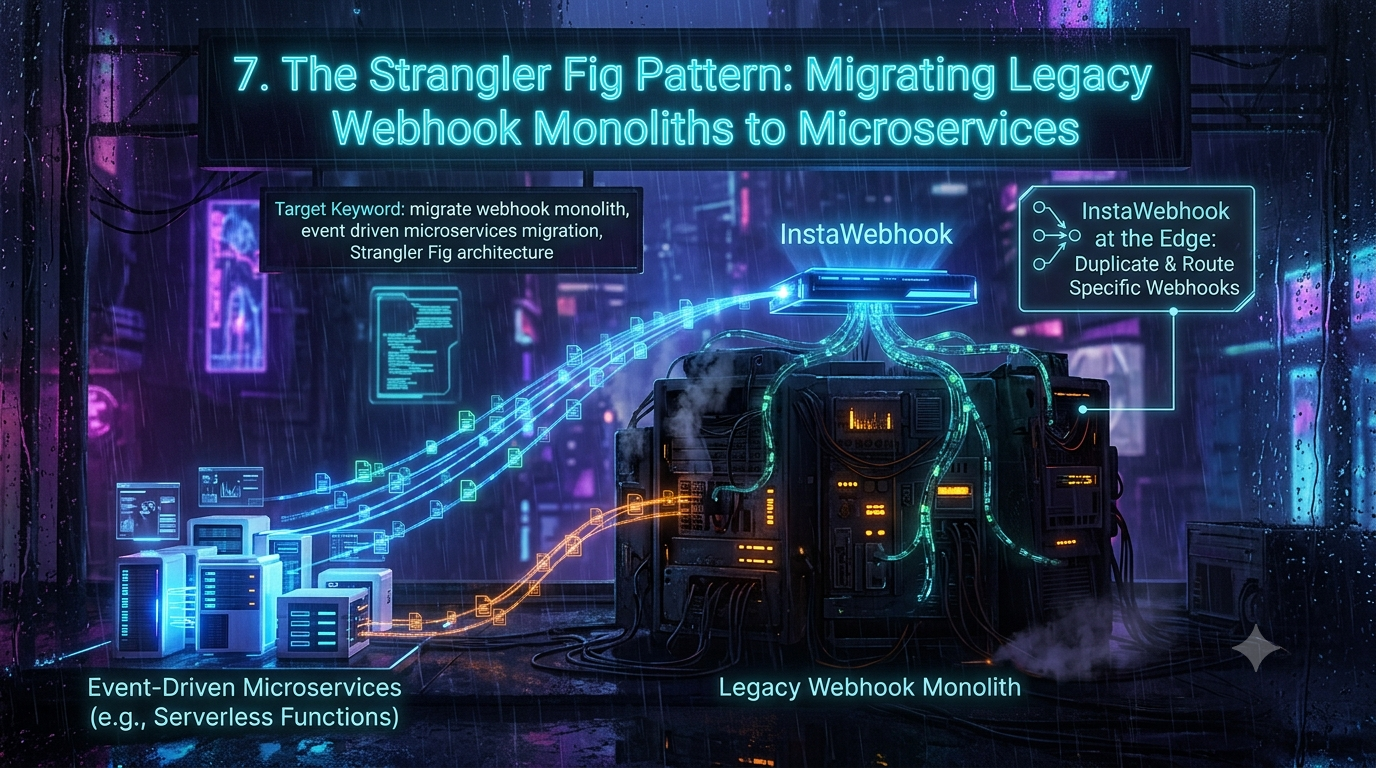
The Strangler Fig Pattern: Migrating Legacy Webhook Monoliths to Microservices
Executive Summary
Enterprise systems built on mature monolithic frameworks — Ruby on Rails, Django, Laravel, Spring Boot — frequently hit a wall around inbound webhook processing. When providers like Stripe, Shopify, GitHub, or Twilio fire off sudden bursts of HTTP POST payloads, the monolith has to parse, verify, and queue those events while competing for the same thread pool and database connections as real user traffic.
A full rewrite to peel webhook handling into serverless functions or microservices is tempting but risky: webhooks carry revenue-critical state (payments, fulfillment, entitlement changes), and a botched cutover can take production down with it. The Strangler Fig Pattern — Martin Fowler's incremental modernization strategy — offers a lower-risk path: put an intelligent routing layer at the edge, and migrate webhook event types one at a time while the legacy monolith keeps handling everything else.
This guide walks through the architecture, implementation, edge cases, and realistic trade-offs of that migration, and points to real tools you can actually evaluate today.
1. The Webhook Monolith Problem
Monolithic architectures are genuinely good for early-stage products: one codebase, simple deploys, centralized data access. But inbound webhook ingestion becomes a structural pain point as traffic grows, for a few concrete reasons:
                     +---------------------------------------+
                     |        Legacy Monolith App             |
Inbound Webhooks --->|  (Rails / Django / Express / Spring)   |
(Stripe, Shopify)    |  - Synchronous ingress router          |
                     |  - HMAC signature verification         |
                     |  - DB transaction locks                |
                     |  - Background workers (Sidekiq/Celery) |
                     +---------------------------------------+
                                        |
                                        v
                               [ Monolithic DB ]
                         (Saturated connection pool)
Bursty traffic and thread exhaustion. Webhook providers don't throttle to match your capacity. A flash sale or a billing run can trigger tens of thousands of requests per minute, and synchronous app servers (Puma, Gunicorn, Unicorn) exhaust their thread pools waiting on payload parsing or synchronous DB writes.
The "noisy neighbor" effect. A webhook surge competes for the same CPU and memory as your customer-facing frontend, so unrelated user traffic slows down too.
HMAC verification overhead. Verifying cryptographic signatures (HMAC-SHA256) inside the application runtime spends CPU cycles before you even know whether the payload is legitimate.
Queue and connection exhaustion. When background workers (Sidekiq, Celery, BullMQ) try to ingest thousands of payloads at once, the database's connection limit saturates, and that can cascade into timeouts across the whole platform.
The risk of a full rewrite
It's tempting to respond to these problems by proposing a full rewrite of the webhook domain into a new stack. Independent analyst and industry research is not encouraging about that path: Gartner, McKinsey, and the Standish Group's long-running CHAOS report have each, in different ways, found that a large share of major IT modernization and rewrite programs — commonly cited in the 60–80% range across different studies and years — fail to meet their goals, run significantly over budget, or get abandoned outright. The exact percentage varies by study and definition of "failure," so treat any single number as directional rather than a precise, universal statistic.
A concrete, well-documented example: in April 2018, UK bank TSB attempted a single-weekend "big bang" migration of roughly 5.2 million customer records to a new banking platform. The cutover went wrong immediately — a significant share of customers were locked out of their accounts, some could see other customers' account details, and the disruption took until December 2018 to fully resolve. The UK's Financial Conduct Authority and Prudential Regulation Authority later fined TSB £48.65 million for the failure, on top of roughly £330 million in total costs, compensation, and lost income the bank had already absorbed. CEO Paul Pester resigned months later. It's not a webhook-specific case, but it's a real, regulator-documented illustration of what a single-cutover migration can cost when it goes wrong.
Halting feature development for months to execute an all-or-nothing cutover on a system that touches payments and order fulfillment is a hard sell for exactly this reason.
2. The Strangler Fig Pattern, Applied to Webhooks
Martin Fowler introduced this pattern in a 2004 blog post, inspired by a trip to the rainforests of Queensland, Australia, where strangler figs germinate in the upper branches of a host tree and gradually grow downward, enveloping it until the host eventually dies and the fig stands alone. He originally titled the post "StranglerApplication." Years later he retitled it "Strangler Fig Application," specifically to push back against people using the bare word "strangler" — which reads as needlessly violent — and to keep the botanical metaphor in view.
The idea: instead of a single cutover, you build new capability around the edges of the legacy system and migrate one thin slice of functionality at a time, until the old system can be safely retired.
                   +-----------------------------------+
                   |     Edge Ingress Router / Facade   |
                   |      (your webhook gateway)        |
                   +-----------------------------------+
                               /           \
               (Legacy Topics)/             \(Migrated Topics)
                             v               v
                +-----------------+     +-----------------------+
                | Legacy Monolith |     |  Modern Microservice  |
                |   (Rails App)   |     | (Lambda / Cloud Run)  |
                +-----------------+     +-----------------------+
Why webhooks need a different approach than a typical Strangler Fig migration
The classic Strangler Fig implementation uses a reverse proxy (NGINX, an API gateway) to route by URL path — /api/v1/users versus /api/v2/users. That doesn't work for webhooks, because most providers send every event type to a single destination URL (e.g., https://api.yourcompany.com/webhooks/stripe) regardless of what the event actually is. You can't decide whether a payload is a payment_intent.succeeded or a customer.subscription.updated event without unmarshalling the JSON body — path-based routing alone can't see inside it.
So a webhook-aware edge layer needs to do more than a typical reverse proxy:
- Payload inspection — parse the JSON body to determine the event type, not just the URL path
- Topic extraction — read fields like
event.typeortopicto decide where a given event should go - Signature verification — validate HMAC or RSA signatures before forwarding anything downstream
- Selective fan-out / shadowing — send specific event types to a new microservice while everything else keeps going to the legacy monolith, or duplicate traffic to both for verification
3. A Phased Rollout Blueprint
| Phase | Legacy Monolith | Microservices | Edge Router's Job |
|---|---|---|---|
| 0: Baseline | Handles 100% of events | Not built yet | Proxy everything to the monolith |
| 1: Edge validation | Relieved of signature checks | Inactive | Verify signatures at the edge; reject invalid payloads |
| 2: Shadow traffic | Still authoritative | Ingesting duplicate traffic for testing | Fan out target event types to both systems |
| 3: Topic cutover | Handles remaining (unmigrated) topics | Authoritative for migrated topics | Route extracted topics exclusively to the new service |
| 4: Full strangulation | Decommissioned | Handles 100% of events | Streams directly into an event mesh (Kafka, NATS, EventBridge) |
4. Step-by-Step Implementation
The walkthrough below models migrating Stripe payment webhooks from a Django/Rails monolith to an AWS Lambda function, using a hypothetical edge gateway configuration. The YAML syntax is illustrative — you'd adapt it to whatever gateway or reverse proxy you're actually using.
Note on tooling: rather than build this edge layer from scratch, most teams evaluate a dedicated webhook infrastructure product. As of 2026 the commonly evaluated options include Hookdeck (purpose-built for receiving, routing, and fanning out inbound webhooks — the closest match to the use case in this guide), Svix (focused more on reliably sending outbound webhooks to your own customers, with a claimed 99.99999% historical uptime by its own reporting), and Convoy (an open-source, self-hostable webhooks gateway that handles both directions). Evaluate current pricing, support status, and feature sets directly with each vendor before committing, since this space moves quickly.
Step 1 — Re-point the webhook endpoint
Update your provider's dashboard (Stripe, GitHub, etc.) or your DNS to send events to the new edge endpoint instead of directly to your monolith:
OLD: https://api.yourcompany.com/v1/webhooks/stripe
NEW: https://ingress.your-gateway.example.com/v1/ingest/wh_live_98x723a109
Step 2 — Baseline: proxy everything to the monolith
Configure signature verification and a default rule that forwards 100% of traffic to your existing application. At this point no business logic has changed — you've only added a layer that can reject malformed or unauthenticated payloads before they hit your infrastructure.
# gateway-config.yaml
version: "2.0"
provider: stripe
signing_secret: "env(STRIPE_WEBHOOK_SECRET)"

ingress:
  path: "/v1/ingest/wh_live_98x723a109"

routes:
  - name: "default-legacy-fallback"
    match:
      topic: "*"  # matches every event type not otherwise routed
    destination:
      type: "http"
      url: "https://legacy-monolith.internal.yourcompany.com/v1/webhooks/stripe"
      timeout_ms: 5000
      retry_policy:
        max_retries: 3
        backoff: "exponential"
Step 3 — Extract the first event type into a microservice
Pick a high-volume, relatively isolated event type to migrate first. payment_intent.succeeded is a common candidate. Build a small, single-purpose handler:
# microservices/payment_processor/handler.py
import json
import logging
from typing import Dict, Any

logger = logging.getLogger()
logger.setLevel(logging.INFO)

def lambda_handler(event: Dict[str, Any], context: Any) -> Dict[str, Any]:
    """
    Serverless handler for payment_intent.succeeded webhooks,
    decoupled from the legacy monolith.
    """
    try:
        payload = json.loads(event.get("body", "{}"))
        event_type = payload.get("type")

        if event_type != "payment_intent.succeeded":
            logger.warning(f"Unexpected event type received: {event_type}")
            return {"statusCode": 400, "body": json.dumps({"error": "Invalid event topic"})}

        payment_intent = payload["data"]["object"]
        customer_id = payment_intent.get("customer")
        amount = payment_intent.get("amount")
        currency = payment_intent.get("currency")

        logger.info(f"Processing payment {payment_intent['id']} for customer {customer_id}")
        process_successful_payment(customer_id, amount, currency)

        return {
            "statusCode": 200,
            "body": json.dumps({"status": "success", "processed_id": payment_intent["id"]})
        }

    except Exception as e:
        logger.error(f"Error processing webhook payload: {str(e)}", exc_info=True)
        return {"statusCode": 500, "body": json.dumps({"error": "Internal processing failure"})}

def process_successful_payment(customer_id: str, amount: int, currency: str) -> None:
    # Isolated DB transaction or event bus emission
    pass
Step 4 — Shadow the traffic before cutting over
Before trusting the new service with production behavior, mirror live traffic to it without letting its response reach the provider or affect the customer-facing status code.
routes:
  - name: "shadow-payment-succeeded"
    match:
      topic: "payment_intent.succeeded"
    mode: "shadow"
    destinations:
      - name: "legacy-monolith"
        type: "http"
        url: "https://legacy-monolith.internal.yourcompany.com/v1/webhooks/stripe"
        primary: true  # this response is what actually goes back to Stripe
      - name: "new-payment-lambda"
        type: "http"
        url: "https://payments.api.yourcompany.com/v1/events"
        primary: false  # runs in dry-run/shadow mode

  - name: "default-legacy-fallback"
    match:
      topic: "*"
    destination:
      type: "http"
      url: "https://legacy-monolith.internal.yourcompany.com/v1/webhooks/stripe"
Before moving on, verify:
- Log output matches between the monolith's background job and the Lambda execution
- The microservice meets or beats current processing-time targets
- Side effects (outbound API calls to third parties) are pointed at sandboxes during shadow mode, not production
Step 5 — Cut over the event type
Once shadow traffic checks out, make the new service authoritative for that event type while everything else keeps flowing to the monolith:
routes:
  - name: "migrated-payment-succeeded"
    match:
      topic: "payment_intent.succeeded"
    mode: "authoritative"
    destination:
      type: "http"
      url: "https://payments.api.yourcompany.com/v1/events"
      timeout_ms: 3000
      circuit_breaker:
        error_threshold_percentage: 15
        fallback_destination: "legacy-monolith"  # automatic failover

  - name: "default-legacy-fallback"
    match:
      topic: "*"
    destination:
      type: "http"
      url: "https://legacy-monolith.internal.yourcompany.com/v1/webhooks/stripe"
Step 6 — Repeat, then decommission
Repeat Steps 3–5 for remaining event types (customer.subscription.deleted, invoice.payment_failed, etc.). Once every topic is migrated: point the default fallback at your new services mesh, remove the legacy controllers and background workers, and reclaim the monolith's database connections and instance capacity.
5. Distributed-System Edge Cases
Splitting webhook handling across services introduces problems a monolith's single database quietly used to hide.
| Challenge | Common Solution |
|---|---|
| Duplicate payloads | Edge- or service-level deduplication (e.g., Redis with a TTL) |
| Out-of-order events | Timestamp checks or explicit state-machine transition guards |
| Keeping monolith and microservice data in sync | Change Data Capture (e.g., Debezium) streaming into an event bus |
| Microservice outages | Dead-letter queues plus a replay mechanism at the edge |
Idempotency across service boundaries
Providers like Stripe deliver webhooks at least once, so duplicates are expected, not exceptional. A monolith typically enforces idempotency with a single ACID transaction:
# Legacy Rails monolith
ActiveRecord::Base.transaction do
  return if WebhookLog.exists?(event_id: payload['id'])
  WebhookLog.create!(event_id: payload['id'])
  process_event(payload)
end
Without a shared database, you need a fast distributed lock instead — an atomic "set if not exists" against Redis works well:
import redis

redis_client = redis.Redis(host="redis-cluster.internal", port=6379)

def process_webhook_with_idempotency(event_id: str, payload: dict) -> bool:
    lock_key = f"idempotency:webhook:{event_id}"

    # NX = only set if the key doesn't already exist; expire after 24h
    is_new_event = redis_client.set(lock_key, "processing", nx=True, ex=86400)

    if not is_new_event:
        logger.info(f"Duplicate event received: {event_id}. Skipping.")
        return True  # still return 200 OK to the provider

    try:
        execute_business_logic(payload)
        redis_client.set(lock_key, "completed", ex=86400)
        return True
    except Exception as e:
        redis_client.delete(lock_key)  # allow a retry to reprocess
        raise e
Out-of-order delivery
A subscription.updated event can arrive before a delayed subscription.created event, purely because of network variance between requests. Two common mitigations: compare the event's own timestamp against what's currently recorded on the entity and discard stale updates, or enforce explicit state-machine rules (an order can't go from FULFILLED back to PENDING, for instance).
Keeping the monolith and microservices in sync
During a multi-month migration, a new microservice will sometimes need data that still lives only in the monolith's database. Querying the monolith's database synchronously from the microservice reintroduces the tight coupling you're trying to remove. The standard alternative is Change Data Capture: a tool like Debezium (a real, actively maintained open-source CDC project built on Kafka Connect) streams row-level database changes out of the monolith into an event bus, so microservices can build their own local read models without querying the source database directly.
Resilience: circuit breakers and dead-letter queues
If a newly deployed microservice starts erroring, the edge layer needs to shield the provider from seeing 5xx responses — some providers, including Stripe, will automatically disable an endpoint after enough consecutive delivery failures. Route failed deliveries into a persistent dead-letter queue with a defined retry policy, and give engineers a way to bulk-replay events once a bug is fixed, without needing the provider to resend anything.
6. What to Actually Expect
It's tempting to attach a tidy "before/after" metrics table to a migration story like this, but real numbers depend heavily on your traffic shape, current infrastructure, and how much of the work you offload to a managed vendor versus build yourself — so treat any specific percentage you see in a vendor's marketing (including this kind of article) with some skepticism unless it's backed by a named, reproducible benchmark.
What's well-supported instead:
- Provider timeout pressure is real, even if the exact number isn't published. Stripe doesn't publish an official webhook response deadline, and developer reports of the practical cutoff vary — commonly somewhere in the 10–20 second range — but Stripe's own guidance is unambiguous that you should verify the signature, return a 2xx response quickly, and do slow work asynchronously rather than during the request. Stripe also retries failed deliveries on an exponential backoff schedule for up to three days in live mode before disabling the endpoint.
- Dedicated webhook infrastructure is a mature market, not a hypothetical. Vendors like Hookdeck, Svix, and Convoy exist specifically because retries, replay, signature verification, and noisy-neighbor isolation are hard to get right, and building all of it yourself is a real cost most teams underestimate.
- Offloading signature verification and routing to the edge does reduce load on the monolith and the new services, because rejected or misrouted traffic never reaches your application code — but the magnitude of that improvement is workload-specific, so measure it in your own environment rather than assuming a fixed percentage.
7. Migration Checklist
Phase 1: Preparation & edge setup
- Audit every inbound webhook endpoint across providers (Stripe, GitHub, Shopify, etc.)
- Map each event type to its internal business consumer
- Deploy the edge gateway and configure provider signing secrets
- Re-point ingestion URLs with a 100% baseline fallback to the existing application
Phase 2: Extraction & parity testing
- Pick a low-risk or high-volume event type as the first candidate
- Build the replacement service
- Enable shadow traffic to the new service
- Verify idempotency handling, data sync, and log parity against the monolith
Phase 3: Cutover & cleanup
- Route the migrated event type's live traffic to the new service
- Monitor error rates, latency, and circuit-breaker activity
- Repeat extraction for remaining event types
- Decommission the legacy controllers, workers, and unused schemas
FAQ
What's the main benefit of the Strangler Fig pattern for webhooks? Risk reduction. You extract and validate one event type at a time instead of cutting the entire system over at once, and the legacy monolith keeps handling everything you haven't migrated yet.
Does re-pointing webhook URLs to an edge gateway cause downtime? Not if you set up a 100% fallback route to your existing monolith before changing the provider-side URL. Traffic keeps flowing through the new ingress point while you build out routing behind it.
What happens if a newly deployed microservice fails in production? A well-configured edge gateway includes circuit breakers and failover routing: once errors cross a threshold, traffic can automatically fail back to the legacy monolith or land in a dead-letter queue for later replay.
Does Stripe really enforce a strict timeout on webhook responses? Stripe doesn't publish an exact figure, and reports of the practical cutoff vary by source — commonly cited in the 10–20 second range. The safe practice regardless of the exact number is the same: verify and acknowledge quickly, and process asynchronously.
Sources
- Martin Fowler, "Strangler Fig Application", martinfowler.com
- Strangler fig pattern, AWS Prescriptive Guidance
- Strangler fig pattern, Microsoft Azure Architecture Center
- UK bank TSB fined nearly £49m over IT system meltdown, TechInformed
- Guide to Stripe Webhooks: Features and Best Practices, Hookdeck
- Svix vs Hookdeck vs Convoy (2026), PkgPulse
- Convoy — webhooks gateway, getconvoy.io
- Debezium — open-source change data capture project