Securing Kubernetes Admission Webhooks: Preventing Cluster Deployment Failures
Securing Kubernetes Admission Webhooks: Preventing Cluster Deployment Failures When managing enterprise Kubernetes clusters, admission controllers serve as the ultimate...
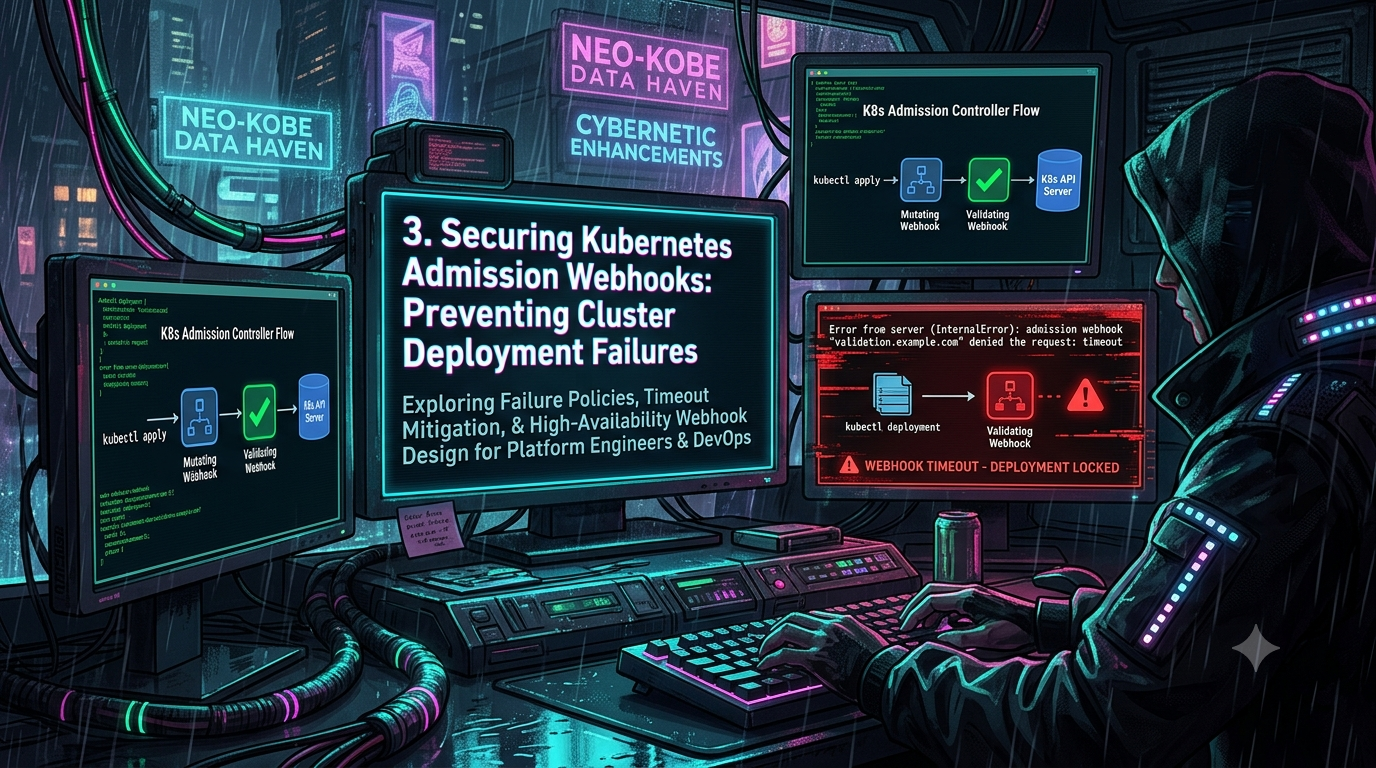
Securing Kubernetes Admission Webhooks: Preventing Cluster Deployment Failures
When managing enterprise Kubernetes clusters, admission controllers serve as the ultimate gatekeepers. Whether enforcing security benchmarks, injecting sidecar proxies, or validating resource quotas, MutatingAdmissionWebhook and ValidatingAdmissionWebhook allow platform engineering teams to enforce policy before any object state is written to etcd.
However, this immense power comes with a significant architectural vulnerability: admission webhooks sit directly in the critical path of the Kubernetes API server. If a webhook service experiences high latency, crashes, suffers from network partitioning, or hits a TLS certificate expiration, the entire control plane can stall — CI/CD pipelines freeze, kubectl commands time out, autoscaling fails, and in severe cases the cluster enters an unrecoverable deadlock.
This guide covers the root causes of admission webhook failures, how to tune timeout and failure-policy settings, how to harden webhook infrastructure, and the high-availability patterns that keep clusters running. It also covers what's changed as of Kubernetes v1.37 "Garhwal" (released August 26, 2026), the current upstream release at the time of writing, plus real, currently-tracked CVEs that affect this part of the stack.
1. Admission Webhooks in the Kubernetes Request Lifecycle
To understand why admission webhooks fail so catastrophically, trace how the API server processes an incoming request (e.g., kubectl apply -f deployment.yaml):
- Authentication & Authorization — verifies identity and RBAC permissions.
- Mutating Admission Phase — invokes external mutating webhooks to modify the object (e.g., injecting sidecars, applying default labels).
- Object Schema Validation — checks the object against the OpenAPI schema.
- Validating Admission Phase — invokes external validating webhooks to inspect the final object state and return an
allowed: true/falseverdict. - Persistence — the object is written to etcd.
Because mutating and validating webhooks execute synchronously before persistence, the API server must block and wait for an HTTP response. If the remote endpoint fails to respond within the configured timeout, the API server applies the webhook's failurePolicy.
2. Anatomy of an Admission Webhook Failure
How does a single pod failure turn into a full cluster outage? The most dangerous scenario is a circular dependency deadlock — a webhook hosted inside the very cluster it validates, without proper exclusions.
┌─────────────────┐       1. API Request        ┌──────────────────────┐
│  Kubernetes API │ ──────────────────────────> │ Validating Webhook   │
│     Server      │                             │      Webhook Pod     │
└────────┬────────┘                             └──────────┬───────────┘
         │                                                 │
         │ 2. Webhook is Down / Unreachable                │ 3. Connection
         │    (failurePolicy: Fail)                        │    Refused / Timeout
         ▼                                                 ▼
┌──────────────────────────────────────────────────────────────────────┐
│                  CLUSTER DEPLOYMENT LOCKUP                           │
│  - API Server rejects ALL Pod creation requests                      │
│  - Webhook Pod cannot be rescheduled or restarted                    │
│  - CoreDNS / CNI Pods cannot start                                   │
└──────────────────────────────────────────────────────────────────────┘
The chain reaction:
- A node failure terminates the webhook pod.
- The webhook configuration specifies
failurePolicy: Failacross all namespaces, includingkube-systemordefault. - The scheduler tries to spawn a replacement webhook pod.
- The API server tries to admission-check that pod creation and attempts to contact the (now-dead) webhook service.
- The request times out.
failurePolicy: Failcauses the API server to reject the pod creation.
At that point you cannot deploy the fix, because the gatekeeper preventing deployment is itself unreachable.
Common root causes
- CNI / DNS dependencies — webhook services are usually addressed by internal DNS (
my-webhook.policy-system.svc:443). If CoreDNS or the CNI plugin fails, resolution halts and every admission check times out. - TLS certificate expiration — an expired secret or a stale
caBundlecauses immediate handshake failures. - Resource starvation / cold starts — under high churn (large batch jobs, autoscaling bursts), webhook pods can be CPU-throttled or memory-limited past the timeout threshold.
- Network restrictions — overly strict NetworkPolicies or cloud security groups blocking control-plane egress to the webhook's worker nodes.
- Unbounded request payloads — a webhook server with no limit on the size of the
AdmissionReviewbody it will parse can be pushed into memory exhaustion by a single oversized request (see Section 8).
3. Configuring Webhook Resilience: failurePolicy and timeoutSeconds
The danger of default settings
If you don't explicitly set these fields, Kubernetes defaults favor safety over availability:
| Field | Default | Security impact | Cluster risk |
|---|---|---|---|
failurePolicy | Fail | High — strictly blocks non-compliant objects | Critical — an unreachable webhook blocks deployments |
timeoutSeconds | 10 seconds (v1.14+) | Neutral | High — a 10s delay per request causes cascading client timeouts |
A 10-second default timeout is generous for production. If a request triggers three sequential webhooks that each time out, the client (kubectl, Helm, ArgoCD) waits 30 seconds before failing — longer than most controllers (ingress-nginx, cluster-autoscaler) will tolerate.
Hardened example
apiVersion: admissionregistration.k8s.io/v1
kind: ValidatingWebhookConfiguration
metadata:
  name: production-policy-validator
webhooks:
  - name: validate.security.company.domain
    rules:
      - apiGroups: ["apps", ""]
        apiVersions: ["v1"]
        operations: ["CREATE", "UPDATE"]
        resources: ["deployments", "statefulsets", "pods"]
        scope: "Namespaced"
    clientConfig:
      service:
        name: policy-validator-svc
        namespace: policy-system
        path: "/validate"
        port: 443
      caBundle: "LS0tLS1CRUdJTiBDRVJUSUZJQ0FURS0tLS0t..." # Base64-encoded CA cert
    # --- CRITICAL RESILIENCE CONFIGURATION ---
    failurePolicy: Fail   # Enforce strict policy for business workloads
    timeoutSeconds: 3     # Drop connection fast to prevent API server thread exhaustion
    sideEffects: None
    admissionReviewVersions: ["v1"]

    # --- SCOPE CONTROL AND EXCLUSIONS ---
    namespaceSelector:
      matchExpressions:
        - key: kubernetes.io/metadata.name
          operator: NotIn
          values: ["kube-system", "kube-public", "policy-system"]
        - key: control-plane
          operator: DoesNotExist
Key parameters:
timeoutSeconds: 3— if your webhook cannot evaluate a payload within 3 seconds, it's overloaded or defective; a short timeout lets clients fail fast instead of hanging.failurePolicydecision matrix:Ignore— for non-critical mutations (telemetry sidecars, informational labels). If the webhook fails, the request proceeds.Fail— for core security rules (blocking root containers, unauthorized registry images). Must be paired with strict namespace selectors to avoid deadlocks.
4. Scope Control: Preventing Control-Plane Deadlocks
Namespace exclusions
Never let a failurePolicy: Fail webhook intercept requests in critical namespaces. Always exclude:
kube-system(CoreDNS, CNI plugins, kube-proxy)kube-node-lease(node heartbeats)- The namespace hosting the webhook deployment itself (e.g.,
policy-system)
namespaceSelector:
  matchExpressions:
    - key: admission-control
      operator: NotIn
      values: ["disabled"]
    - key: kubernetes.io/metadata.name
      operator: NotIn
      values: ["kube-system", "policy-system"]
Fine-grained filtering with matchConditions (CEL)
matchConditions let you write Common Expression Language (CEL) expressions directly inside the webhook configuration. They graduated to GA in Kubernetes v1.30, and are evaluated in-process inside the API server before any HTTP call is made — if the expression evaluates to false, the API server skips the network call entirely.
webhooks:
  - name: check-image-tags.security.domain
    # ... standard config ...
    matchConditions:
      # Skip requests made by system accounts or background controllers
      - name: 'exclude-system-accounts'
        expression: '!request.userInfo.username.startsWith("system:serviceaccount:kube-system:")'
      # Only evaluate requests that alter container specs
      - name: 'is-create-or-update-pod'
        expression: 'has(request.object.spec.containers)'
New in Kubernetes v1.37: webhooks now exclude "virtual" auth resources by default
Prior to v1.37, it was possible to accidentally (or maliciously) configure a webhook whose rules matched non-persisted, in-memory API objects such as SubjectAccessReview or TokenReview — requests the API server itself generates internally to answer "is this call authorized?" A failing webhook that matched those resources could lock a cluster out of its own authentication and authorization path, because the check that decides whether a request is even allowed could itself get stuck waiting on a dead webhook.
As of v1.37 (beta, enabled by default), admission webhooks are no longer called for these non-persisted authentication/authorization resources, even if a webhook's rules explicitly match them — bringing plain webhooks in line with the behavior ValidatingAdmissionPolicy and MutatingAdmissionPolicy already had. If you have an existing webhook configuration with a rule naming one of these resources, current API servers return a warning rather than silently keeping the old (riskier) behavior.
Practical takeaway: this closes off one specific, previously-real deadlock vector, but it does not replace the namespace and matchConditions hygiene above — it's an additional guardrail, not a substitute.
5. Architecting High-Availability Admission Controllers
If you must run a webhook with failurePolicy: Fail, engineer it to the same availability standard as the API server itself: multi-replica redundancy, pod anti-affinity, and a disruption budget.
apiVersion: apps/v1
kind: Deployment
metadata:
  name: policy-validator
  namespace: policy-system
spec:
  replicas: 3
  selector:
    matchLabels:
      app: policy-validator
  template:
    metadata:
      labels:
        app: policy-validator
    spec:
      priorityClassName: system-cluster-critical
      topologySpreadConstraints:
        - maxSkew: 1
          topologyKey: kubernetes.io/hostname
          whenUnsatisfiable: DoNotSchedule
          labelSelector:
            matchLabels:
              app: policy-validator
      containers:
        - name: validator
          image: myregistry.internal/policy-validator:v1.4.0
          resources:
            limits:
              cpu: 500m
              memory: 512Mi
            requests:
              cpu: 100m
              memory: 128Mi
          readinessProbe:
            httpGet:
              path: /healthz
              port: 8443
              scheme: HTTPS
            initialDelaySeconds: 3
            periodSeconds: 5
          livenessProbe:
            httpGet:
              path: /healthz
              port: 8443
              scheme: HTTPS
            initialDelaySeconds: 10
            periodSeconds: 10
---
apiVersion: policy/v1
kind: PodDisruptionBudget
metadata:
  name: policy-validator-pdb
  namespace: policy-system
spec:
  minAvailable: 2
  selector:
    matchLabels:
      app: policy-validator
HA checklist:
- Deployment priority —
priorityClassName: system-cluster-criticalso evictions don't preempt admission webhooks. - Pod Disruption Budgets —
minAvailable: 2so a node drain can't take down every replica at once. - Local informers / caching — never make a synchronous downstream API call during an admission review; pre-index required metadata with local caches so response times stay in single-digit milliseconds.
- Non-blocking I/O — use compiled, lightweight runtimes (Go, Rust) over heavy dynamic script engines where latency matters.
- Bound the request body — reject or stream-limit oversized
AdmissionReviewpayloads instead of buffering them unbounded in memory (see the ingress-nginx CVE in Section 8).
6. Securing Webhook Infrastructure
Hardening webhook security requires addressing three pillars: certificate management, network controls, and authentication.
Automated certificate lifecycle with cert-manager
Manually managing webhook TLS certificates leads to sudden outages when they expire. Use cert-manager with its CA-injector to automatically generate, rotate, and inject certificates into your webhook configuration:
apiVersion: cert-manager.io/v1
kind: Certificate
metadata:
  name: policy-validator-certs
  namespace: policy-system
spec:
  secretName: policy-validator-tls
  duration: 2160h    # 90 days
  renewBefore: 360h  # 15 days
  issuerRef:
    name: internal-ca-issuer
    kind: ClusterIssuer
  dnsNames:
    - policy-validator-svc.policy-system.svc
    - policy-validator-svc.policy-system.svc.cluster.local
---
apiVersion: admissionregistration.k8s.io/v1
kind: ValidatingWebhookConfiguration
metadata:
  name: production-policy-validator
  annotations:
    cert-manager.io/inject-ca-from: policy-system/policy-validator-certs
webhooks:
  - name: validate.security.company.domain
    clientConfig:
      service:
        name: policy-validator-svc
        namespace: policy-system
        path: "/validate"
Network isolation
Admission webhooks should only accept traffic from the API server. Restrict cross-namespace or public access:
apiVersion: networking.k8s.io/v1
kind: NetworkPolicy
metadata:
  name: allow-apiserver-to-webhook
  namespace: policy-system
spec:
  podSelector:
    matchLabels:
      app: policy-validator
  policyTypes:
    - Ingress
  ingress:
    - ports:
        - protocol: TCP
          port: 8443
New in Kubernetes v1.37 (alpha): short-lived, scoped webhook authentication tokens
Historically, if your webhook required authentication, you had to statically configure client certs, bearer tokens, or basic-auth credentials for the API server in a kubeConfigFile, referenced from an AdmissionConfiguration — long-lived secrets that need manual rotation and are easy to over-scope.
Kubernetes v1.37 introduces (alpha, off by default) the APIServerWebhookAuthenticationToken feature gate. It extends the TokenRequest API so a token can be bound to a specific ValidatingWebhookConfiguration or MutatingWebhookConfiguration and scoped to specific API groups via an admissionReviewAPIGroups attestation claim. The token becomes invalid automatically if the referenced webhook configuration is deleted. As of this writing, this is token issuance only — automatic token presentation by kube-apiserver and a webhook-side verification library are not yet part of the mechanism — but it signals where credential management for webhooks is heading: short-lived, narrowly-scoped, and tied to the webhook's own lifecycle instead of a long-lived static secret.
7. Known Security Risks: Real, Current CVEs
Two classes of real-world incidents are worth knowing about, because they show that "admission webhook problem" isn't only a latency or availability story — it's also an attack surface.
An acknowledged, unfixed SSRF-adjacent design issue (CVE-2020-8561)
The Kubernetes Security Response Committee has publicly reconfirmed (May 2026) that kube-apiserver follows HTTP redirects when talking to admission webhooks. An actor who can configure a ValidatingWebhookConfiguration or MutatingWebhookConfiguration (a privileged, cluster-scoped action) can point it at a URL that redirects the API server's request to an internal, private network — effectively using the API server as an SSRF proxy. This is rated Medium severity and will not be fixed upstream, because blocking redirects would break standard HTTP client behavior that some legitimate webhook integrations rely on.
Mitigation is architectural, not a patch:
- Treat the ability to create or edit
*WebhookConfigurationobjects as a highly privileged permission, gated by RBAC, same as node or cluster-role management. - Prefer
clientConfig.service(an in-cluster Service reference) overclientConfig.urlwhere possible, since a Service reference gives an attacker far less room to redirect traffic. - Apply NetworkPolicies that restrict what internal ranges the API server's egress can reach, if your CNI supports policy on control-plane-originated traffic.
Ingress-nginx admission webhook denial of service (CVE-2026-24514)
Disclosed and fixed in early 2026, this issue affected the widely-used ingress-nginx validating admission controller: because it did not enforce a reasonable size limit on incoming AdmissionReview objects, an attacker with permission to create or update an Ingress resource — or with direct network access to the webhook's port — could submit an oversized payload and force the controller to allocate memory without bound, OOM-killing the controller pod or pressuring the whole node. CVSS 3.1 base score 6.5 (Medium), fixed in ingress-nginx v1.13.7 and v1.14.3 and later.
This is the concrete, real-world version of the "resource starvation" root cause described in Section 2, and it generalizes: any webhook server that buffers the full request body before validating its size is a DoS target. Mitigations that apply broadly, not just to ingress-nginx:
- Upgrade to a patched ingress-nginx version if you're running the admission webhook feature.
- Enforce request size limits inside your own webhook handlers before deserializing the body.
- Apply
ResourceQuota/ container memory limits so a single webhook pod's OOM event can't take the node down with it. - Monitor for unusually large admission requests and repeated
OOMKilledevents on webhook pods as an early signal.
This CVE was published alongside three ingress-nginx configuration-injection issues (CVE-2026-24512, CVE-2026-24513, CVE-2026-1580) that stem from unsanitized Ingress annotations rather than the admission path itself, but all four are worth checking in the same pass if you run ingress-nginx with its admission webhook enabled.
8. The Native Alternative: ValidatingAdmissionPolicy and MutatingAdmissionPolicy
ValidatingAdmissionPolicy (GA since v1.30)
Instead of an HTTP round trip to an external pod, ValidatingAdmissionPolicy compiles CEL rules into the API server process itself:
TRADITIONAL WEBHOOK (network hop):
  API Server ──[ HTTP POST (10–100ms) ]──> Webhook Pod ──[ Response ]──> API Server

VALIDATING ADMISSION POLICY (in-process):
  API Server ──[ In-memory CEL evaluation (<1ms) ]──> Persist / Deny
Why this eliminates the entire class of outage described in Section 2:
- Zero network latency — rules run in memory inside
kube-apiserver. - No pod or certificate dependencies — no deployment, no TLS injection, no CNI/DNS failure vector.
- Guaranteed availability — as long as the API server is alive, enforcement is active.
apiVersion: admissionregistration.k8s.io/v1
kind: ValidatingAdmissionPolicy
metadata:
  name: check-replica-limits
spec:
  failurePolicy: Fail
  matchConstraints:
    resourceRules:
      - apiGroups: ["apps"]
        apiVersions: ["v1"]
        operations: ["CREATE", "UPDATE"]
        resources: ["deployments"]
  validations:
    - expression: "object.spec.replicas <= 10"
      message: "Deployments in this environment cannot exceed 10 replicas."
---
apiVersion: admissionregistration.k8s.io/v1
kind: ValidatingAdmissionPolicyBinding
metadata:
  name: bind-check-replica-limits
spec:
  policyName: check-replica-limits
  validationActions: [Deny]
  matchResources:
    namespaceSelector:
      matchExpressions:
        - key: environment
          operator: In
          values: ["staging", "production"]
New: MutatingAdmissionPolicy (beta since v1.34)
The mutating half of the same idea landed as beta in Kubernetes v1.34: MutatingAdmissionPolicy lets you declare CEL-based mutations — the equivalent of a MutatingAdmissionWebhook's "inject a sidecar" or "set a default label" behavior — without running an external service at all. It's off by default; you enable it via the MutatingAdmissionPolicy feature gate and --runtime-config=admissionregistration.k8s.io/v1beta1=true on kube-apiserver.
A MutatingAdmissionPolicy pairs a policy object (the CEL mutation logic) with a MutatingAdmissionPolicyBinding (scope and parameters), mirroring the validating side. It's a genuinely different tool from ValidatingAdmissionPolicy, not a drop-in superset: if all you need is to block a change (e.g., protect a namespace from deletion), the Kubernetes project's own guidance is that ValidatingAdmissionPolicy alone is the simpler, more effective choice — reach for MutatingAdmissionPolicy specifically when you need to change the object, not just judge it.
When to keep external webhooks vs. migrate to CEL
| Capability | External webhooks (OPA Gatekeeper, Kyverno) | Native CEL policies |
|---|---|---|
| Execution overhead | Network round trip (5–100ms) | In-process (<1ms) |
| Infrastructure overhead | High (pods, services, TLS, PDBs, monitoring) | Zero (native CRDs) |
| Mutation capability | Yes (MutatingAdmissionWebhook) | Yes, via MutatingAdmissionPolicy (beta, v1.34+) |
| External state / API lookups | Yes (e.g., query an OCI registry for image signatures) | No — evaluates only the request payload |
| Maturity | Long-established, broad ecosystem (Gatekeeper, Kyverno) | ValidatingAdmissionPolicy GA (v1.30); MutatingAdmissionPolicy beta (v1.34) |
Recommendation: migrate standard metadata, resource-bound, security-context, and label-compliance checks to ValidatingAdmissionPolicy (and MutatingAdmissionPolicy where mutation is genuinely needed). Reserve external HTTP webhooks for cases that require external state lookups or logic too complex to express cleanly in CEL.
9. Emergency Operations: Recovering from a Webhook Deadlock
If kubectl apply or helm upgrade is hanging cluster-wide right now:
Step 1 — Identify the failing webhook configuration
kubectl get validatingwebhookconfigurations,mutatingwebhookconfigurations -o wide
Look for custom configurations covering the resource type you're failing to deploy.
Step 2 — Patch or remove it
Option A (recommended): flip the failure policy to Ignore to restore traffic flow without deleting the policy definition:
kubectl patch validatingwebhookconfiguration production-policy-validator \
  --type='json' -p='[{"op": "replace", "path": "/webhooks/0/failurePolicy", "value": "Ignore"}]'
Option B: delete the webhook configuration entirely if patching fails or the API server is severely unresponsive:
kubectl delete validatingwebhookconfiguration production-policy-validator --timeout=5s
Deleting the ValidatingWebhookConfiguration object only removes its registration from the API server — it does not touch your underlying webhook pods, but it immediately stops the API server from attempting network calls to the dead endpoint.
Step 3 — Monitor admission metrics going forward
Track these Prometheus metrics to catch degradation before it becomes an outage:
apiserver_admission_webhook_admission_duration_seconds_bucket— HTTP response latency from webhook endpoints; alert if p99 > 2s.apiserver_admission_webhook_rejection_count— denied requests per webhook.apiserver_admission_webhook_request_total— spike detection for volume anomalies.
Conclusion & Architecture Checklist
Admission webhooks are vital for security and operational compliance, but a poorly configured one introduces a single point of failure into your control plane. To protect your cluster:
- Set strict timeouts — 3 seconds or less, to fail fast.
- Exclude core namespaces — always keep
kube-systemand the webhook's own namespace out offailurePolicy: Failwebhooks. - Use
matchConditions— drop unnecessary requests in-process with CEL before any network call is made. - Don't rely solely on the new v1.37 virtual-resource exclusion — it closes one deadlock vector, not all of them.
- Build for high availability — multi-replica webhooks, PDBs, priority classes, anti-affinity, and a bound on request body size.
- Automate TLS management — use cert-manager to eliminate certificate-expiry outages, and watch for the emerging short-lived webhook-token mechanism as it matures past alpha.
- Treat webhook configuration as a privileged capability — the unfixed webhook-redirect issue (CVE-2020-8561) means anyone who can write a
*WebhookConfigurationobject can potentially redirect API server traffic internally. - Patch known CVEs — if you run ingress-nginx with its admission webhook enabled, confirm you're past v1.13.7 / v1.14.3 (CVE-2026-24514 and related injection CVEs).
- Adopt
ValidatingAdmissionPolicyandMutatingAdmissionPolicy— move declarative rules to in-process CEL policies (GA since v1.30, beta since v1.34 respectively) to remove network hops entirely wherever the logic doesn't need external state.
Applying these principles lets platform teams keep strong security boundaries without turning the admission path into the cluster's weakest link.
Further reading
- Kubernetes docs — Dynamic Admission Control
- Kubernetes docs — Validating Admission Policy
- Kubernetes docs — Mutating Admission Policy
- Kubernetes blog — Kubernetes v1.37: Garhwal
- Kubernetes blog — Reconciling the Past: Correcting Records for Unfixed Kubernetes CVEs
- Kubernetes GitHub — CVE-2026-24514: ingress-nginx Admission Controller denial of service