Multi-Tenant Data Sovereignty: Routing and Storing Regional Webhooks Securely
Multi-Tenant Data Sovereignty: Routing and Storing Regional Webhooks Securely Executive Summary Global SaaS platforms now operate under a growing patchwork of regional data rules...
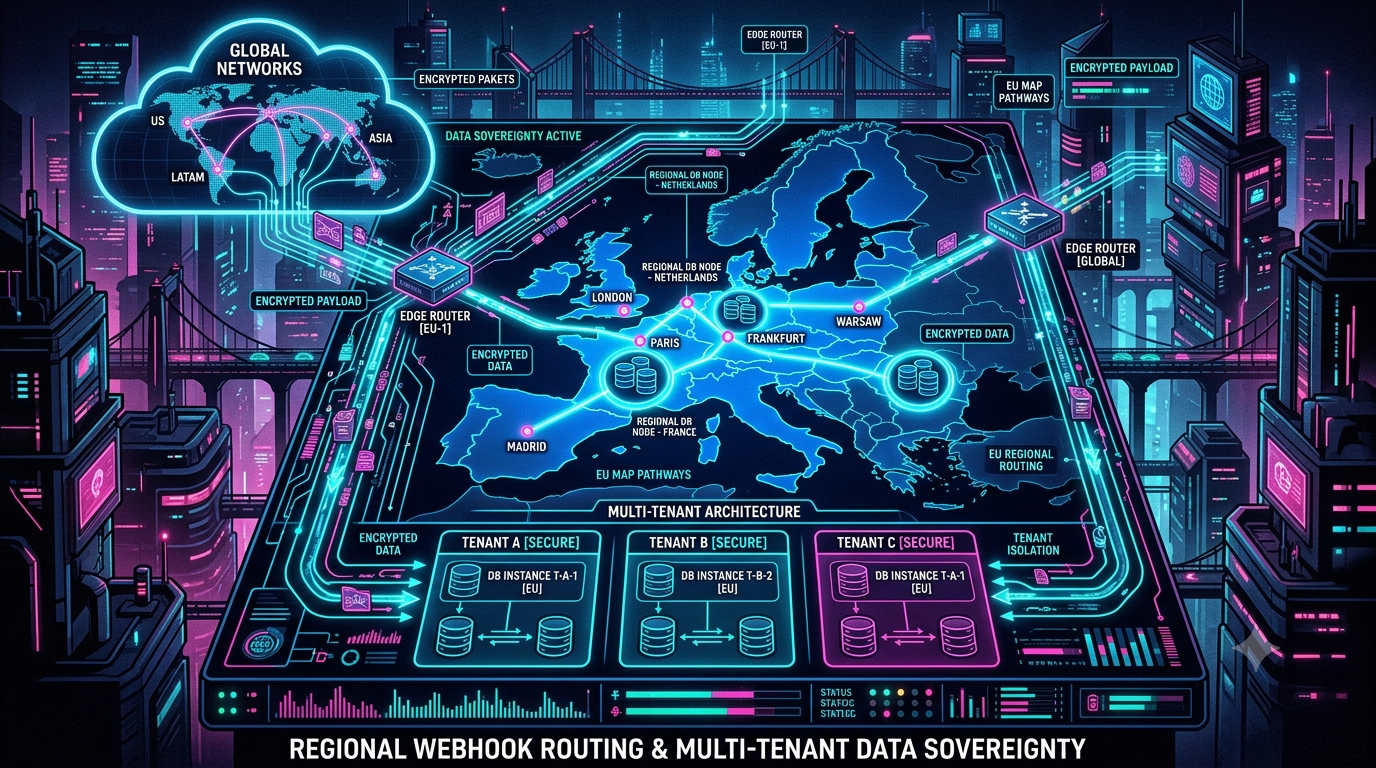
Multi-Tenant Data Sovereignty: Routing and Storing Regional Webhooks Securely
Executive Summary
Global SaaS platforms now operate under a growing patchwork of regional data rules: the EU's GDPR, Microsoft-style "data boundary" commitments that have become an industry pattern, California's CCPA/CPRA, and India's Digital Personal Data Protection (DPDP) Act, whose implementing rules were notified in November 2025 and are phasing in through May 2027. While primary application databases are increasingly sharded by region to meet these demands, inbound third-party webhooks remain a common blind spot.
When providers like Stripe, Shopify, GitHub, or Twilio deliver event notifications, they dispatch payload data to a single, developer-configured HTTP endpoint. If that endpoint sits on a centralized server in the US while the sender is describing an EU customer's subscription or address, personal data crosses a border and lands on disk before your application ever gets a chance to route it correctly.
This guide lays out an architecture for regional webhook routing and multi-tenant data residency: a stateless edge router, a non-PII tenant-lookup table, regional ingestion queues, and Bring-Your-Own-Database (BYODB) storage. It also corrects a few oversimplifications common in first-draft versions of this design — real webhook signature schemes, real edge-runtime constraints, and the current (and, in one case, actively contested) state of the regulations driving all of this — and points to platforms that have already shipped pieces of this architecture in production, so you're not building from a purely theoretical blueprint.
The Webhook Data Sovereignty Dilemma
Why Webhooks Break Traditional Data Residency Models
Modern SaaS applications lean heavily on event-driven integrations. When a customer completes checkout, updates billing, or triggers an authorization flow, a third-party service notifies your application via an HTTP POST webhook. A typical payload carries rich, unencrypted data:
{
  "id": "evt_3Mvw92LkdIw1582x1",
  "object": "event",
  "type": "customer.subscription.updated",
  "data": {
    "object": {
      "id": "sub_1039824",
      "customer": "cus_998124",
      "email": "jean.dupont@enterprise-client.fr",
      "billing_address": {
        "city": "Paris",
        "country": "FR",
        "line1": "15 Rue de la Paix"
      },
      "ip_address": "195.154.122.3"
    }
  }
}
Under GDPR, anything that can directly or indirectly identify a person — names, emails, IP addresses, customer IDs — is personal data, and Chapter V of the regulation (starting at Article 44) restricts moving it outside the EU/EEA without a valid transfer mechanism.
┌────────────────────────────────────────────────────────────────────────┐
│                        THE GLOBAL ENDPOINT TRAP                        │
└────────────────────────────────────────────────────────────────────────┘

 [Third-Party Provider]
   (Stripe / Shopify)
          │
          │ Sends POST to a single global endpoint:
          │ https://api.your-saas.com/v1/webhooks
          ▼
┌────────────────────────────────────────────────────────────────────────┐
│ Global Load Balancer (US-East-1)                                       │
└────────────────────────────────────────────────────────────────────────┘
          │
          │  ❌ PII lands and is written to a US disk
          │  ❌ Undermines an EU data-boundary or in-region storage commitment
          ▼
┌────────────────────────────────────────────────────────────────────────┐
│ Primary US Ingestion Queue & Central Database                          │
└────────────────────────────────────────────────────────────────────────┘
The Single-Endpoint Constraint
This is not a hypothetical: none of the major webhook senders — Stripe, Shopify, GitHub, Twilio — let you register a different delivery URL per customer region from within a single account. A provider has no concept of "Customer A is an EU enterprise whose data must stay in eu-central-1, Customer B is a US business in us-east-1." You get one URL (or one per event type), and it's on you to fan that out correctly once it arrives.
If your pipeline receives all inbound events at a central gateway, writes them to a central Kafka topic or SQS queue, and then dispatches to regional databases, the violation already happened: the data touched disk and existed, unencrypted, on the wrong side of a border before you ever inspected it.
One clarification worth making up front: CCPA/CPRA is not a data-localization law in the way GDPR's transfer restrictions or the EU Data Boundary are. It doesn't require California residents' data to stay in-state. It's a consumer-rights and disclosure regime — the right to know, delete, correct, and opt out of "sale" or "sharing" of personal information. It still matters for this architecture (a webhook payload sitting in the wrong region's audit log complicates a deletion or access request), but it belongs in a different bucket from GDPR- or DPDP-style residency mandates. Conflating the two leads teams to over- or under-build.
Architectural Blueprint: The 3-Tier Sovereign Webhook System
                               ┌───────────────────────────────────┐
                               │     Third-Party Webhook Sender     │
                               │  (Stripe, Shopify, Twilio, etc.)   │
                               └─────────────────┬───────────────────┘
                                                  │ HTTP POST
                                                  ▼
┌─────────────────────────────────────────────────────────────────────────────────────────────────┐
│ TIER 1: GLOBAL EDGE ROUTER (Zero-Storage Dispatcher)                                             │
│ (Cloudflare Workers / Fastly Compute / AWS CloudFront + Lambda@Edge)                              │
│                                                                                                    │
│  1. Verify the provider's signature in memory (scheme varies by provider — see below)             │
│  2. Read the tenant identifier (path segment, header, or a JSON field)                            │
│  3. Look up a non-PII tenant → region mapping                                                     │
│  4. Forward the request body to the correct regional ingress URL                                  │
└──────────────┬───────────────────────────────────────────────────┬──────────────────────────────┘
               │                                                    │
               ▼                                                    ▼
┌──────────────────────────────────────────────┐    ┌──────────────────────────────────────────────┐
│ TIER 2: EU REGIONAL INGESTION                 │    │ TIER 2: US REGIONAL INGESTION                 │
│ Region: eu-central-1 (Frankfurt)              │    │ Region: us-east-1 (Virginia)                  │
│  Regional API Gateway → Regional Queue        │    │  Regional API Gateway → Regional Queue        │
│  → Regional Ingestion Workers                 │    │  → Regional Ingestion Workers                 │
└──────────────────────┬─────────────────────────┘    └──────────────────────┬─────────────────────────┘
                       ▼                                                    ▼
┌──────────────────────────────────────────────┐    ┌──────────────────────────────────────────────┐
│ TIER 3: SOVEREIGN STORAGE & BYODB             │    │ TIER 3: SOVEREIGN STORAGE & BYODB             │
│  [EU Tenant DB]        [EU Customer BYODB]     │    │  [US Tenant DB]        [US Customer BYODB]    │
│  (CockroachDB / Aurora  (VPC / PrivateLink)     │    │  (Aurora Postgres)     (KMS-encrypted)        │
│   EU region)                                    │    │                                              │
└──────────────────────────────────────────────┘    └──────────────────────────────────────────────┘
Three decoupled tiers:
- Tier 1 — Global Edge Router: verifies the sender cryptographically, extracts a tenant identifier without persisting the payload to disk, resolves that tenant to a region, and proxies the request stream onward.
- Tier 2 — Regional Ingestion & Queue Ecosystem: lives strictly inside the customer's jurisdiction, accepts the proxied request, and enqueues it on a region-local broker.
- Tier 3 — Regional & BYO Database Storage: persists the payload either in a regional multi-tenant shard or writes it directly into an enterprise customer's own database via a BYODB connection.
Tier 1: Zero-Storage Edge Routing
Step 1: Signature Verification — and Why "One HMAC Scheme" Is a Myth
Every major webhook sender signs its payloads, but the schemes are not interchangeable, and treating them as one generic HMAC-SHA256(body, secret) check is the most common bug in edge routers like this. As of today:
| Provider | Header | Scheme |
|---|---|---|
| Stripe | Stripe-Signature | t=<unix_timestamp>,v1=<hex_sig> — the signed string is "{timestamp}.{raw_body}", HMAC-SHA256, hex-encoded. Stripe recommends rejecting timestamps older than a default 5-minute tolerance window as replay protection. |
| GitHub | X-Hub-Signature-256 | sha256=<hex_sig> — HMAC-SHA256 over the raw body only, no timestamp. |
| Shopify | X-Shopify-Hmac-SHA256 | Base64-encoded HMAC-SHA256 over the raw body (not hex). |
Stripe's own guidance is to use their SDK's constructEvent/Webhook.construct_event helpers rather than hand-rolling verification, precisely because the timestamp-tolerance replay check is easy to omit. If you're building a custom edge verifier (as this architecture requires, since Stripe's Node SDK isn't guaranteed to run in every edge runtime), implement the timestamped scheme explicitly rather than a generic hex comparison, and keep a small per-provider adapter table instead of one shared verification function.
Step 2: Extracting Tenant Metadata Without Disk Persistence
Two common approaches:
- URL path routing (preferred): the webhook URL registered with the provider embeds a tenant token —
https://api.your-saas.com/v1/webhooks/ingress/tn_tenant_882319. - Payload field lookup: for providers that only support one uniform URL, parse a top-level field (
metadata.tenant_id,account_id) once the body is in memory.
One accuracy note on the original version of this pattern: true zero-copy streaming parsing (reading a tenant ID before the full body arrives) is difficult to combine with signature verification, since HMAC verification needs the complete raw body anyway. In practice, edge workers buffer the body in in-memory/ephemeral request scope (not disk) and parse it there — which is the meaningful sovereignty boundary (memory vs. persistent storage), not "streaming vs. buffered."
Step 3: Non-PII Tenant Lookup
The router queries a lookup store — Cloudflare KV, Fastly Config Store, or a DynamoDB Global Table — that maps an anonymous tenant ID to a region and ingress URL, and nothing else:
tenant_882319 → {
  "region": "eu-central-1",
  "ingress_url": "https://eu-ingest.your-saas.com/v1/events",
  "byodb_enabled": true
}
A refinement worth making: don't assume this lookup table has to be globally replicated by default just because it's non-PII. Cloudflare's Workers KV, for example, now supports jurisdiction restrictions (an "EU jurisdiction" mode) that keep even non-sensitive key-value data pinned to EU infrastructure, as part of its broader Data Localization Suite. If your compliance team wants to minimize any metadata leaving a region — not just PII — this is available without giving up the edge-lookup pattern.
A Runtime Constraint the Original Design Glosses Over
AWS Lambda@Edge functions must be authored and deployed from us-east-1, even though they execute at edge locations globally — a control-plane detail that trips people up when they assume "Lambda@Edge" means fully region-agnostic deployment. It's also worth distinguishing Lambda@Edge from the newer, cheaper CloudFront Functions: CloudFront Functions run sub-millisecond JavaScript at the edge but cannot read request bodies or make outbound network calls, which rules them out for this design — you need Lambda@Edge's origin-request trigger (or a platform like Cloudflare Workers or Fastly Compute, which don't have this split) to do body-based HMAC verification and a KV lookup in the same hop.
Edge Router Reference Implementation
The following demonstrates the pattern on Cloudflare Workers, with Stripe's actual timestamped signature scheme rather than a generic HMAC check:
/**
 * Edge Webhook Regional Router
 * Runtime: Cloudflare Workers / V8 Edge Runtime
 */

interface Env {
  TENANT_REGION_KV: KVNamespace;   // Maps tenant_id -> region config (non-PII only)
  STRIPE_WEBHOOK_SECRET: string;   // Provider signing secret (whsec_...)
}

interface RegionConfig {
  targetRegion: string;
  ingressUrl: string;
}

const REPLAY_TOLERANCE_SECONDS = 300; // Stripe's own default tolerance

export default {
  async fetch(request: Request, env: Env): Promise<Response> {
    if (request.method !== 'POST') {
      return new Response('Method Not Allowed', { status: 405 });
    }

    const rawBody = await request.text();
    const sigHeader = request.headers.get('stripe-signature');

    const verification = await verifyStripeSignature(
      rawBody,
      sigHeader,
      env.STRIPE_WEBHOOK_SECRET
    );

    if (!verification.valid) {
      return new Response(`Invalid Signature: ${verification.reason}`, { status: 401 });
    }

    // Extract tenant ID from payload metadata (adjust per your onboarding contract)
    let tenantId: string | null = null;
    try {
      const payload = JSON.parse(rawBody);
      tenantId = payload.data?.object?.metadata?.tenant_id ?? null;
    } catch {
      return new Response('Malformed JSON Payload', { status: 400 });
    }

    if (!tenantId) {
      return new Response('Missing Tenant Identifier', { status: 422 });
    }

    const routeConfigJson = await env.TENANT_REGION_KV.get(`tenant:${tenantId}`);
    if (!routeConfigJson) {
      return new Response('Tenant Routing Not Configured', { status: 404 });
    }
    const routeConfig: RegionConfig = JSON.parse(routeConfigJson);

    const forwardHeaders = new Headers(request.headers);
    forwardHeaders.set('X-Routed-By', 'Edge-Sovereign-Router');

    const regionalResponse = await fetch(routeConfig.ingressUrl, {
      method: 'POST',
      headers: forwardHeaders,
      body: rawBody,
    });

    return new Response(regionalResponse.body, {
      status: regionalResponse.status,
      headers: regionalResponse.headers,
    });
  },
};

/**
 * Stripe's actual signature scheme: t=<timestamp>,v1=<hex_sig>
 * Signed string is "{timestamp}.{raw_body}", HMAC-SHA256, hex-encoded.
 * Timestamp tolerance provides replay protection.
 */
async function verifyStripeSignature(
  payload: string,
  header: string | null,
  secret: string
): Promise<{ valid: boolean; reason?: string }> {
  if (!header) return { valid: false, reason: 'missing header' };

  const parts = Object.fromEntries(
    header.split(',').map((kv) => kv.split('=') as [string, string])
  );
  const timestamp = parts['t'];
  const signature = parts['v1'];
  if (!timestamp || !signature) return { valid: false, reason: 'malformed header' };

  const age = Math.abs(Date.now() / 1000 - Number(timestamp));
  if (age > REPLAY_TOLERANCE_SECONDS) return { valid: false, reason: 'timestamp outside tolerance' };

  const signedPayload = `${timestamp}.${payload}`;
  const encoder = new TextEncoder();
  const key = await crypto.subtle.importKey(
    'raw',
    encoder.encode(secret),
    { name: 'HMAC', hash: 'SHA-256' },
    false,
    ['sign']
  );
  const sigBuffer = await crypto.subtle.sign('HMAC', key, encoder.encode(signedPayload));
  const computedHex = [...new Uint8Array(sigBuffer)]
    .map((b) => b.toString(16).padStart(2, '0'))
    .join('');

  return { valid: timingSafeEqualHex(computedHex, signature) };
}

function timingSafeEqualHex(a: string, b: string): boolean {
  if (a.length !== b.length) return false;
  let result = 0;
  for (let i = 0; i < a.length; i++) result |= a.charCodeAt(i) ^ b.charCodeAt(i);
  return result === 0;
}
Tier 2: Regional Webhook Ingestion & Queue Isolation
Once the edge router forwards the request to a regional ingress URL (e.g., https://eu-ingest.your-saas.com/v1/events), it enters the regional layer: a regional API Gateway enqueues the payload into a region-isolated broker — AWS SQS (regional), a single-region Kafka/Confluent cluster, RabbitMQ, or Redpanda in a regional Kubernetes cluster. Cross-region SQS replication or a global Kafka hub that syndicates event bodies back to a central analytics lake defeats the whole point.
                     ┌────────────────────────────────────────────────────────┐
                     │          TIER 2: REGIONAL ISOLATION (EU)                │
                     └────────────────────────────────────────────────────────┘
                                                │
                                                ▼
                                   ┌─────────────────────────┐
                                   │  Regional Ingress API   │
                                   └────────────┬────────────┘
                                                │
                                                ▼
                                   ┌─────────────────────────┐
                                   │ Regional Queue (SQS EU) │
                                   └────────────┬────────────┘
                                                │
                                                ▼
                                   ┌─────────────────────────┐
                                   │   Regional Consumer     │
                                   └────────────┬────────────┘
                          ┌─────────────────────┴─────────────────────┐
       (Success)          ▼                                (Failure)  ▼
┌───────────────────────────────────┐               ┌───────────────────────────────────┐
│ Write Payload to EU DB / BYODB     │               │ Regional Dead-Letter Queue (DLQ)  │
└───────────────────────────────────┘               └───────────────────────────────────┘
The Observability Leak Most Teams Miss
A frequent, quiet violation happens during error handling: when a regional worker throws, a default-configured Sentry, Datadog, or CloudWatch agent will happily capture the stack trace — raw webhook body included — and ship it to a centralized US logging bucket. To close this:
- Keep dead-letter queues regional; never forward failed payloads to a global triage queue.
- Scrub PII at the logger boundary — raw bodies, auth headers, emails — before anything leaves instance memory.
- Run OpenTelemetry collectors inside the local VPC to redact before export.
Tier 3: Regional Sharding vs. Bring-Your-Own-Database (BYODB)
Model A: Regional Tenant Sharding
Distributed databases such as CockroachDB, YugabyteDB, or Aurora Multi-Region support row- or table-level placement. CockroachDB's LOCALITY REGIONAL BY ROW is real, current syntax:
CREATE TABLE tenant_webhooks (
    id UUID NOT NULL DEFAULT gen_random_uuid(),
    tenant_id UUID NOT NULL,
    region_code VARCHAR(10) NOT NULL,
    event_type VARCHAR(100) NOT NULL,
    payload JSONB NOT NULL,
    created_at TIMESTAMPTZ NOT NULL DEFAULT now(),
    PRIMARY KEY (region_code, tenant_id, id)
) LOCALITY REGIONAL BY ROW AS region_code;

INSERT INTO tenant_webhooks (tenant_id, region_code, event_type, payload)
VALUES (
    '8c903910-1d8d-4f11-a89e-223120bc9182',
    'eu-central-1',
    'invoice.payment_succeeded',
    '{"amount": 4900, "currency": "eur", "email": "client@enterprise.de"}'
);
Model B: Enterprise BYODB
For regulated customers — finance, healthcare, defense — logical multi-tenant isolation isn't enough. The platform processes the webhook but writes the final payload into a database the customer owns, typically reached over AWS PrivateLink (private VPC-to-VPC, no public internet transit) or cross-account IAM role assumption with an external ID, with credentials pulled dynamically from a regional secrets vault:
/**
 * Dynamic BYODB Database Router & Ingestor
 * Executed inside a regional processing worker (eu-central-1)
 */
import { Client } from 'pg';
import { SecretsManagerClient, GetSecretValueCommand } from "@aws-sdk/client-secrets-manager";

interface BYODBCredentials {
  host: string;
  port: number;
  database: string;
  username: string;
  passwordSecretRef: string;
}

export class SovereignWebhookStorageService {
  private secretsClient: SecretsManagerClient;

  constructor(region: string) {
    this.secretsClient = new SecretsManagerClient({ region }); // stays inside the regional boundary
  }

  public async storeInBYODB(
    tenantId: string,
    eventId: string,
    eventType: string,
    payload: Record<string, any>
  ): Promise<void> {
    const config = await this.getTenantDatabaseConfig(tenantId);
    const secretValue = await this.secretsClient.send(
      new GetSecretValueCommand({ SecretId: config.passwordSecretRef })
    );

    const client = new Client({
      host: config.host, // e.g. an AWS PrivateLink VPC endpoint in the customer's account
      port: config.port,
      database: config.database,
      user: config.username,
      password: secretValue.SecretString,
      ssl: { rejectUnauthorized: true },
    });

    try {
      await client.connect();
      await client.query(
        `INSERT INTO customer_event_store.webhooks (id, event_type, raw_payload, received_at)
         VALUES ($1, $2, $3, NOW())`,
        [eventId, eventType, JSON.stringify(payload)]
      );
    } finally {
      await client.end();
    }
  }

  private async getTenantDatabaseConfig(tenantId: string): Promise<BYODBCredentials> {
    return {
      host: "vpce-0a8f921bc109a-eu-central-1.rds.amazonaws.com",
      port: 5432,
      database: "enterprise_sovereign_db",
      username: "saas_ingest_role",
      passwordSecretRef: `arn:aws:secretsmanager:eu-central-1:123456789012:secret:tenant-${tenantId}-byodb`,
    };
  }
}
Real-World Validation: Who's Already Building This
This architecture isn't purely theoretical — pieces of it map directly to products already shipping:
- Cloudflare Data Localization Suite. Regional Services lets you choose which data centers decrypt and process traffic for a given hostname; Customer Metadata Boundary controls where logs are stored; Workers KV and Durable Objects support jurisdiction tags so even non-PII lookup data can be pinned to a region. Cloudflare has continued extending this — a June 2026 update added "Regionalized IP Bindings" for BYOIP customers who address traffic by IP rather than hostname.
- Svix. A webhooks-as-a-service platform built for exactly the sending and, via its newer Svix Ingest product, the receiving side of this problem, with regional data residency across the US, EU, Canada, Australia, and India, and compliance coverage including SOC 2 Type II, HIPAA, GDPR, and CCPA. It's worth pointing to as evidence this is a well-defined, buy-or-build market segment, not a niche concern.
- Microsoft's EU Data Boundary. Completed in February 2025 after roughly two years of engineering work, it lets EU commercial and public-sector customers keep customer data and pseudonymized personal data for Microsoft 365, Dynamics 365, Power Platform, and most Azure services inside the EU/EFTA region — a large-scale, real precedent for the "region-pinned by default" posture this architecture targets, though Microsoft itself notes that in narrow security-response scenarios, data may still leave the boundary with additional safeguards.
- Salesforce Hyperforce. A ground-up move from proprietary hardware to AWS/Azure/GCP-based infrastructure-as-code, giving customers a choice of region (US, UK, Germany, India, Japan, and others) for where their org's data is stored and processed, plus out-of-region disaster recovery.
The Regulatory Landscape You're Actually Building Against (2026)
A few things worth being precise about, since the compliance case for this architecture is only as strong as the regulatory facts behind it:
- GDPR remains the anchor: Chapter V (from Article 44) restricts transfers of personal data outside the EU/EEA absent an adequacy decision or an appropriate safeguard (standard contractual clauses, binding corporate rules, etc.).
- India's DPDP Act is no longer a future concern — the Digital Personal Data Protection Rules, 2025 were notified on 13 November 2025, alongside the establishment of the Data Protection Board of India. Compliance and enforcement provisions phase in over 18 months, with the Consent Manager framework live from 13 November 2026 and full enforcement targeted for 13 May 2027. If you sell into India, the clock is now running, not hypothetical.
- CCPA/CPRA, as noted above, is a consumer-rights regime, not a localization mandate — don't architect for it the same way you architect for GDPR or DPDP.
- The EU-US Data Privacy Framework — the mechanism many companies lean on instead of building region-pinned architecture — is less stable than it looks. It survived its first direct legal challenge when the EU General Court upheld it in September 2025, but that ruling is now on appeal to the Court of Justice of the EU. More pointedly, in July 2026 the European Data Protection Board formally asked the European Commission to examine whether a US Supreme Court ruling on FTC commissioner independence (Trump v. Slaughter) undermines the oversight structure the DPF's adequacy decision depends on. Nothing has been suspended, but the direction of travel — this is the third framework in a row to face this kind of challenge, after Safe Harbor and Privacy Shield were both struck down — is exactly why architecture that keeps data in-region by construction, rather than relying on a transfer mechanism that regulators are actively re-examining, is the more durable bet for anything genuinely sensitive.
None of this is cause for alarm, but it's a reasonable reason to treat "we rely on the DPF" as a temporary answer rather than a permanent one when a customer's data residency clause is on the line.
Architectural Comparison Matrix
| Dimension | Centralized Global Ingestion | Edge-Routed Regional Ingestion | Enterprise BYODB |
|---|---|---|---|
| GDPR / residency compliance | ❌ Cross-border spills | ✅ In-region processing & storage | ✅ Zero vendor-side storage |
| Ingestion latency | High for distant customers | Minimal at the edge | Minimal at edge + PrivateLink write |
| Data isolation | Shared global tables | Regional multi-tenant sharding | Full physical VPC isolation |
| Infrastructure complexity | Low | Moderate | High |
| Third-party integration | Native, single URL | Native, routed at the edge | Native, routed to customer VPC |
| Blast radius of a breach | Global | Regional | Single tenant |
Implementation Checklist
 [1] Map all inbound webhook sources and catalog every PII field
 [2] Deploy an edge router with zero-storage proxying rules
 [3] Implement provider-specific signature verification at the edge (don't genericize schemes)
 [4] Build a non-PII, optionally jurisdiction-pinned tenant → region lookup table
 [5] Provision region-isolated queues (SQS/Kafka) per compliance zone
 [6] Configure local DLQs and PII-scrubbing rules for telemetry
 [7] Deploy regional DB shards or BYODB PrivateLink connections
 [8] Audit end-to-end sovereignty and update DPAs to reflect actual routing behavior
Conclusion
Data residency law has turned naive, single-region event pipelines into genuine compliance risk — and the regulatory ground under the alternative (relying on cross-border transfer mechanisms like the EU-US DPF) is shifting in real time as this is being written. Edge routers that verify signatures and resolve tenant-to-region mappings in memory, paired with regional queues and BYODB storage, give you a defensible answer: payload data never touches unauthorized disk. Products from Cloudflare, Svix, Microsoft, and Salesforce show this isn't a speculative pattern — it's an increasingly standard expectation from enterprise buyers, and one worth building for correctly rather than approximately.
Sources
- Microsoft: EU Data Boundary completion announcement
- India DPDP Rules 2025 notification timeline
- DPDP Rules 2025 / 2026 compliance milestones
- EDPB letter questioning EU-US DPF oversight foundation, July 2026
- EU-US DPF survives first judicial challenge, September 2025
- Stripe webhook signature verification reference
- Cloudflare Data Localization Suite
- Cloudflare Regionalized IP Bindings changelog, June 2026
- CloudFront Functions vs. Lambda@Edge
- Svix — webhooks-as-a-service, regional data residency
- Salesforce Hyperforce data residency overview
- CPRA enforcement timeline background