Integrating Legacy XML/SOAP Systems with Modern JSON Webhook Infrastructure
Integrating Legacy XML/SOAP Systems with Modern JSON Webhook Infrastructure Executive Summary & Architecture Overview Modern SaaS platforms — Stripe, Shopify, GitHub, Salesforce...
Integrating Legacy XML/SOAP Systems with Modern JSON Webhook Infrastructure
Executive Summary & Architecture Overview
Modern SaaS platforms — Stripe, Shopify, GitHub, Salesforce, and most others — rely heavily on JSON-based webhooks to stream real-time events. These HTTP callbacks push updates instantly, enabling reactive, event-driven architectures.
However, many established enterprise backends (legacy SAP deployments, on-premise Oracle ERPs, mainframes, or bespoke internal services) still rely on XML, SOAP, or EDI formats. SOAP hasn't disappeared the way REST advocates predicted a decade ago — it remains common in banking, insurance, telecom, healthcare, and government systems precisely because those industries prioritize strict contracts, transactional guarantees, and compliance mandates over the flexibility that made REST/JSON popular elsewhere.
That persistence creates two distinct integration challenges:
- Legacy systems are unable to natively parse inbound JSON payloads or handle dynamic HTTP push callbacks.
- They're architected around synchronous, heavy transactional models with strict concurrency limits and cannot handle the bursty nature of modern webhook triggers.
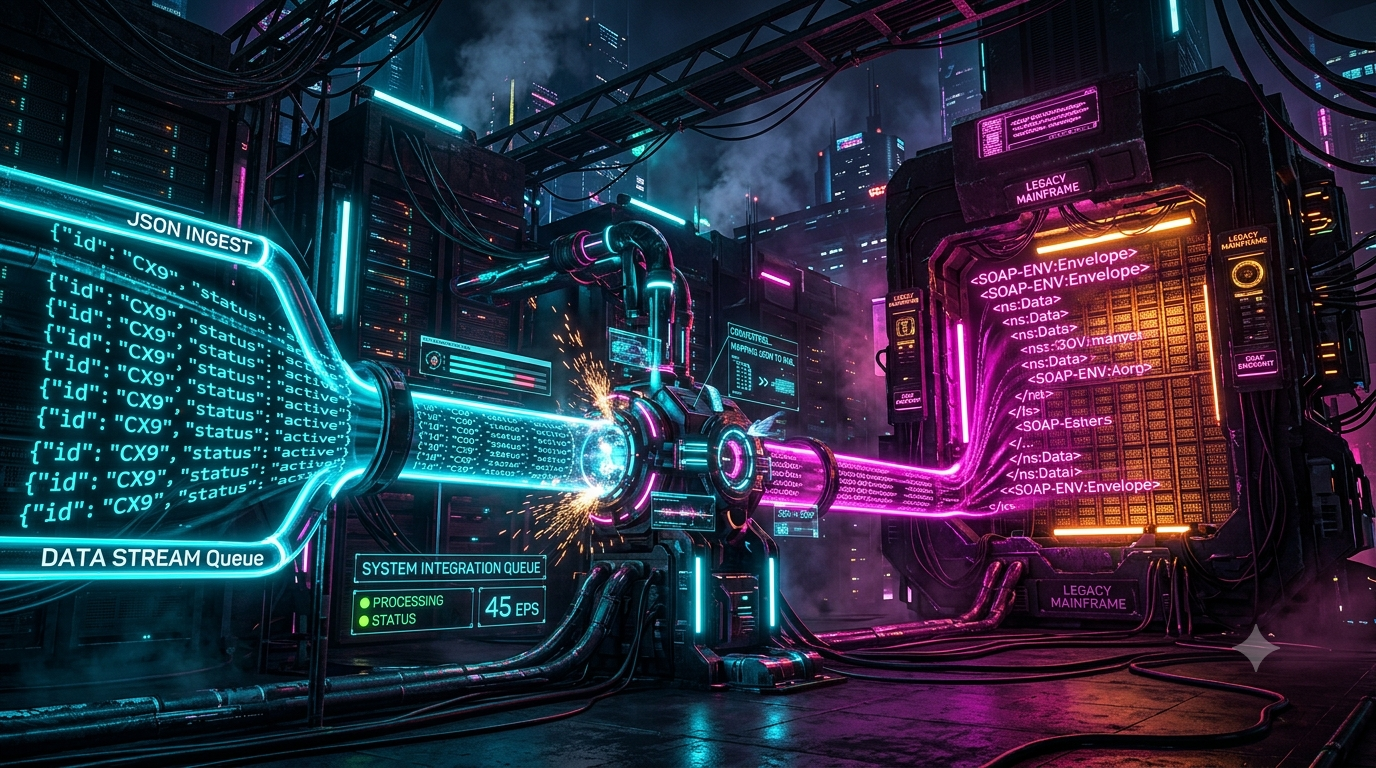
To bridge this gap without rewriting core enterprise infrastructure, engineering teams implement an Anti-Corruption Layer (ACL). This architecture ingests high-frequency JSON webhooks, queues them durably in a message broker, transforms JSON payloads into valid SOAP envelopes or XML structures, and trickles requests into legacy SOAP endpoints at controlled concurrency rates.
The Core Impedance Mismatches
Connecting modern JSON event streams to legacy enterprise systems involves overcoming four fundamental engineering challenges:
| Architectural Metric | Modern JSON Webhook Stream | Legacy SOAP / XML Enterprise System |
|---|---|---|
| Payload Structure | Lightweight JSON, flexible schema, key-value trees | Strictly typed XML, WSDL contract, mandatory XML namespaces |
| Delivery Mechanism | Asynchronous HTTP POST push (at-least-once) | Synchronous HTTP/HTTPS request-response, WS-Addressing |
| Concurrency & Volume | High burstiness (thousands of events per second) | Low concurrency thresholds (5–20 concurrent connections max) |
| Authentication | HMAC signatures (X-Hub-Signature), bearer tokens | WS-Security (wsse:Security), mTLS, XML digital signatures |
| Fault Tolerance | Expects HTTP 200/202 ACK within < 2 seconds | Processing times can span 1,000ms–10,000ms per transaction |
Directly exposing a legacy SOAP API endpoint to third-party JSON webhooks leads to predictable failure modes:
- Connection exhaustion — a sudden traffic spike from a third-party event stream can overwhelm the limited thread pool of an application server running a legacy SOAP service.
- Payload incompatibility — legacy XML parsers reject JSON payloads immediately, resulting in HTTP 400 or 500 responses.
- Rate-limit bans — webhook providers flag unacknowledged or timed-out requests as failed and eventually disable the webhook subscription entirely.
To resolve these issues, you need an event-driven middleware bridge that acts as both a protocol adapter and a concurrency buffer.
Architectural Blueprint: The Transformation Layer
The recommended architecture isolates the legacy system behind a resilient middleware pipeline built on four core components:
[ Third-Party SaaS ]
         │ (HTTP POST - JSON Webhook)
         ▼
┌────────────────────────────────────────────────────────┐
│ 1. Ingestion Layer (Fast API Gateway / Ingress Edge)   │
│    - Verifies HMAC signatures                          │
│    - Fast ACK (HTTP 202 Accepted < 50ms)                │
└────────────────────────┬───────────────────────────────┘
                          │ (Raw JSON Event)
                          ▼
┌────────────────────────────────────────────────────────┐
│ 2. Durable Buffer Layer (Queue / Message Broker)        │
│    - SQS / RabbitMQ / Redis BullMQ / Kafka              │
│    - Persistent Storage & Dead-Letter Queue (DLQ)       │
└────────────────────────┬───────────────────────────────┘
                          │ (Decoupled Stream)
                          ▼
┌────────────────────────────────────────────────────────┐
│ 3. Worker Transformation Engine                         │
│    - JSON Parsing & Schema Normalization                │
│    - XML Building & SOAP Envelope Wrapping               │
│    - WS-Security Headers & Authentication Insertion      │
└────────────────────────┬───────────────────────────────┘
                          │ (Rate-Controlled SOAP XML)
                          ▼
┌────────────────────────────────────────────────────────┐
│ 4. Rate-Limited Dispatcher (Leaky Bucket / Worker)       │
│    - Strict Concurrency Pooling (e.g., max 5 requests)   │
│    - Exponential Backoff & Retry Logic                   │
└────────────────────────┬───────────────────────────────┘
                          │ (Synchronous SOAP Request)
                          ▼
[ Legacy ERP / SOAP System ]
Component functions:
- Ingress Ingestion Layer — receives the raw HTTP POST request, validates the cryptographic signature (HMAC-SHA256) sent by the webhook provider, and immediately returns an HTTP 202 Accepted response. Processing happens asynchronously to ensure zero dropped webhooks.
- Durable Message Broker — stores incoming events in a message queue (AWS SQS, RabbitMQ, Kafka, or Redis-backed BullMQ). This absorbs sudden traffic bursts and decouples the webhook source from your internal backend.
- Transformation Engine — a stateless worker pool that reads JSON payloads, maps data fields, converts types, and constructs valid, namespace-compliant XML SOAP envelopes.
- Throttled Dispatcher — executes requests against the legacy SOAP API while adhering strictly to predefined rate limits, thread pools, and mTLS/WS-Security requirements.
Step-by-Step Implementation Guide
Below is a working implementation pattern using Node.js, TypeScript, Express, and BullMQ/Redis.
Step 1: Secure Ingestion and Instant Acknowledgement
The ingestion endpoint validates the webhook signature, pushes the raw body into a queue, and returns an instant acknowledgment.
// ingress-server.ts
import express, { Request, Response } from 'express';
import crypto from 'crypto';
import { Queue } from 'bullmq';

const app = express();
// Capture raw body buffer for HMAC validation
app.use(express.json({
  verify: (req: any, _res, buf) => {
    req.rawBody = buf;
  }
}));

const webhookQueue = new Queue('legacy-soap-transform-queue', {
  connection: { host: 'localhost', port: 6379 }
});

const WEBHOOK_SECRET = process.env.WEBHOOK_SECRET || 'supersecretkey';

function verifyHmacSignature(req: any): boolean {
  const signature = req.headers['x-hub-signature-256'] as string;
  if (!signature) return false;

  const hmac = crypto.createHmac('sha256', WEBHOOK_SECRET);
  const digest = 'sha256=' + hmac.update(req.rawBody).digest('hex');
  return crypto.timingSafeEqual(Buffer.from(signature), Buffer.from(digest));
}

app.post('/api/v1/webhooks/orders', async (req: Request, res: Response) => {
  // 1. Verify request integrity
  if (!verifyHmacSignature(req)) {
    return res.status(401).json({ error: 'Invalid signature verification' });
  }

  // 2. Queue payload for asynchronous processing
  await webhookQueue.add('order_created_event', {
    eventId: req.headers['x-request-id'] || crypto.randomUUID(),
    receivedAt: new Date().toISOString(),
    payload: req.body
  }, {
    attempts: 5,
    backoff: { type: 'exponential', delay: 2000 },
    removeOnComplete: true
  });

  // 3. Immediately acknowledge reception (<50ms)
  return res.status(202).json({ status: 'ACCEPTED', queued: true });
});

app.listen(3000, () => console.log('Webhook Ingress Server listening on port 3000'));
2026 update — a standard is emerging for this layer. The bespoke
X-Hub-Signature-256pattern above (popularized by GitHub and Stripe) still works fine, but a community effort called Standard Webhooks — backed by companies including Zapier, Twilio, Lob, and Mux — now defines a common set of headers (webhook-id,webhook-timestamp,webhook-signature) and an HMAC-SHA256 verification scheme with a five-minute replay-tolerance window, with maintained reference libraries for TypeScript, Python, Go, Java/Kotlin, and Rust. Newer providers (Svix-backed platforms, Clerk, and others) are adopting it directly. If you're designing a new ingestion contract in 2026 rather than matching an existing provider's format, it's worth adopting Standard Webhooks instead of a bespoke header scheme — it saves you from re-solving signature verification, secret rotation, and timestamp tolerance yourself.
Step 2: The Payload Transformation Layer (JSON to SOAP XML)
Legacy SOAP services require precise XML formatting, including strict namespace definitions (xmlns), outer SOAP envelopes, and structured bodies.
Sample inbound JSON webhook payload:
{
  "event": "order.created",
  "data": {
    "order_id": "ORD-99281",
    "customer": {
      "id": "CUST-402",
      "email": "customer@example.com"
    },
    "amount": 249.99,
    "currency": "USD"
  }
}
Transformation utility code:
// transformer.ts
import { Builder } from 'xml2js';

interface OrderEvent {
  order_id: string;
  customer: { id: string; email: string };
  amount: number;
  currency: string;
}

export function buildSoapRequestEnvelope(eventData: OrderEvent, wsToken: string): string {
  const builder = new Builder({
    xmldec: { version: '1.0', encoding: 'UTF-8' },
    renderOpts: { pretty: false }
  });

  const soapObject = {
    'soapenv:Envelope': {
      $: {
        'xmlns:soapenv': 'http://schemas.xmlsoap.org/soap/envelope/',
        'xmlns:erp': 'http://legacy.enterprise.com/erp/orders'
      },
      'soapenv:Header': {
        'wsse:Security': {
          $: {
            'xmlns:wsse': 'http://docs.oasis-open.org/wss/2004/01/oasis-200401-wss-wssecurity-secext-1.0.xsd'
          },
          'wsse:UsernameToken': {
            'wsse:Username': 'SERVICE_USER_WEBHOOK',
            'wsse:Password': wsToken
          }
        }
      },
      'soapenv:Body': {
        'erp:CreateOrderRequest': {
          'erp:ExternalOrderId': eventData.order_id,
          'erp:CustomerId': eventData.customer.id,
          'erp:CustomerEmail': eventData.customer.email,
          'erp:TotalAmount': eventData.amount.toFixed(2),
          'erp:CurrencyCode': eventData.currency
        }
      }
    }
  };

  return builder.buildObject(soapObject);
}
Resulting outbound SOAP XML request:
<?xml version="1.0" encoding="UTF-8"?>
<soapenv:Envelope xmlns:soapenv="http://schemas.xmlsoap.org/soap/envelope/" xmlns:erp="http://legacy.enterprise.com/erp/orders">
  <soapenv:Header>
    <wsse:Security xmlns:wsse="http://docs.oasis-open.org/wss/2004/01/oasis-200401-wss-wssecurity-secext-1.0.xsd">
      <wsse:UsernameToken>
        <wsse:Username>SERVICE_USER_WEBHOOK</wsse:Username>
        <wsse:Password>token_secret_value</wsse:Password>
      </wsse:UsernameToken>
    </wsse:Security>
  </soapenv:Header>
  <soapenv:Body>
    <erp:CreateOrderRequest>
      <erp:ExternalOrderId>ORD-99281</erp:ExternalOrderId>
      <erp:CustomerId>CUST-402</erp:CustomerId>
      <erp:CustomerEmail>customer@example.com</erp:CustomerEmail>
      <erp:TotalAmount>249.99</erp:TotalAmount>
      <erp:CurrencyCode>USD</erp:CurrencyCode>
    </erp:CreateOrderRequest>
  </soapenv:Body>
</soapenv:Envelope>
2026 update — swap
xml2jsforfast-xml-parser.xml2jsstill works, but it has fallen behind: it has no built-in streaming support and community discussion around it has quieted, with several teams publicly noting they've moved off it.fast-xml-parseris the more actively maintained option today — it ships ESM builds (since v5.0, released early 2025), has an integratedXMLBuilder, sees tens of millions of weekly downloads, and is still receiving regular releases. A drop-in equivalent for the builder above looks like this:Code exampleimport { XMLBuilder } from 'fast-xml-parser'; const builder = new XMLBuilder({ ignoreAttributes: false, attributeNamePrefix: '@_', format: false }); const xmlPayload = builder.build({ '?xml': { '@_version': '1.0', '@_encoding': 'UTF-8' }, 'soapenv:Envelope': { '@_xmlns:soapenv': 'http://schemas.xmlsoap.org/soap/envelope/', '@_xmlns:erp': 'http://legacy.enterprise.com/erp/orders', // ...header and body as before, using '@_' for attributes } });Either library gets the job done for occasional envelope-building; if you're validating output against a strict WSDL/XSD, it's worth adding a schema-validation pass regardless of which builder you use, since neither performs XSD validation on its own.
Step 3: Throttled Dispatcher & Concurrency Control
To protect legacy enterprise systems from performance degradation, worker instances should process queue items with concurrency throttling and rate limiting.
// worker.ts
import { Worker, Job } from 'bullmq';
import axios from 'axios';
import { buildSoapRequestEnvelope } from './transformer';

const LEGACY_SOAP_ENDPOINT = 'https://erp-internal.enterprise.local/soap/OrderService';

// Configure worker concurrency to prevent overloading the legacy server
const worker = new Worker('legacy-soap-transform-queue', async (job: Job) => {
  const { payload } = job.data;

  // 1. Convert JSON to SOAP XML envelope
  const xmlPayload = buildSoapRequestEnvelope(payload.data, process.env.ERP_SOAP_PASS || '');

  // 2. Dispatch with strict timeouts
  try {
    const response = await axios.post(LEGACY_SOAP_ENDPOINT, xmlPayload, {
      headers: {
        'Content-Type': 'text/xml;charset=UTF-8',
        'SOAPAction': 'http://legacy.enterprise.com/erp/orders/CreateOrder'
      },
      timeout: 10000 // 10-second request timeout limit
    });

    // Parse legacy XML response for fault elements
    if (response.data.includes('<soapenv:Fault>')) {
      throw new Error(`SOAP Application Error: ${response.data}`);
    }

    console.log(`[Job ${job.id}] Successfully dispatched to legacy SOAP API`);
    return { status: 'SUCCESS' };

  } catch (error: any) {
    console.error(`[Job ${job.id}] Delivery Failed: ${error.message}`);
    // Re-throw error to trigger BullMQ exponential backoff retry mechanism
    throw error;
  }
}, {
  connection: { host: 'localhost', port: 6379 },
  // RESTRICT CONCURRENCY: Maximum 5 parallel HTTP connections to the legacy backend
  concurrency: 5,
  limiter: {
    max: 20,
    duration: 1000 // Rate limit: Max 20 calls per second
  }
});
2026 update — BullMQ has moved forward. BullMQ 5.x is now on the 5.7x line and remains the de-facto Redis-backed job queue for Node.js. Recent releases added native OpenTelemetry tracing,
FlowProducerfor DAG-style job dependencies (useful if a single webhook event needs to fan out into several dependent SOAP calls), and refinedattemptsMadevs.attemptsStartedsemantics for cleaner retry bookkeeping. If you're standing this up fresh, pin a current 5.7x release and consider wiring in the OpenTelemetry exporter from day one — tracing a request fromX-Request-Idthrough the queue and into the SOAP call is the single biggest debugging win in this kind of pipeline.An alternative worth evaluating: durable execution engines. Where BullMQ gives you a queue plus manual retry/backoff logic, a durable-execution platform like Temporal models the whole "wait for ack, retry with backoff, eventually give up" sequence as ordinary code that survives process and server restarts — the workflow resumes exactly where it left off rather than replaying from a queue message. Temporal specifically documents this "delayed callback" pattern for HTTP webhook integrations, including inbound signal-based intake and outbound retryable HTTP activities. For a simple one-hop JSON-to-SOAP bridge, BullMQ is usually the simpler and cheaper choice; for pipelines with multi-step sagas, long waits (hours to days), or compensating transactions if the SOAP call partially succeeds, Temporal's durable-timer and workflow-history model removes a lot of the bookkeeping you'd otherwise hand-roll.
Reliability, Security & Error Handling Strategies
Integrating modern event streams into legacy enterprise architectures requires dedicated handling for security, retries, and data consistency.
1. Idempotency & Deduplication
Because webhooks use at-least-once delivery, duplicate events will occur. Many legacy SOAP endpoints do not support built-in idempotency keys.
To prevent duplicate processing:
- Extract the unique event ID or transaction ID from the inbound JSON payload (e.g.,
evt_3Mtw2eLkd...). - Store the event ID in a distributed cache (such as Redis) with a 24–48 hour TTL before calling the SOAP endpoint.
- If a duplicate event ID arrives, acknowledge it immediately without submitting another transaction to the legacy backend.
Incoming Webhook ──► Check Key in Redis? ─┬─► Yes ──► Skip Processing & ACK 200
                                           └─► No  ──► Lock Key ──► Process SOAP Request
2026 update — this is becoming a formal HTTP standard. The IETF's HTTPAPI working group has an active Internet-Draft,
draft-ietf-httpapi-idempotency-key-header, standardizing a dedicatedIdempotency-Keyrequest header for exactly this purpose: making non-idempotent methods like POST fault-tolerant across retries. It's still a draft (not yet an RFC as of early 2026), so don't treat it as guaranteed-stable, but it's a good signal of where deduplication conventions are heading — and adopting the header name now costs nothing and makes your ingestion layer forward-compatible with clients that already send it (Stripe and several other providers have used this pattern for years).
2. Handling SOAP Faults vs. Network Failures
Legacy SOAP APIs sometimes return an HTTP 200 OK status code even for application-level errors, wrapping the error inside a <soapenv:Fault> payload.
Your transformation layer must inspect the response payload for structural faults:
- Transient errors (HTTP 502/503, timeout, database lock) — the worker should throw an exception to trigger an automated retry with exponential backoff and jitter.
- Deterministic errors (XML validation failure, invalid business key, malformed schema) — retrying will not fix these. Move the message directly to a Dead-Letter Queue (DLQ) and notify the integration team.
                  ┌──────────────────────────────┐
                  │ Evaluate Legacy SOAP Response │
                  └──────────────┬───────────────┘
                                 │
         ┌───────────────────────┴───────────────────────┐
         ▼                                                ▼
[ HTTP 200 + <soapenv:Fault> ]                  [ Network Timeout / 503 ]
         │                                                │
         ▼                                                ▼
Deterministic / Schema Error                    Transient Infrastructure Failure
         │                                                │
         ▼                                                ▼
Route directly to Dead-Letter Queue (DLQ)       Retry with Exponential Backoff + Jitter
3. Authentication & Credential Translation
Inbound JSON webhooks typically authenticate using bearer tokens or HMAC signatures in HTTP headers. Legacy enterprise backends, by contrast, often require older security patterns:
- WS-Security (WSS) — username tokens, nonce hashes, and timestamp elements injected directly into the XML
<soapenv:Header>. - Mutual TLS (mTLS) — client certificates configured at the transport layer of the outbound worker node.
- IP whitelisting — static egress IPs routed through a NAT Gateway for on-premise firewall traversal.
The middleware bridge acts as a credential translator, validating incoming SaaS signatures at the edge and injecting required enterprise credentials during XML compilation.
Technology Selection: Middleware vs. iPaaS vs. Custom Engine
Depending on your enterprise architecture, several patterns exist for implementing this transformation layer:
                  ┌───────────────────────────────────────────────┐
                  │ How complex are your transformation rules,     │
                  │ rate limits, and compliance constraints?       │
                  └───────────────────────┬───────────────────────┘
                                           │
                  ┌────────────────────────┴───────────────────────┐
                  ▼                                                 ▼
       [ High-Volume / Custom ]                          [ Enterprise Integration ]
                  │                                                 │
                  ▼                                                 ▼
┌───────────────────────────────────┐             ┌───────────────────────────────────┐
│ Custom Microservice Middleware     │             │ Enterprise Integration / iPaaS     │
│ (Node.js, Go, Rust, BullMQ/SQS,    │             │ (MuleSoft, Apache Camel, Boomi)    │
│  or Temporal for durable workflow) │             │                                     │
├───────────────────────────────────┤             ├───────────────────────────────────┤
│ • Ultra-low latency                │             │ • Low-code interface                │
│ • Fine-grained rate limits         │             │ • Pre-built WSDL parsers            │
│ • Custom pipeline tests            │             │ • Out-of-the-box governance          │
└───────────────────────────────────┘             └───────────────────────────────────┘
| Strategy | Recommended Tools | Advantages | Disadvantages |
|---|---|---|---|
| Custom Microservice Middleware | Node.js, Go, Python, BullMQ, AWS SQS, Temporal | Complete control over rate limiting, lower operational cost at scale, easily testable | Requires maintenance of custom application code |
| Enterprise Integration Engine (ESB / iPaaS) | Apache Camel, MuleSoft Anypoint, Dell Boomi | Native WSDL parsers, drag-and-drop transformation, enterprise governance compliance | Higher licensing costs, vendor lock-in, potential performance overhead |
| Cloud-Native Serverless Pipeline | AWS EventBridge, Lambda, SQS, API Gateway | Zero server maintenance, automatic scaling, pay-per-use model | Cold starts, configuration complexity for strict connection pooling |
2026 update — the iPaaS market has kept consolidating, and the "serverless" row has a purpose-built feature now.
- The iPaaS market is projected to exceed $17 billion by 2028, and Dell Boomi was named a Leader in Gartner's Magic Quadrant for iPaaS for the 11th consecutive year in 2025, alongside MuleSoft (Salesforce-owned since 2018), which continues to lean on its API-led connectivity model and Anypoint connector ecosystem for exactly this kind of SOAP/legacy bridging work.
- If you're leaning toward the serverless row, look specifically at EventBridge API destinations rather than a raw Lambda/SQS combination: API destinations have a built-in
invocationRateLimitPerSecondsetting, enforced with a token-bucket algorithm, that throttles outbound calls to an HTTP(S) endpoint directly at the platform level — which is effectively the "Throttled Dispatcher" component from the architecture above, without you writing the concurrency-limiting code yourself. It won't build your SOAP envelope for you (that transformation still happens in a Lambda upstream of the API destination), but it removes one whole component from the custom build.
Production Readiness Checklist
Before deploying your JSON-to-SOAP integration bridge to production, verify the following operational safeguards:
- Cryptographic Verification — inbound endpoints validate webhook signatures using strict time-constant comparison to prevent timing attacks (whether via a custom HMAC scheme or the Standard Webhooks convention).
- Stateless Ingestion ACK — ingress nodes return an HTTP 202 Accepted status code immediately after enqueuing payloads.
- Rate Limiting & Concurrency Controls — worker threads (or your EventBridge API destination) are restricted to a maximum parallel connection count that matches the legacy system's capacity limits.
- XML Namespace Validation — XML output is strictly validated against the target system's WSDL/XSD schema definitions.
- Dead-Letter Queue (DLQ) — messages failing after maximum retry attempts are captured in a DLQ with automated alerting.
- Idempotency Safeguards — event unique identifiers are cached (or carried via an
Idempotency-Key-style header) to prevent duplicate processing from webhook retries. - Monitoring & Tracing — distributed tracing headers (such as
traceparentorX-Correlation-ID) are passed from inbound JSON headers into XML SOAP headers for end-to-end visibility, ideally exported via OpenTelemetry. - Dependency Currency — XML libraries, queue clients, and SDKs are pinned to actively maintained, current major versions rather than long-abandoned forks.
Conclusion
Integrating modern event-driven JSON webhooks with legacy SOAP and XML infrastructure requires balancing two different architectural models. Attempting to connect these systems directly exposes legacy enterprise endpoints to unexpected traffic bursts, connection limits, and payload incompatibilities.
By establishing an Anti-Corruption Integration Layer — built around fast ingestion, durable queueing, XML transformation, and rate-limited dispatching — organizations can leverage modern event-driven SaaS capabilities while preserving the stability of core enterprise legacy systems. The core pattern hasn't changed; what's shifted in the last year is that more of it is becoming standardized (Standard Webhooks, the IETF idempotency-key draft) or available as a managed building block (EventBridge API destinations, durable-execution platforms like Temporal), which means less of this pipeline needs to be hand-rolled than it did even a couple of years ago.
Further Reading & Sources
- Standard Webhooks specification
- IETF Idempotency-Key HTTP header draft
- AWS EventBridge — create an API destination (rate limiting)
- AWS EventBridge quotas
- Temporal — Delayed Callback (Webhooks) design pattern
- fast-xml-parser (GitHub)
- Boomi named a Leader in the 2025 Gartner Magic Quadrant for iPaaS
- Boomi: Application Integration Trends for 2025