High-Performance Webhook Architecture: Scaling Ingress, Partitioning Queues, and Neutralizing Poison Pills
Learn how horizontal database partitioning and multi-tenant isolation prevent slow consumers from clogging your webhook intake pipelines. Scale your event-driven ingestion today.
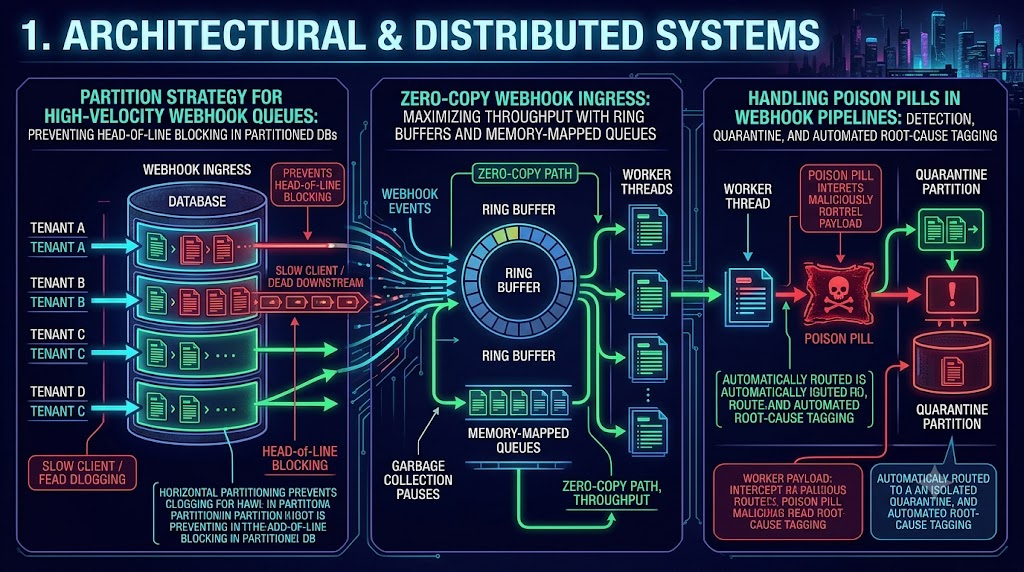
High-Performance Webhook Architecture: Scaling Ingress, Partitioning Queues, and Neutralizing Poison Pills
Webhooks drive asynchronous, event-driven integrations between microservices, SaaS vendors, and enterprise customers. At millions of events per day, the usual failure modes are a slow downstream consumer, a burst from one tenant, or a malformed payload that keeps crashing workers. Any of these can turn a local problem into a platform-wide one.
This guide covers three pillars of a resilient webhook pipeline:
- Partitioning and fair scheduling to contain noisy tenants and head-of-line blocking.
- Low-allocation ingress, meaning ring buffers and zero-copy techniques, plus what they can and cannot deliver.
- Poison pill detection and quarantine, using dead-letter queues, bounded retries, and safe replay.
The patterns apply to a webhook platform that receives events and fans them out to tenant endpoints. Where a technique applies only to inbound traffic or only to outbound delivery, the text says so.
1. Partition Strategy: Containing Noisy Tenants and Head-of-Line Blocking
The head-of-line blocking problem
In a multi-tenant pipeline, events are written to a queue or table and then picked up by workers. When all tenants share one global queue, a single slow tenant becomes a problem. If workers stall on its slow endpoint, they hold connections, threads, and in-flight slots, and healthy tenants wait behind them. This is head-of-line (HoL) blocking, a close relative of the “noisy neighbor” problem.
Senders impose their own deadlines, so the cost of being slow is real. GitHub, for example, expects a 2xx response within 10 seconds, treats a slower response as a failed delivery, and recommends queueing payloads and processing them asynchronously. Stripe tells receivers to return a successful status quickly and defer complex logic.
Partitioning helps, but it is not a complete fix
Partitioning by tenant (or by a hash of the tenant ID) narrows the blast radius, but two caveats apply:
- Hash partitioning still co-locates tenants. If tenants 17 and 902 hash to the same partition, one slow tenant still delays the other. In a classic Kafka consumer group, each partition is assigned to exactly one consumer in the group, so a stalled consumer stalls everything on its partitions.
- Partitioning a database table is about data layout, not worker isolation. It helps with pruning, index size, and cheap retention (detaching or dropping old partitions). It does not stop a stalled worker pool from starving other tenants.
Incoming webhooks
       │
       ▼
[Ingress: authenticate, size-limit, persist, ack]
       │
       ├─► Partition 0 (tenant hash bucket 0) ──► Worker pool 0
       ├─► Partition 1 (tenant hash bucket 1) ──► Worker pool 1
       ├─► Partition N ...                    ──► Worker pool N
       └─► Dedicated queue for very large or unreliable tenants
Practical techniques
- Tenant-aware keys in relational storage. PostgreSQL requires that a primary key or unique constraint on a partitioned table include all partition key columns, and the partition key cannot contain expressions. If you hash-partition on
tenant_id, a key such as(tenant_id, webhook_id)works. If you also range-partition oncreated_atfor retention,created_atmust appear in the key too. Note that time-based partitioning separates data by time, not by tenant, so use hash or list partitioning ontenant_id(optionally sub-partitioned by time) when tenant segregation is the goal. - Route by tenant at the edge. Extract the tenant identifier from the URL path, a header, or an authenticated token. The URL or header is usually better than the payload, because you can read it without parsing the body. Use it as the Kafka message key, the SQS message group ID, or the Redis Stream key.
- Use fair scheduling, not only partitioning. There are now managed building blocks for this:
- Amazon SQS fair queues (announced July 2025) work on standard queues. You set a
MessageGroupIdas the tenant identifier. When one tenant builds a backlog, SQS prioritizes delivery of other tenants’ messages. The noisy tenant’s messages are not dropped or throttled and are delivered as capacity allows. Messages without a group ID are each treated as their own tenant. - Kafka share groups (KIP-932, “queues for Kafka”) let consumers scale beyond the partition count and provide per-message processing controls. They became production-ready with Apache Kafka 4.2.
- Amazon SQS fair queues (announced July 2025) work on standard queues. You set a
- Add per-tenant limits as well. A token bucket per tenant caps request rate at ingress. Pair it with a concurrency limit for outbound delivery. Rate limiting stops a tenant from flooding you, while fair queueing shares worker capacity among tenants that are all legitimately busy. You usually want both.
2. Low-Allocation Ingress: Ring Buffers and Zero-Copy Techniques
Where the cost actually is
At 50,000 requests per second with 10 KB payloads, the pipeline moves about 500 MB/s of payload data. That is a modest rate for modern hardware, and in practice most webhook platforms are limited by durable writes, TLS, JSON parsing, and slow downstream HTTP calls rather than by raw memory copies. Measure before optimizing.
Allocation pressure still matters in managed runtimes, because frequent short-lived allocations increase garbage collection work and can hurt tail latency (p99/p999). Reducing allocations is a legitimate goal, as long as you are clear about which techniques achieve it.
Ring buffers: the Disruptor pattern
The LMAX Disruptor is an inter-thread messaging library for the JVM built around a pre-allocated ring buffer. Its main ideas:
- Pre-allocation. Ring buffer entries are created once at startup. Publishers claim an existing entry and overwrite its fields instead of allocating new objects, which reduces garbage in steady state.
- Single-writer principle. One thread writing to a given piece of state avoids write contention.
- Sequence counters instead of locks. Producers and consumers coordinate through sequence numbers rather than mutexes.
- Cache-line padding. The sequence counters are padded so that independent variables written by different threads do not share a cache line (typically 64 bytes on common x86 CPUs). This avoids false sharing.
[Network I/O thread] ──► [Ring buffer: pre-allocated slots]
                                  │
                      (sequence barriers / dependencies)
                                  │
                                  ▼
                       [Parse / validate stage]
                          │               │
                          ▼               ▼
                   [Route stage]    [Journal stage]
Three limits to keep in mind:
- A ring buffer is in-process and in-memory. It is not durable, so it does not make a webhook safe to acknowledge. For inbound webhooks, only return a 2xx after the event has been written to durable storage or a durable queue.
- It is bounded. When the buffer is full, you must apply backpressure. At the HTTP edge that means returning a retryable status such as
429or503rather than dropping events silently. Stripe retries non-2xx responses for up to three days in live mode, and many senders retry in a similar way, so a retryable failure beats data loss. - Its latency numbers do not describe your whole request. In-process handoff can be very fast, but end-to-end webhook latency also includes the network, TLS, and the durable write.
What “zero-copy” really means on Linux
The claim that mmap lets network data flow from the NIC into shared memory without copies is not accurate. mmap maps files or devices into a process’s address space, and it is useful for file-backed logs and queues, but it does not by itself remove copies on the socket receive path. The real options are narrower:
- Transmit side.
MSG_ZEROCOPYlets the kernel send from user pages without copying them first. It mainly benefits large sends, such as outbound webhook delivery with big payloads, and less so small ones. - Receive side, in-kernel TCP. Linux 6.15 added io_uring zero-copy receive, which delivers packet payload directly into user memory. It needs specific NIC features (header/data split, flow steering, and RSS configuration), and the kernel still processes packet headers and runs the TCP stack as normal.
- Receive side, kernel bypass. Frameworks such as DPDK take the network stack out of the kernel entirely, which means you must supply your own TCP/TLS/HTTP handling. This is rarely justified for an HTTP webhook receiver.
- TLS. Webhook traffic is HTTPS (Stripe requires TLS 1.2 or higher), so the payload has to be decrypted before it can be parsed. In practice most teams terminate TLS at a load balancer or proxy and focus on efficient buffer reuse downstream.
For persistence, an append-only log is the proven pattern. Kafka, for example, leans on the OS page cache and sequential I/O. If you build your own memory-mapped journal, treat durability settings (when data is flushed to disk) as an explicit design decision.
Realistic benefits
- Fewer allocations in the hot path, which means less GC pressure in JVM-based ingress.
- Lower lock contention between pipeline stages inside one process.
- Better CPU cache behavior from contiguous, pre-allocated structures.
These are targeted gains for a specific hot path, not a replacement for sound queueing, partitioning, and acknowledgment design.
3. Handling Poison Pills: Detection, Quarantine, and Safe Replay
What is a poison pill?
A poison pill is a message that repeatedly fails processing, for example a payload that crashes a parser, triggers an unhandled exception, or hangs a worker. The exact loop depends on the broker:
- With Amazon SQS, a consumer that fails to delete a message sees it reappear after the visibility timeout, and it is then retried.
- With Kafka, a consumer that fails before committing its offset re-reads the same record after a restart or rebalance.
Without a limit, the same message keeps consuming worker capacity. In a partitioned or ordered queue, it can also block everything behind it.
Phase 1: Reject early, but choose responses carefully
For inbound webhooks from third parties, what you return to the sender affects what happens next:
- Verify signatures on the raw request body. Both Stripe and GitHub document signature verification. A request that fails verification should get a 4xx response and should not be queued.
- Apply cheap, strict limits at the edge. Enforce maximum body size, content type, and basic structural checks.
- Be careful about rejecting well-formed requests from legitimate senders. Stripe retries any non-2xx response, and if an endpoint fails to return 2xx for multiple days, Stripe emails the account owner and may disable the endpoint. If you reject a payload with a 400 because of your own schema or processing problem, the sender will keep retrying a message that can never succeed. For authenticated senders, it is usually better to acknowledge after durable persistence and do deep schema validation asynchronously, sending failures to quarantine.
- Return 5xx or 429 only for transient problems on your side, such as the queue being unavailable, so the sender’s retry logic can help you.
Phase 2: Bounded retries and dead-letter queues
Bounded retries, then isolation, is the core defense:
- Count attempts per message. Brokers can do this for you. In SQS, when a message’s receive count exceeds the queue’s
maxReceiveCount, SQS moves it to the configured dead-letter queue. A dead-letter queue for a standard queue must itself be a standard queue (and FIFO for FIFO). SQS also supports redriving messages from a DLQ back to the source queue. - Pick the threshold deliberately. Too low and transient failures (a brief database blip) land in the DLQ. Too high and a true poison pill burns capacity. Use exponential backoff between attempts, and consider distinguishing crashes and hangs from ordinary retryable errors.
- On Kafka, a consumer group has no built-in per-message retry or dead-letter mechanism, so teams typically write failed records to a separate “dead-letter” topic from application code. Kafka 4.2 adds built-in dead-letter-queue handling to Kafka Streams (KIP-1034), and share groups bring per-message acknowledgment semantics.
[Active queue]
     │
     ├──► [Worker] ──► success ──► ack
     │
     └──► [Worker] ──► failure ──► retry with backoff
                                       │
                                       ▼ (attempts exceeded)
                               [Quarantine / DLQ] ──► [Classifier] ──► [Review & replay]
Phase 3: Classify, notify, and replay safely
- Enrich with metadata. Record the error signature, stack trace, attempt count, timestamps, tenant ID, payload size, and a payload hash. Be careful with the payload itself: webhook bodies often contain sensitive customer or payment data. Encrypt quarantined payloads, restrict access, and set a retention limit.
- Classify automatically. Simple rules on error type give you categories such as
JSON_SYNTAX_ERROR,SCHEMA_MISMATCH,PAYLOAD_TOO_LARGE, orHANDLER_EXCEPTION. Group by signature so one bug that produces thousands of failures shows up as one alert. - Use circuit breakers on outbound delivery. If a tenant’s endpoint keeps failing, open a circuit breaker, pause delivery to it, keep buffering events (within retention limits), and probe periodically. Notify the tenant through email or a dashboard, not only by webhook, since the webhook endpoint is the thing that is broken. Stripe behaves similarly: it retries for up to three days with exponential backoff and warns account owners about misconfigured endpoints.
- Make replay idempotent. Replays and sender retries both produce duplicates, so deduplicate on a stable event ID. GitHub sends an
X-GitHub-Deliveryheader that stays the same when you request a redelivery, and Stripe events carry their own event ID. Store processed IDs and make handlers safe to run twice. - Let senders help. Both Stripe and GitHub support redelivering or resending events, so a quarantined event that you cannot recover may be recoverable from the sender.
Summary Table: Architectural Comparison
| Dimension | Naive pipeline | Partitioned and fair-scheduled | Hardened ingress and quarantine |
|---|---|---|---|
| Ingestion bottleneck | Single table or global queue | Tenant-keyed partitions or fair queues | Durable log behind a low-allocation ingress stage |
| Failure isolation | Low: one slow tenant can delay all | Moderate: tenants sharing a partition can still interfere | Higher: per-tenant limits, circuit breakers, and DLQs |
| Memory and GC behavior | Frequent per-request allocation | Unchanged | Reduced by pre-allocated buffers in hot paths |
| Poison pill handling | Endless retries or worker crashes | Basic DLQ after max attempts | Bounded retries, quarantine, classification, and idempotent replay |
Conclusion
Reliable webhook infrastructure comes from layering several measures, not from a single trick:
- Acknowledge fast and durably. Persist first, process asynchronously, and return retryable errors only for genuinely transient problems.
- Isolate tenants at several levels. Partition by tenant, add per-tenant rate and concurrency limits, and use fair queueing (such as SQS fair queues or Kafka share groups) so a noisy tenant slows itself rather than everyone.
- Optimize the hot path only where measurements justify it. Ring buffers and zero-copy I/O can reduce allocation and contention, but they do not provide durability and their gains are narrower than often claimed.
- Bound retries and quarantine failures. Dead-letter queues, classification, circuit breakers, and idempotent replay keep one bad message or tenant from taking down the fleet.
References
- Amazon SQS fair queues announcement and documentation: https://aws.amazon.com/about-aws/whats-new/2025/07/amazon-sqs-introduces-fair/ and https://docs.aws.amazon.com/AWSSimpleQueueService/latest/SQSDeveloperGuide/sqs-fair-queues.html
- Amazon SQS dead-letter queues: https://docs.aws.amazon.com/AWSSimpleQueueService/latest/SQSDeveloperGuide/sqs-dead-letter-queues.html
- Stripe webhooks documentation: https://docs.stripe.com/webhooks
- GitHub webhook best practices: https://docs.github.com/webhooks/using-webhooks/best-practices-for-using-webhooks
- PostgreSQL table partitioning: https://www.postgresql.org/docs/current/ddl-partitioning.html
- LMAX Disruptor: https://github.com/lmax-exchange/disruptor
- Linux io_uring zero-copy receive: https://docs.kernel.org/6.15/networking/iou-zcrx.html
- Queues for Kafka (KIP-932) and Kafka 4.2: https://www.confluent.io/blog/kafka-queue-semantics-share-consumer-ga/ and https://www.instaclustr.com/support/documentation/announcements/apache-kafka-and-kafka-connect/instaclustr-for-apache-kafka-and-kafka-connect-4-2-1-are-now-generally-available/