Ephemeral Webhook Tokens: Moving Beyond Long-Lived Static Secrets
Ephemeral Webhook Tokens: Moving Beyond Long-Lived Static Secrets Introduction: The Fragile State of Webhook Security Webhooks are the connective tissue of modern event-driven...
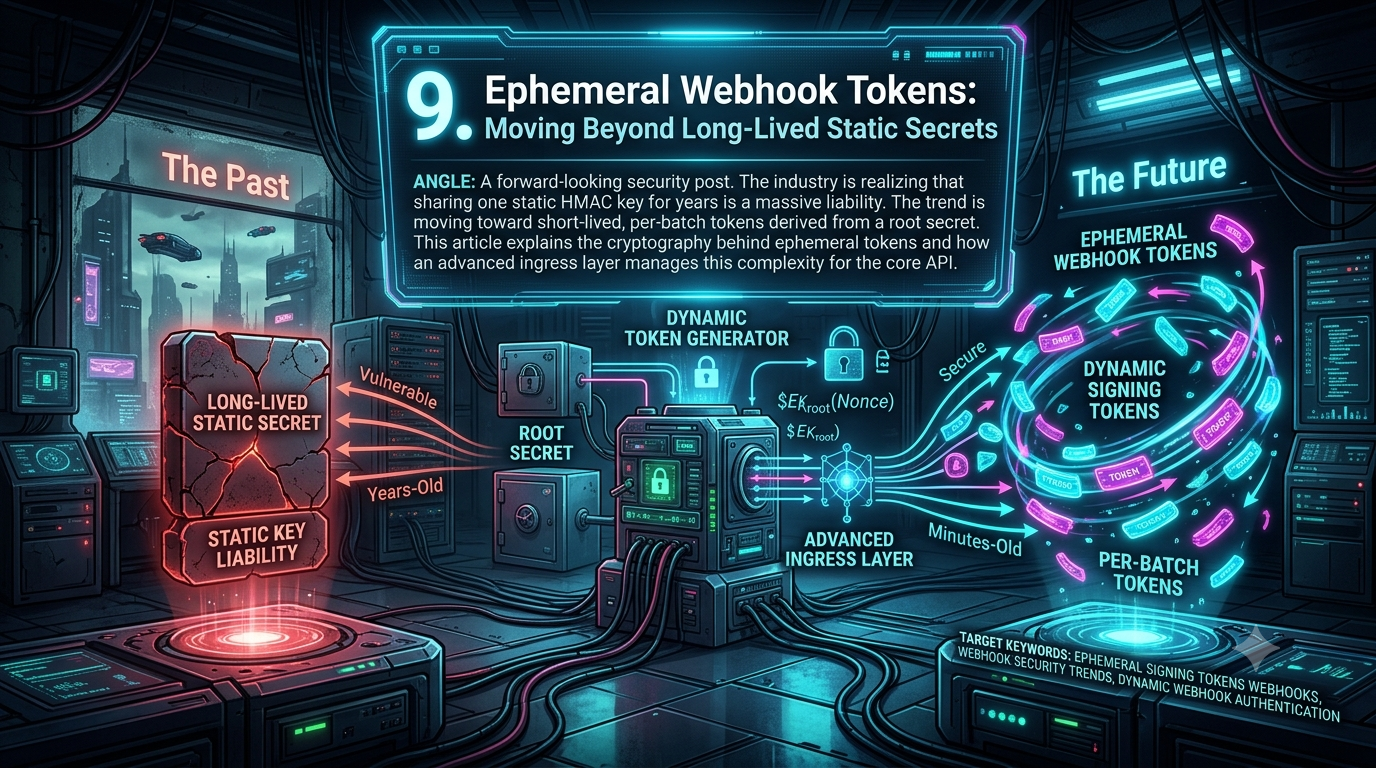
Ephemeral Webhook Tokens: Moving Beyond Long-Lived Static Secrets
1. Introduction: The Fragile State of Webhook Security
Webhooks are the connective tissue of modern event-driven architecture. A payment succeeds in Stripe, a commit lands in GitHub, an order ships in Shopify — each fires an HTTP callback that keeps decoupled systems in sync without anyone polling for updates.
For over a decade, the way those callbacks prove they're legitimate has barely changed: a provider and a consumer share a static secret, and every request is signed with an HMAC over that secret. It works, but a secret that never expires is also a secret that never stops being a liability. As organizations move toward Zero Trust architectures and just-in-time credentials for machine-to-machine traffic, that static-forever model looks increasingly out of step with how the rest of the identity stack is evolving.
This article covers where webhook authentication actually stands heading into the second half of 2026: the industry-standard signing scheme most providers now share, the IETF standard trying to generalize it further, and the short-lived-key techniques — including HKDF-derived ephemeral tokens — that a smaller but growing set of teams are adopting at the edge.
2. The Vulnerabilities of Long-Lived Static Secrets
2.1 The Traditional Static HMAC Model
In a standard webhook setup, the sender signs the request body with a shared secret key, $K_{\text{static}}$:
$$\text{Signature} = \text{HMAC-SHA256}(K_{\text{static}}, \text{Payload})$$
The receiver recomputes the same HMAC locally and compares it, in constant time, against the signature header.
Sender                                                          Receiver
  |                                                                 |
  |-- 1. Compute HMAC(K_static, Body) ---------------------------->|
  |-- 2. Send HTTP POST with signature header --------------------->|
  |                                                                 |-- 3. Look up K_static
  |                                                                 |-- 4. Recompute HMAC(K_static, Body)
  |                                                                 |-- 5. Compare, constant-time
2.2 Where This Breaks Down
- Blast radius. If $K_{\text{static}}$ leaks — via logs, a misconfigured secret store, or a checked-in
.envfile — an attacker can forge valid events indefinitely, for every endpoint that shares the secret. - Secret sprawl. As a company's webhook consumers multiply across services and lambdas, the same secret ends up copied into more places than anyone can easily audit.
- Rotation friction. Rotating a shared secret needs coordinated deploys on both sides. Because a bad rotation can break production traffic, it's routinely delayed — sometimes indefinitely.
- Replay risk. A signature alone doesn't say when it was valid. Without an enforced timestamp check, a captured request can be replayed long after the fact.
None of this is new — it's the reason the industry has spent the last few years converging on shared standards rather than each provider inventing its own scheme from scratch.
3. Where the Industry Actually Stands in 2026
3.1 Standard Webhooks: the de facto baseline
The most consequential real-world change isn't ephemeral cryptography — it's standardization. Standard Webhooks, an open specification authored by Svix along with Twilio, Kong, Supabase, Mux, ngrok, and Lob, has become the closest thing the industry has to a shared webhook-signing convention, and has reportedly been adopted by companies including OpenAI, Anthropic, and Google.
The spec fixes three headers and a signing scheme:
webhook-id:        msg_2b1c...             # unique message id
webhook-timestamp: 1614265330              # unix seconds
webhook-signature: v1,g0hM9SsE...          # space-delimited "v1,<base64 sig>" entries
The signed content is {webhook-id}.{webhook-timestamp}.{raw body}, HMAC-SHA256'd with the base64-decoded bytes of a whsec_-prefixed secret (24–64 random bytes), then base64-encoded. Two details matter more than they look:
- Rotation is built into the header, not bolted on. During a secret rotation, the sender signs with both the old and new secret and sends both space-delimited signatures. A receiver holding either one verifies successfully, so the two sides never have to cut over in the same instant.
- The recommended replay tolerance is 300 seconds. Stripe's own libraries independently reject events more than 300 seconds outside server time — that five-minute window has effectively become an industry default, and it lines up with what security guides now cite as OWASP's recommended maximum.
3.2 RFC 9421: the IETF's answer for HTTP signatures generally
In February 2024, the IETF published RFC 9421, HTTP Message Signatures, a general-purpose standard for signing components of an HTTP message (not just webhooks), designed to survive intermediaries and proxies that might otherwise mangle a naive signature. It supports both asymmetric signatures and keyed MACs.
RFC 9421 already has real, if narrow, adoption: it underpins server-to-server authentication in ActivityPub implementations like Mastodon, and the Open Payments standard for payment interoperability requires it for every API request. That said, as of early 2026, mainstream webhook adoption is still limited — a widely used platform like GitHub still runs its own ad hoc signature scheme rather than RFC 9421, and framework-level support (e.g., in Spring Security) is still an open request rather than a shipped feature. It's a serious standards-track effort, but it hasn't yet displaced HMAC-based schemes for webhooks specifically.
3.3 Short-lived signing keys: the emerging edge
Underneath both of the above, a narrower trend is visible in 2025–2026 security guidance: replacing a single long-lived signing secret with short-lived signing keys — typically valid from fifteen minutes to twenty-four hours — published through a signed, JWKS-style endpoint that receivers poll and cache. This shrinks the blast radius of a leaked key without requiring a full protocol change, and it's showing up in webhook security guides as a 2026 trend alongside CloudEvents adoption as a common payload format and built-in exponential backoff in major platforms.
The most aggressive version of this idea — deriving a fresh key per time window, on demand, from a root secret via HKDF, with no key ever transmitted or stored — is a legitimate cryptographic pattern, and one with precedent in adjacent areas (for example, several AI API providers now issue short-lived, scoped tokens so a long-lived server key never has to touch an untrusted client). But it's worth being precise about where it stands: as of 2026 this is an advanced pattern discussed in engineering blogs and implemented by individual teams at their own ingress layer, not something baked into a ratified webhook standard or offered by name as a feature by major providers like Stripe or GitHub. If you build it, you're building ahead of the pack, not catching up to it.
4. The Cryptography Behind HKDF-Derived Ephemeral Tokens
For teams that do want to go this route, here's the mechanism. Rather than transmitting or storing a key directly, an ephemeral-key architecture derives temporary keys ($K_{\text{ephemeral}}$) from a root secret using HKDF (RFC 5869), which operates in two phases.
                   +------------------------+
                   |  Root Secret (K_root)  |
                   +------------------------+
                                |
                                v
+----------+          +-------------------+
|   Salt   | -------> |    HKDF-Extract   |
+----------+          +-------------------+
                                |
                                v
                    Pseudo-Random Key (PRK)
                                |
                                v
+----------+          +-------------------+
|   Info   | -------> |    HKDF-Expand    |
+----------+          +-------------------+
                                |
                                v
                    +-----------------------+
                    | Ephemeral Signing Key |
                    |     (K_ephemeral)     |
                    +-----------------------+
HKDF-Extract condenses the root key material into a fixed-length pseudorandom key using an optional salt:
$$PRK = \text{HMAC-Hash}(\text{Salt}, K_{\text{root}})$$
HKDF-Expand stretches that into an output key of the desired length, bound to an application-specific context string:
$$K_{\text{ephemeral}} = \text{HKDF-Expand}(PRK, \text{Info}, L)$$
4.1 Binding keys to a time window
To make $K_{\text{ephemeral}}$ genuinely short-lived, the Info context string includes a time-bucketed epoch, computed by dividing Unix time by an interval $\Delta t$ (e.g., 300 seconds):
$$T_{\text{epoch}} = \left\lfloor \frac{\text{Unix Timestamp}}{\Delta t} \right\rfloor$$
$$\text{Info} = \text{"webhook-v1:"} \parallel \text{TenantID} \parallel T_{\text{epoch}}$$
Because both sides share $K_{\text{root}}$ and agree on $\Delta t$, each independently derives the identical $K_{\text{ephemeral}}$ for the current window — no key ever crosses the wire.
Current Time: 10:04:15 AM (Unix: 1776247455)
Time Window (Δt): 300 seconds (5 minutes)

Epoch = floor(1776247455 / 300) = 5920824
Info Context String = "webhook-v1:tenant_99:5920824"
4.2 Signing the payload
The sender computes the signature over the payload combined with a batch ID and timestamp:
$$S = \text{HMAC-SHA256}(K_{\text{ephemeral}}, \text{BatchID} \parallel \text{Timestamp} \parallel P)$$
If $S$ and the payload are captured in transit, the exposure is bounded: the key expires automatically at the next epoch boundary, and $K_{\text{root}}$ itself is never exposed.
5. Architecture: Pushing the Complexity to the Ingress Layer
Implementing epoch math, clock-skew tolerance, and constant-time comparison in every microservice that consumes webhooks is a recipe for subtle bugs. A cleaner pattern offloads verification to a single ingress layer (an API gateway or a dedicated sidecar), so backend services never see raw signing headers at all.
[ External Webhook Provider ]
             |
             | 1. HTTP POST — X-Signature, X-Batch-ID, X-Timestamp
             v
+-------------------------------------------------------------------+
| INGRESS LAYER / API GATEWAY                                       |
|   a. Check timestamp drift                                        |
|   b. Derive K_ephemeral = HKDF(K_root, epoch)                     |
|   c. Recompute and compare the HMAC                                |
|   d. Strip external headers, mint a short-lived internal token    |
+-------------------------------------------------------------------+
             |
             | 2. Authorization: Bearer <internal token>
             v
+-------------------------------------------------------------------+
| CORE API / INTERNAL MICROSERVICES                                 |
|   Handles business logic — never touches raw HMAC verification    |
+-------------------------------------------------------------------+
Egress side: the outbound proxy checks the clock, derives $K_{\text{ephemeral}}$, signs, and attaches the epoch, batch ID, and signature as headers.
Ingress side: the gateway checks the timestamp against a tolerance window, derives the same key (checking both the current epoch and the previous one, to tolerate clock boundary drift), verifies in constant time, then mints an internal credential and forwards the request — the backend service never handles the external signature at all.
6. Reference Implementation
6.1 Headers
POST /api/v1/webhooks/payments HTTP/1.1
Host: api.subscriber.com
Content-Type: application/json
X-Webhook-Timestamp: 1776247455
X-Webhook-Batch-ID: bch_987654321
X-Webhook-Epoch: 5920824
X-Webhook-Signature: v1=a8f5f167f123456789abcdef0123456789abcdef0123456789abcdef01234567
Content-Length: 142

{
  "event": "payment_intent.succeeded",
  "amount": 4900,
  "currency": "usd"
}
6.2 Python: HKDF signer and verifier
import hashlib
import hmac
import math
import time
from cryptography.hazmat.primitives.kdf.hkdf import HKDF
from cryptography.hazmat.primitives import hashes


class EphemeralWebhookSigner:
    def __init__(self, root_secret: bytes, window_seconds: int = 300):
        self.root_secret = root_secret
        self.window_seconds = window_seconds

    def _get_epoch(self, timestamp: float) -> int:
        return math.floor(timestamp / self.window_seconds)

    def derive_ephemeral_key(self, tenant_id: str, epoch: int) -> bytes:
        """Derive an ephemeral key for a tenant and time epoch via HKDF."""
        info = f"webhook-v1:{tenant_id}:{epoch}".encode("utf-8")
        hkdf = HKDF(algorithm=hashes.SHA256(), length=32, salt=None, info=info)
        return hkdf.derive(self.root_secret)

    def generate_signature(self, tenant_id: str, timestamp: float,
                            batch_id: str, payload: bytes) -> tuple[str, int]:
        epoch = self._get_epoch(timestamp)
        ephemeral_key = self.derive_ephemeral_key(tenant_id, epoch)
        canonical = f"{batch_id}.{int(timestamp)}.".encode("utf-8") + payload
        sig = hmac.new(ephemeral_key, canonical, hashlib.sha256).hexdigest()
        return f"v1={sig}", epoch

    def verify_signature(self, tenant_id: str, timestamp: float, batch_id: str,
                          payload: bytes, incoming_signature: str) -> bool:
        # Reject signatures outside the tolerance window
        if abs(time.time() - timestamp) > self.window_seconds:
            return False

        current_epoch = self._get_epoch(timestamp)
        # Check current and previous epoch to tolerate boundary drift
        for epoch in (current_epoch, current_epoch - 1):
            ephemeral_key = self.derive_ephemeral_key(tenant_id, epoch)
            canonical = f"{batch_id}.{int(timestamp)}.".encode("utf-8") + payload
            expected = "v1=" + hmac.new(ephemeral_key, canonical, hashlib.sha256).hexdigest()
            if hmac.compare_digest(expected, incoming_signature):
                return True
        return False


if __name__ == "__main__":
    ROOT_SECRET = b"super-secret-root-key-known-only-to-gateways"
    TENANT_ID = "org_acme_corp"
    PAYLOAD = b'{"event":"order.created","id":"ord_123"}'
    BATCH_ID = "bch_000112233"

    signer = EphemeralWebhookSigner(root_secret=ROOT_SECRET, window_seconds=300)

    now = time.time()
    sig_header, epoch = signer.generate_signature(TENANT_ID, now, BATCH_ID, PAYLOAD)
    print(f"Signature: {sig_header} (epoch {epoch})")
    print("Valid now?", signer.verify_signature(TENANT_ID, now, BATCH_ID, PAYLOAD, sig_header))

    # A replay 10 minutes later, after the window has expired
    later = now + 600
    print("Valid after 10 min?", signer.verify_signature(TENANT_ID, later, BATCH_ID, PAYLOAD, sig_header))
7. Comparing the Options in 2026
| Dimension | Static HMAC (raw) | Standard Webhooks | RFC 9421 (asymmetric) | HKDF ephemeral tokens |
|---|---|---|---|---|
| Real-world adoption | Legacy, still common | Wide — Svix, Twilio, Kong, and reportedly OpenAI, Anthropic, Google | Narrow but growing (ActivityPub, Open Payments) | Individual teams, not a named provider feature yet |
| Credential lifetime | Months–years | Same secret, but rotation is built into the header format | Certificate/key lifetime, automated via JWKS | Minutes, derived on demand |
| Blast radius if leaked | High | Bounded by rotation speed | Low (public keys only) | Minimal — limited to one epoch |
| Verification cost | Very low | Very low | Higher (asymmetric signature checks) | Low (HKDF + HMAC) |
| Replay protection | Depends entirely on app-level checks | Enforced timestamp, ~300s default tolerance | Depends on implementation | Hard expiration at epoch boundary |
8. Rotating the Root Secret Without Downtime
Even with ephemeral derivation, the underlying root secret still needs periodic rotation to satisfy compliance requirements. The pattern that both Standard Webhooks and most rotation-aware implementations converge on is the same: run two secrets in parallel for a bounded window.
  Phase 1: Normal          Phase 2: Dual-Active         Phase 3: Complete
  Primary: K_root_V1       Primary: K_root_V2           Primary: K_root_V2
  Fallback: none           Fallback: K_root_V1          Fallback: none
- Sign every outbound message with the new key, but keep verifying against the old one for a defined overlap (commonly 24–48 hours) so in-flight retries don't fail.
- Track usage of the old key so you know when it's safe to retire.
- Delete the old key once telemetry confirms nothing is still relying on it.
9. A Practical Checklist for 2026
Whatever scheme you land on, the fundamentals that security guidance converges on haven't changed much, and they matter more than which cryptographic primitive you pick:
- Enforce a timestamp tolerance, commonly cited at a five-minute (300-second) maximum, and reject anything older.
- Verify against the raw request body, not a re-parsed and re-serialized copy — whitespace and key ordering changes will silently break otherwise-correct signatures.
- Deduplicate on the message ID, not just the timestamp, since legitimate retries can arrive more than once.
- Treat webhook payloads as untrusted input — validate and sanitize before acting on any URL or value they contain, particularly if your handler makes outbound requests based on payload contents.
- Where a provider publishes source IP ranges, allowlist them as a defense-in-depth layer, not a substitute for signature verification.
- Don't over-index on post-quantum urgency for HMAC. NIST's current transition guidance (deprecating classical asymmetric algorithms like RSA and ECDSA after 2030, disallowing them after 2035) targets asymmetric cryptography threatened by Shor's algorithm. Symmetric HMAC-SHA256 isn't in that category — it only needs adequate key length against Grover's algorithm — so if you're using RFC 9421 with asymmetric signatures, plan for that migration; if you're on HMAC-based Standard Webhooks, it's a lower near-term priority.
10. Conclusion & Outlook
The picture in 2026 is less "static secrets are dead" and more "static secrets got a standard, and something better is being built on top." Standard Webhooks has done the unglamorous, high-leverage work of getting most of the industry to sign the same three headers the same way, with rotation designed in from the start. RFC 9421 offers a more general, IETF-backed path for HTTP-level signatures, though it's still early in webhook-specific adoption. And HKDF-derived, time-boxed ephemeral tokens represent a genuinely stronger security posture — automated rotation, minimal blast radius, hard cryptographic expiration — that a growing number of security-conscious teams are building at their ingress layer, even though no major provider ships it as a named feature yet.
If you're building a webhook receiver today, adopting Standard Webhooks conventions and enforcing the checklist above will cover the overwhelming majority of real-world risk. If you're building the sending side for a security-sensitive product, the ephemeral-token pattern is a legitimate next step worth evaluating — just go in knowing you're ahead of the standard, not implementing one.
Sources
- Standard Webhooks specification
- Svix: Announcing Standard Webhooks
- Svix: What is a webhook signature?
- Svix: What is a webhook secret?
- RFC 9421 — HTTP Message Signatures (IETF)
- Spring Security issue tracking RFC 9421 support
- Hooklistener: Webhooks Fundamentals (2026)
- Hooklistener: Webhook Security Fundamentals
- Obsidian Security: What is Webhook Security (2026)
- APIsec: Securing Webhook Endpoints
- NIST IR 8547 (Initial Public Draft): Transition to Post-Quantum Cryptography Standards
- Zapier docs: Verifying webhook signatures