Building Scalable Webhook Ingestion: Serverless vs. Dedicated Infrastructure
Building Scalable Webhook Ingestion: Serverless vs. Dedicated Infrastructure For modern distributed systems, webhooks are the central nervous system.
Building Scalable Webhook Ingestion: Serverless vs. Dedicated Infrastructure
For modern distributed systems, webhooks are the central nervous system. Whether you're processing payments from Stripe, inventory updates from Shopify, or internal service-to-service events, your application's ability to reliably receive and process these asynchronous events is critical.
But as platforms grow, what begins as a simple HTTP POST endpoint quickly becomes an architectural bottleneck. Building scalable webhook ingestion is rarely as straightforward as writing a controller to parse JSON. When traffic spikes, a poorly designed ingestion layer leads to dropped payloads, exhausted database connections, and hours spent digging through logs to manually replay failed events.
For senior engineers and architects, the ingestion layer usually forces a hard choice: lean on the auto-scaling promises of serverless platforms like AWS Lambda and Cloudflare Workers, or fall back on the predictable performance of dedicated infrastructure?
This piece walks through the real technical trade-offs of both approaches — cold starts, timeout limits, and the database connection pooling problem — using current data rather than folklore, and then looks at a third option that removes the ingestion layer from your infrastructure entirely.
The Core Principles of Resilient Webhook Architecture
Before comparing infrastructure, it's worth being precise about why webhook traffic behaves differently from ordinary API traffic.
Webhooks are bursty by nature. A flash sale, a batch job completing on a provider's end, or a routine subscription-renewal cycle at the start of the month can turn a quiet endpoint into a thundering herd in seconds. Stripe's own documentation warns that large spikes in webhook deliveries — for example, at the start of the month when many subscriptions renew — can overwhelm an endpoint that processes events synchronously, which is exactly why Stripe recommends queuing incoming events rather than handling them inline.
A resilient webhook architecture rests on three principles:
Decoupling (asynchronous processing). The ingestion layer should do two things only: validate the payload and store it durably, then return a fast success response. Stripe's documentation is explicit about this — your endpoint should return a 2xx status before running any logic that could cause a timeout, such as updating an invoice or triggering a fulfillment workflow.
Idempotency. Every major webhook provider guarantees "at-least-once" delivery, not "exactly-once." Stripe's own docs note that endpoints "might occasionally receive the same event more than once," and recommend deduplicating using the event ID. Your system has to handle a duplicate payload safely, without double-charging a card or double-sending a receipt.
Durability and replayability. When a downstream dependency — your database, a third-party API, a deploy in progress — goes offline, the ingestion layer needs to hold the event and retry with backoff, not drop it. Events that exhaust their retries should land in a dead-letter queue for inspection and manual replay rather than disappearing.
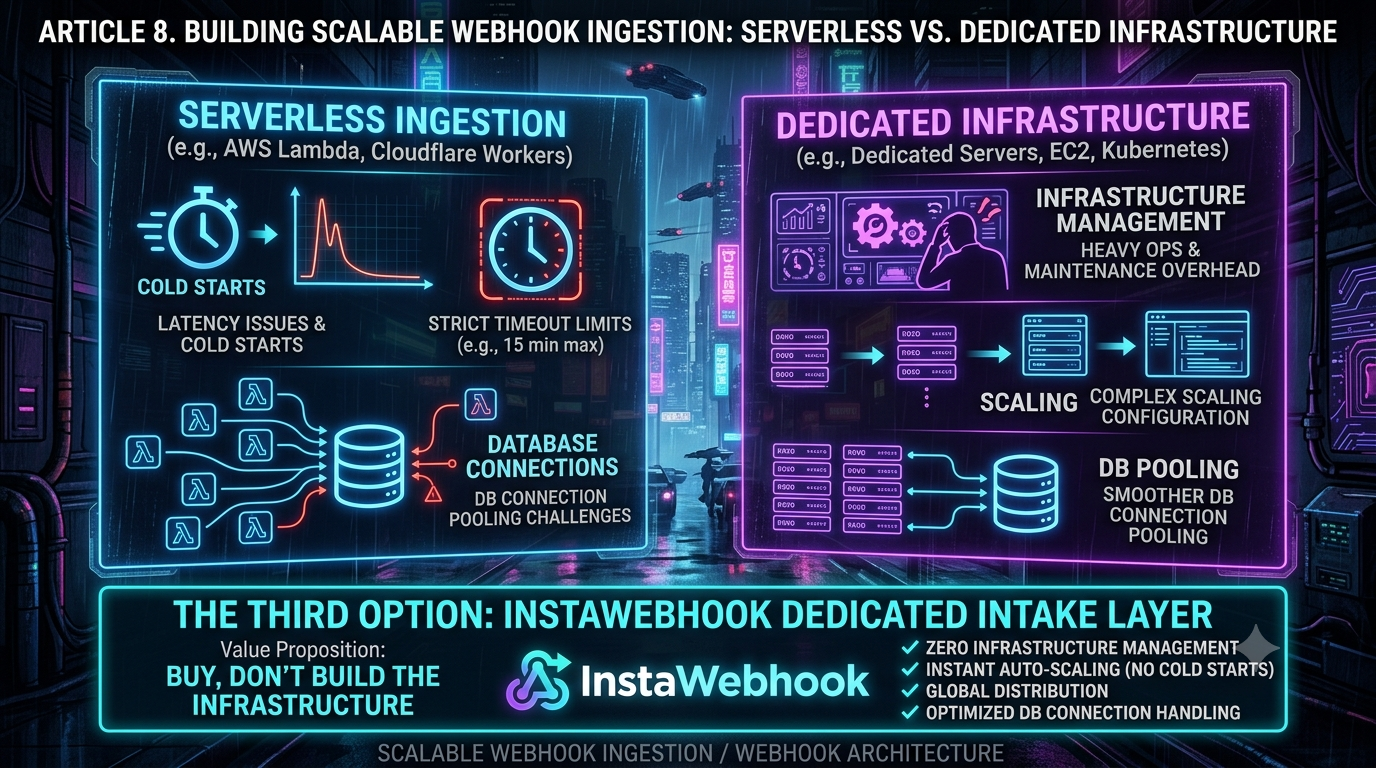
Approach 1: Serverless Ingestion (AWS Lambda & Cloudflare Workers)
Serverless looks like a natural fit for webhooks: event-driven compute for event-driven traffic, scaling from zero without you provisioning anything. In practice, both major serverless platforms carry real, well-documented constraints once you push past a toy endpoint.
AWS Lambda: cold starts are smaller than the myth, but the billing model just changed
Cold starts remain the most-discussed serverless pain point, but the actual numbers are less alarming than most 2020-era blog posts suggest — and one thing did meaningfully change in 2025.
AWS's own telemetry indicates that cold starts affect fewer than 1% of invocations in most production workloads. When they do happen, duration depends heavily on runtime: compiled, lightweight runtimes like Go and Rust routinely cold-start in well under 100ms, while interpreted runtimes like Node.js and Python typically land in the 200–400ms range at the median. Java and .NET remain the outliers, sometimes taking multiple seconds without optimization, largely because of JVM/CLR startup and dependency injection overhead.
Two things worth updating from the standard cold-start narrative:
- VPC attachment is no longer the cold-start killer it used to be. AWS's Hyperplane ENI improvements mean VPC-attached Lambdas now typically add well under 100ms of overhead — a stark contrast to the multi-second VPC cold starts engineers dealt with several years ago. If your Lambda needs a database in a VPC, that alone is no longer a strong reason to avoid it.
- AWS SnapStart can cut cold start duration by roughly 90% by snapshotting an initialized execution environment. It launched for Java, and AWS has been extending it — it now covers .NET 8 functions compiled with Native AOT, with broader runtime support rolling out incrementally.
The bigger change: as of August 1, 2025, AWS began billing the Lambda INIT phase the same way it bills invocation duration. Previously, the time your function spent initializing was free. Now every cold start has a direct cost, and for workloads with long, heavy initialization (particularly Java and .NET), this has reportedly pushed Lambda costs up by 10–50% in some cases. It doesn't change whether cold starts happen, but it changes the economics of ignoring them — a Java function with multi-second cold starts on a high-traffic webhook endpoint is a materially different line item on your AWS bill today than it was a year ago.
Provisioned Concurrency still solves the latency problem, and it still costs the same as running dedicated compute 24/7 — that trade-off hasn't changed.
The database connection pooling problem is still real, and it's arguably the more consequential of the two issues for webhook ingestion specifically. Each concurrent Lambda invocation runs in its own isolated execution environment. If a burst spins up 5,000 concurrent Lambdas and each opens a direct connection to Postgres or MySQL, you can exhaust max_connections in seconds — Lambda's ability to scale concurrency far outpaces a traditional database's ability to accept new connections. Reusing a connection across warm invocations helps, but a cold start destroys and recreates it, and under high concurrency you get connection churn regardless.
The standard fix is still to add a pooling layer in front of the database — Amazon RDS Proxy, Prisma Accelerate, or a self-managed PgBouncer instance. This works, but it adds a component you now have to configure, secure, and monitor, and RDS Proxy specifically still requires VPC networking to reach your database.
Cloudflare Workers: fast starts, real CPU limits — but the limits are more forgiving than they sound
Cloudflare Workers run on V8 isolates rather than containers, which genuinely eliminates the classic container cold start. For routing and lightweight intake, they're extremely fast — Cloudflare's own documentation states the average Worker uses only about 2.2ms of CPU time per request.
The CPU-time limits are real, but they're commonly misunderstood, which matters a lot for a webhook ingestion use case:
- CPU time and wall-clock time are different things, and only CPU time is capped. Time spent waiting on a
fetch()call, a KV read, a queue write, or a database round-trip does not count against your CPU-time limit. A webhook handler that validates an HMAC signature (genuine CPU work) and then writes to Cloudflare Queues (I/O wait, not CPU time) can comfortably fit inside the limit even though the request as a whole might take longer than the CPU-time ceiling suggests. - On the Free plan, CPU time is capped at 10ms per request — tight for anything beyond trivial validation. On the Paid plan, the default is 30 seconds of CPU time, and as of a March 2025 platform change, that can be raised to 5 minutes (300,000ms) per request by configuration. Heavy cryptographic verification or JSON parsing of large payloads is unlikely to hit the ceiling on a Paid Worker.
- There's a separate, smaller constraint worth knowing about: a Worker's top-level (global scope) code must finish executing within 1 second at deploy time, or the deployment itself is rejected. This affects how you structure imports and initialization, not request handling.
The state and storage point from the original framing still holds directionally: to decouple intake from processing, you need to persist the event immediately, and Cloudflare pushes you toward its own primitives — Queues, D1, KV, R2 — for that. You can call out to AWS SQS or another external queue over HTTPS from a Worker, but you're making a signed API call over the open internet rather than using a same-platform binding, which adds latency and operational surface area compared to Cloudflare's native queueing.
Approach 2: Dedicated Infrastructure (EC2, ECS, or Kubernetes)
Frustrated by cold starts and connection limits, many teams retreat to a fleet of long-running Go, Node.js, or Rust services on ECS, EKS, or bare EC2 instances.
The advantages hold up
- Persistent connection pooling. A long-running process keeps a small, stable pool of database connections open and multiplexes thousands of incoming webhook requests over it — no cold-start churn, no connection storms.
- Predictable latency. Without container-provisioning overhead, a dedicated server can validate a signature, push the payload to a queue, and return
202 Acceptedin single-digit-to-low-double-digit milliseconds, comfortably inside any provider's timeout window. - Controlled background processing. Workers built with Celery, Sidekiq, or BullMQ pull from the queue at a steady, tunable rate, protecting downstream systems instead of hammering them with a burst.
The scaling drawback, with real numbers
This is where dedicated infrastructure genuinely struggles against bursty webhook traffic, and it's worth walking through the actual mechanics rather than a vague "auto-scaling is slow."
Kubernetes' Horizontal Pod Autoscaler polls the Metrics Server on a fixed interval — 15 seconds by default (--horizontal-pod-autoscaler-sync-period). Scale-up decisions have no stabilization delay by default, so in principle HPA reacts as soon as it sees the metric cross a threshold. In practice, the full path from "traffic spike hits" to "new capacity is actually serving requests" involves several sequential stages:
- ~30–45 seconds: the metrics pipeline detects the spike and the HPA controller decides to scale.
- ~45–90 seconds: the scheduler places new pods on nodes with available capacity — or, if none exist, the Cluster Autoscaler has to provision new EC2 nodes first, which is the slowest part of this chain.
- ~90–180+ seconds: the application itself starts up, including any JVM warm-up, cache hydration, or readiness-probe delay before it's marked ready to receive traffic.
Chained together, engineers who monitor this closely report a realistic range of roughly 30 seconds in the best case (warm nodes, cached images, fast startup) to 3+ minutes in the worst case (cold nodes, large images, slow readiness checks). During that entire window, your existing pods absorb the full spike — which either degrades them into cascading OOM failures, or the webhook provider has already timed out and started queuing retries that land on your servers right as they're trying to recover.
There's a second, subtler issue worth flagging: HPA's default behavior scales on average CPU across pods. If nine pods are idle and one is pinned at 100% handling a burst of webhook traffic, the fleet-wide average can look perfectly healthy while that one "hot pod" is timing out requests — HPA sees no reason to act because the average never crosses the threshold. Teams that rely on webhook ingestion at scale increasingly scale on request rate or queue depth instead of raw CPU, using tools like KEDA, specifically to avoid this blind spot.
The common mitigation is still what it's always been: over-provision. Run more baseline capacity than you need on an average day so there's headroom to absorb a spike before the autoscaler catches up — which means paying for idle compute most of the time to survive a small fraction of traffic.
Comparing the Trade-offs
| AWS Lambda | Cloudflare Workers | Dedicated (K8s/ECS) | |
|---|---|---|---|
| Cold start impact | <1% of invocations, ~100ms–low seconds; now billed since Aug 2025 | Effectively none (V8 isolates) | None — always warm |
| Reaction to sudden bursts | Scales in seconds | Scales in milliseconds | 30s best case, 3+ min worst case |
| DB connection handling | Requires a pooler (RDS Proxy, PgBouncer) | Not designed for direct SQL connections | Native, persistent pooling |
| Execution/CPU limits | 15-minute max duration | 10ms (Free) – 5 min (Paid, configurable) CPU time; I/O wait excluded | No inherent limit |
| Operational overhead | Low, but proxy layer adds complexity | Low, but ties you to Cloudflare's storage/queue primitives | High — you own scaling, patching, capacity planning |
The True Cost of Building Ingestion Pipelines
Regardless of which column you pick, a production-grade webhook ingestion layer is a full distributed system, not an endpoint:
- An API gateway or load balancer to route requests
- A compute layer to verify HMAC signatures
- A message broker (Kafka, SQS, RabbitMQ, or a platform-native equivalent) to decouple intake from processing
- Worker fleets that poll the queue and actually do the work
- A dead-letter queue for events that exhaust their retries
- Internal tooling so support and engineering can inspect and replay failed events
Unless webhook infrastructure is your product, none of this is a competitive advantage. Time spent tuning Lambda concurrency, managing Kafka partitions, or building a replay UI from scratch is time not spent on the product itself.
The Third Option: Offloading with a Dedicated Intake Layer
Given those trade-offs, a growing number of teams treat webhook intake as something to buy rather than build — the same way most teams stopped self-hosting SMTP servers or building in-house feature-flagging systems. This category is sometimes called "webhook infrastructure," and includes a handful of players — Svix, Hookdeck, Convoy, and InstaWebhook among them — each taking a slightly different approach to the same underlying problem: durable intake, retries, and replay, without you owning the queue.
InstaWebhook, specifically, positions itself as a durable proxy that sits between providers (Stripe, Shopify, GitHub, and so on) and your backend. The pitch is straightforward: it absorbs the intake burden so your application only has to deal with already-validated, already-durable events.
How this pattern solves the architecture problem
1. Absorbing bursts without you managing scaling. The intake layer validates the endpoint token, accepts the payload, encrypts and stores it outside the request path, and returns a fast success response to the sender. Neither Lambda cold starts nor HPA lag show up on the sender's side, because the sender's connection is closed the moment the event is durably stored — the actual delivery to your backend happens asynchronously, on a schedule the intake layer controls.
2. Protecting your database with controlled delivery. Because the event is already durably stored, the intake layer can attempt delivery to your API at a pace your systems can absorb, and back off automatically if your backend returns a 503 or is mid-deploy. This is the same idea as a message broker, minus the broker you'd otherwise have to run yourself — you can keep using Lambda for your actual business logic without redesigning around connection-pool exhaustion, because the intake layer, not your database, absorbs the retry pressure.
3. Delivery visibility. Debugging "why didn't this webhook process" is usually the most time-consuming part of running your own pipeline — digging through CloudWatch or Datadog logs to reconstruct a timeline. A dedicated intake layer typically gives you a visual delivery record: when an event was received, queued, attempted, what status code your endpoint returned, and when the next retry is scheduled.
4. Replay controls. Events that exhaust retries land in a dead-letter queue you can inspect from a dashboard, rather than a table you have to query manually — with the ability to replay individual events or in bulk once the downstream issue is resolved.
5. Data sovereignty via "bring your own database." The most legitimate hesitation architects have about a third-party intake layer is where sensitive payloads live — PII, financial data, anything HIPAA-adjacent. A "BYO database" mode, where the intake layer stores encrypted payloads directly in a customer-controlled Postgres schema with least-privilege credentials, is one way vendors in this space address that: the routing, retry state machine, and worker processes are managed externally, but the payload itself never leaves infrastructure you control.
6. Signing outbound deliveries. To prevent spoofed requests from reaching your backend, a dedicated intake layer signs every delivery to your servers with a timestamped HMAC signature you can verify — the same pattern Stripe itself uses to sign events to you, just one hop further down the chain.
Choosing an Approach
There isn't a universally correct answer here — it depends on traffic shape and team size more than anything else:
- Low, steady volume, small team: a simple Lambda or Cloudflare Worker endpoint with a queue behind it is usually enough. Cold starts and connection pooling rarely bite until you're past a few hundred concurrent invocations.
- High, spiky volume, in-house platform team: dedicated infrastructure with request-rate-based autoscaling (not plain CPU) and deliberate over-provisioning is a defensible choice if you already run Kubernetes and have the operational muscle for it.
- Any volume, small team, or webhooks aren't your core product: offloading intake to a managed layer removes an entire category of on-call pages without requiring you to pick a side in the serverless-vs-dedicated debate at all.
Conclusion
Designing scalable webhook ingestion means balancing cost, complexity, and reliability — and the specifics have shifted meaningfully in the last year. AWS Lambda's cold starts are smaller and rarer than their reputation suggests, but the August 2025 INIT billing change means they now show up on your invoice in a way they didn't before. Cloudflare Workers' CPU limits are more forgiving than the "10ms" headline implies once you understand that I/O wait doesn't count against them. And Kubernetes autoscaling, while it has gotten smarter with request-rate-based metrics and tools like KEDA, still can't out-run a traffic spike that arrives faster than its 30-second-to-3-minute reaction window.
For teams where the ingestion layer isn't the product, offloading it to a dedicated intake service is a legitimate way to sidestep all three problems at once — you're not fighting Lambda's billing model, Workers' storage lock-in, or Kubernetes' scheduling lag, because none of that infrastructure is yours to manage in the first place.
Sources: AWS Lambda cold start documentation and INIT-phase billing change (AWS, August 2025); Cloudflare Workers platform limits documentation; Kubernetes Horizontal Pod Autoscaler documentation; Stripe webhook documentation on retries, event ordering, and duplicate delivery.