Bridging External Webhooks to Your Internal Event Mesh: A Secure Edge Gateway Pattern
Bridging External Webhooks to Your Internal Event Mesh: A Secure Edge Gateway Pattern Every SaaS platform your company depends on — Stripe, GitHub, Shopify, Twilio — talks to you...
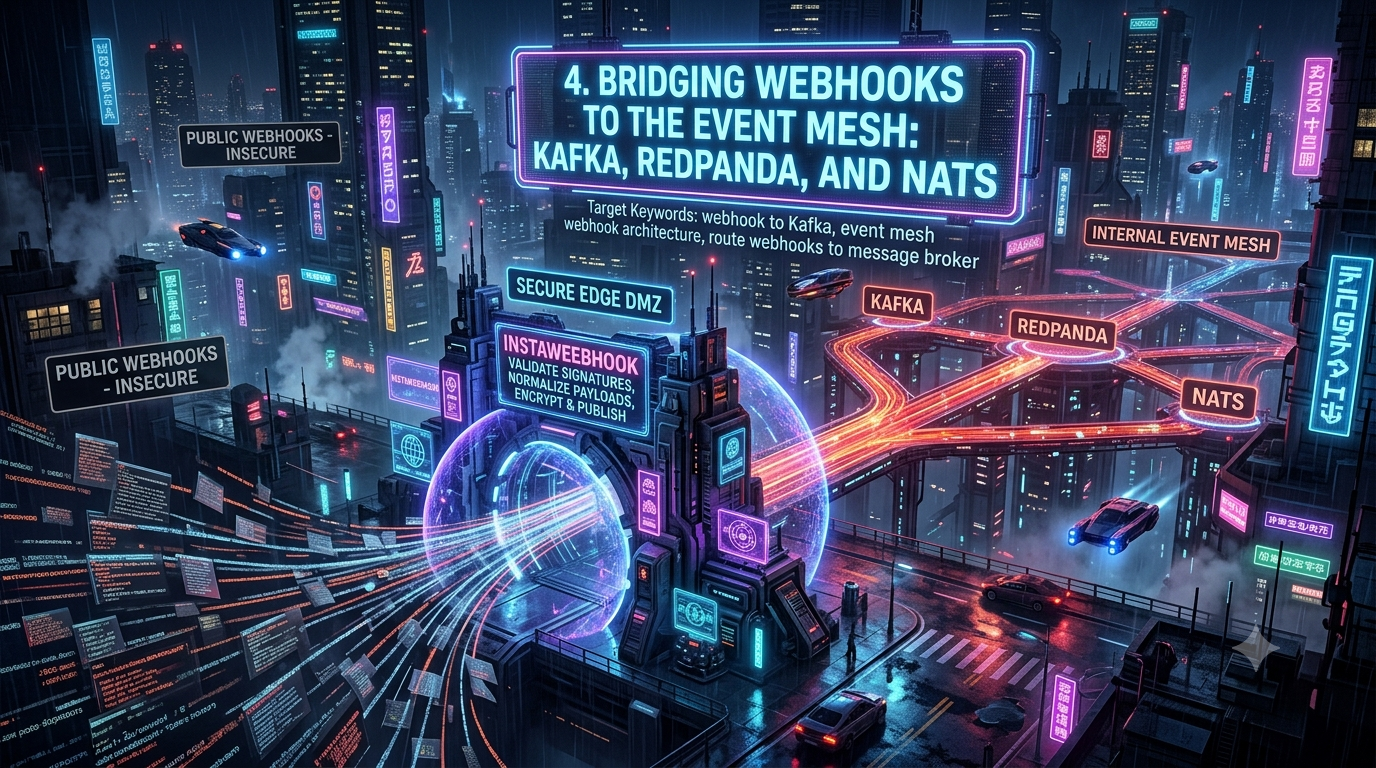
Bridging External Webhooks to Your Internal Event Mesh: A Secure Edge Gateway Pattern
Every SaaS platform your company depends on — Stripe, GitHub, Shopify, Twilio — talks to you the same way: an unannounced HTTP POST to a public URL. The moment you want that event inside Kafka, Redpanda, or NATS JetStream so the rest of your event-driven architecture can react to it, you've created a seam between the public internet and your internal event mesh. How you build that seam determines whether it's a minor integration detail or a standing security liability.
+-------------------+             Public Internet             +---------------------------+
| External Webhook  |  ====================================>  |   Internal Event Mesh     |
|  (Stripe/GitHub)  |  HTTP POST (Port 443)                    |  (Kafka / Redpanda / NATS)|
+-------------------+                                          +---------------------------+
Exposing broker ports directly, skipping signature validation, or building a one-off Lambda for every provider are the three ways teams usually get this wrong. This post walks through why those shortcuts fail, what a proper edge-gateway pattern looks like, and which real tools already implement pieces of it.
1. Why Naive Webhook-to-Broker Wiring Falls Apart
Two anti-patterns show up constantly in the field:
SaaS Webhook  --->  [ Kafka REST Proxy ]  --->  Kafka Cluster
(Exposed proxy, no HMAC validation, no per-provider auth headers, no flood protection)

SaaS Webhook  --->  [ API Gateway + Lambda ]  --->  Kafka / NATS
(Cold starts, per-request cost at scale, bespoke signature code for every provider)
Security gaps in generic HTTP-to-broker proxies
A generic proxy — including something like Confluent's Kafka REST Proxy — will happily forward any POST body to a topic. It has no idea that a request is supposed to carry a Stripe-Signature or X-Hub-Signature-256 header, so it can't tell a real Stripe event from a forged one. Each provider signs its payloads differently:
- GitHub signs with HMAC-SHA256 and sends the digest, prefixed
sha256=, in theX-Hub-Signature-256header (the olderX-Hub-Signatureheader uses SHA-1 and exists only for backward compatibility). - Stripe sends a
Stripe-Signatureheader shaped liket=<timestamp>,v1=<signature>. The signature is computed over the stringtimestamp.payload, not the raw body alone — the timestamp has to be part of what's hashed, or replay protection doesn't actually work. - Shopify sends a base64-encoded (not hex) HMAC-SHA256 digest in
X-Shopify-Hmac-SHA256, computed over the raw request body with the app's client secret.
A proxy that doesn't understand these per-provider schemes can't verify anything — it's just an open funnel into your event mesh.
Replay is a real, documented risk
Because most providers only guarantee at-least-once delivery, and because a captured request can be resent, providers that care about this bake a timestamp into the signature. Stripe's official libraries reject signatures older than 5 minutes by default. Without checking that window yourself, a captured payload stays valid forever.
The cost and latency profile of serverless bridges
API Gateway + Lambda is a common first attempt, but it runs into the same wall every SaaS webhook consumer eventually hits: the timeout budget is tiny and non-negotiable.
| Provider | Response timeout | Failed-delivery retry behavior |
|---|---|---|
| Slack | ~3 seconds | Retries a small, limited number of times |
| Shopify | 5 seconds | Disables the webhook after 8 consecutive failures over ~4 hours |
| Twilio | ~15 seconds | Retries over a defined window |
| GitHub | 10 seconds | Retries up to 3 times within an hour |
| Stripe | Tens of seconds (no single official hard number, but fast acknowledgment is strongly recommended) | Retries with backoff for up to 3 days |
A cold Lambda start alone can eat 1–3 seconds before your code even runs. Add a broker round-trip during a partition rebalance and you can blow through Shopify's or Slack's window on a routine day, which is exactly the kind of failure that gets a webhook subscription silently disabled.
The synchronous/asynchronous mismatch
Webhooks are a synchronous handshake bolted onto systems (Kafka partitions, NATS streams) that are built around asynchronous, at-least-once delivery. If the broker is slow to ack, the honest thing for your ingress layer to do is not wait on it — acknowledge the sender immediately, then get the event onto the broker on your own schedule.
2. The Pattern: A Dedicated Webhook Edge Gateway
The fix is architectural, not clever code: put a purpose-built gateway at the network edge whose only job is to authenticate, buffer, and normalize inbound webhooks before anything touches your internal brokers.
+----------------------------------------------------------------------------+
|                            SECURE EDGE / DMZ                               |
|                                                                            |
|  External SaaS  --HTTPS-->  Webhook Edge Gateway                          |
|                              1. HMAC signature validation                  |
|                              2. Timestamp / replay checks                  |
|                              3. Rate limiting                              |
|                              4. Normalize to a common event envelope       |
|                              5. Local buffer + retry on broker failure     |
+---------------------------------------|------------------------------------+
                                          | mTLS, private network
                                          v
+----------------------------------------------------------------------------+
|                          INTERNAL EVENT MESH                               |
|   Kafka (topic: stripe.events)  |  Redpanda  |  NATS JetStream            |
+----------------------------------------------------------------------------+
The lifecycle at each hop:
- TLS termination and signature check. The gateway holds the shared secret (ideally pulled from a vault/KMS at runtime, not hardcoded) and validates the provider-specific signature using constant-time comparison, so a timing side-channel can't leak information about the correct digest.
- Timestamp and rate checks. Requests outside the provider's tolerance window are dropped; a token-bucket limiter absorbs spikes (e.g., a burst of Shopify order webhooks on a big sale day) without forwarding the flood straight to the broker.
- Fast acknowledgment. The gateway returns
200/202the moment the event is safely queued locally — not after the broker has confirmed the write. This is what keeps you inside GitHub's 10-second or Shopify's 5-second window regardless of what's happening downstream. - Normalization. Every provider ships a different JSON shape. Wrapping the payload in a common envelope means downstream consumers write one parser instead of one per vendor.
- Buffered, mTLS-secured publish to the broker. If Kafka is mid-rebalance or a NATS node is restarting, the gateway holds the event locally and retries rather than dropping it or timing out the original sender.
Normalizing payloads with CloudEvents
Rather than invent a proprietary envelope, most teams adopt the CNCF's CloudEvents specification — a vendor-neutral format for describing event metadata (id, source, type, spec version, time) that graduated as a CNCF project in January 2024 and reached its stable 1.0 core spec back in 2019. Wrapping a raw Stripe payload in a CloudEvents envelope might look like this:
Raw Stripe webhook (excerpt):
{
  "id": "evt_1N3x4y2eZvKYlo2C",
  "type": "charge.succeeded",
  "data": {
    "object": {
      "id": "ch_3N3x4y2eZvKYlo2C01",
      "amount": 4900,
      "currency": "usd",
      "customer": "cus_N987654321"
    }
  }
}
Normalized CloudEvents envelope published to the broker:
{
  "specversion": "1.0",
  "id": "evt_1N3x4y2eZvKYlo2C",
  "source": "com.stripe/webhooks",
  "type": "com.stripe.charge.succeeded",
  "time": "2026-09-10T14:23:52Z",
  "data": {
    "charge_id": "ch_3N3x4y2eZvKYlo2C01",
    "amount": 4900,
    "currency": "usd",
    "customer": "cus_N987654321"
  }
}
Consumers now parse one shape, regardless of whether the underlying event originated at Stripe, GitHub, or an internal service.
Routing considerations once the event reaches the broker
- Partition/subject keys matter. Route by a stable identifier —
customer_id,repo_id,order_id— so events about the same entity land on the same Kafka partition or NATS subject in order. - NATS JetStream deduplication is a genuine safety net. If you forward the provider's own delivery ID (GitHub sends
X-GitHub-Delivery, for example) as theNats-Msg-Idheader, JetStream will silently drop duplicate publishes within its deduplication window — 2 minutes by default, tunable per stream via--dupe-window. This is a real, documented feature, not a marketing claim: it's exactly the kind of built-in guard that saves you from writing your own idempotency table for the ingestion hop. - A conceptual routing rule (illustrative, not tied to any specific vendor's exact syntax) might look like:
ingress:
  - path: /webhooks/github
    provider: github
    signature_header: X-Hub-Signature-256
    dedup_header: X-GitHub-Delivery
    destination:
      broker: nats-jetstream
      subject: "ingress.github.${event_type}"
3. You Don't Have to Build This From Scratch
The good news is that this pattern is well-trodden ground, and several real products already implement large pieces of it — so "build a bespoke edge gateway" often means "wire together an existing one" rather than writing HMAC verification code for a dozen providers yourself.
- Hookdeck offers two complementary products: Event Gateway for receiving inbound webhooks (pre-built signature verification for 160+ providers, durable queueing with backpressure, filtering, and deduplication), and Outpost for sending events onward to a real list of destinations that explicitly includes Kafka, alongside SQS, S3, Pub/Sub, EventBridge, RabbitMQ, and Azure Service Bus. Both expose OpenTelemetry tracing, and the underlying code is open source under Apache 2.0.
- Svix ships three products — Ingest (inbound), Dispatch (outbound), and Stream — and differentiates on compliance certifications (HIPAA, PCI-DSS among others), which matters if the events you're bridging touch regulated data.
- Convoy bundles inbound and outbound handling into a single self-hosted Go service, though its delivery target is HTTP endpoints only rather than message brokers directly.
- InstaWebhook focuses specifically on the reliability side of receiving webhooks: durable endpoints, encrypted payload storage, a visible delivery timeline (received → queued → attempted → retried → delivered/dead-lettered), retry and replay tooling, and a "bring your own database" mode for teams that need payload storage to stay on infrastructure they control.
None of these is a drop-in replacement for architecture — you still decide partitioning keys, envelope format, and topic taxonomy — but they remove the part of the job that's pure liability if you get it wrong: verifying that the request in front of you actually came from the provider it claims to.
4. Security Checklist for the Edge Layer
| Threat | Without an edge gateway | With one |
|---|---|---|
| Unauthenticated injection | Anything reaching the endpoint gets forwarded | Rejected at the edge via HMAC verification |
| Replay attacks | Captured payloads can be resent indefinitely | Rejected outside the timestamp tolerance window |
| Traffic spikes / DDoS | Hits the broker directly | Absorbed by rate limiting before the broker sees it |
| Broker outage | Sender sees timeouts, drops the event or disables the webhook | Buffered locally and retried once the broker recovers |
| Duplicate delivery | Downstream services must dedupe themselves | Dedup handled at the broker (e.g., JetStream's dedup window) or at the gateway |
A few implementation details worth being precise about, since they're easy to get subtly wrong:
- Use constant-time comparison (e.g.,
crypto.timingSafeEqualin Node) when checking the computed digest against the header value — a naive===comparison leaks timing information that can, in theory, be used to guess the correct signature byte by byte. - Verify against the raw request body, not a re-serialized/parsed version of it. Every provider's docs call this out because body-parsing middleware (like
express.json()) will otherwise consume the raw bytes before your verification code sees them, breaking the signature check for reasons that have nothing to do with security and everything to do with request-handling order. - Isolate the broker-facing side with mTLS. Client certificates mean your Kafka/NATS cluster only accepts connections from gateway instances you've explicitly provisioned, not from anything else on the private network.
5. Observability: Don't Lose the Trace at the Edge
Bridging an external, unstructured webhook into a structured internal event stream is exactly the kind of hop where distributed tracing tends to break — the SaaS provider doesn't participate in your tracing setup, so the trace has to originate at the gateway.
Generating a W3C Trace Context traceparent header (version-trace_id-parent_id-flags) at ingestion and propagating it as a message header into Kafka/NATS lets the rest of the trace continue in whatever backend you use (Jaeger, Datadog, etc.) once the event reaches a consumer. Useful metrics to track at this layer:
- Signature verification failure rate — spikes usually mean a rotated secret nobody updated, or an actual forgery attempt.
- Ingress-to-broker publish latency — time from HTTP receipt to broker acknowledgment.
- Buffered/dead-lettered event count — how much is sitting in the retry queue during a broker outage.
- Deduplication drop rate — how many redundant deliveries are being filtered before they ever reach a consumer.
6. Summary
| Direct/legacy approach | Edge gateway pattern |
|---|---|
| Broker or REST proxy exposed to the internet | Internal brokers stay on a private network behind mTLS |
| Signature-checking code duplicated per microservice | Signature verification centralized at one layer |
| Inconsistent, per-provider payload shapes downstream | Normalized envelope (e.g., CloudEvents) for all consumers |
| Traffic spikes hit the broker directly | Rate-limited and buffered at the edge |
| A broker outage risks losing events or getting the webhook disabled by the provider | Local buffering and retry keep both sides happy |
The underlying idea isn't exotic: treat the public internet–facing surface of your event mesh as a DMZ, put authentication and buffering there, and only let verified, normalized events cross into the private network. Whether you build that layer yourself or adopt an existing webhook gateway product, the checklist is the same — verify the signature, check the timestamp, rate-limit, acknowledge fast, and buffer against downstream failure.
Sources referenced: GitHub, Stripe, and Shopify's official webhook documentation; the CNCF CloudEvents specification and project page; NATS JetStream documentation on message headers and deduplication; and public product documentation from Hookdeck, Svix, Convoy, and InstaWebhook.